




01. Edit your form online
Type text, add images, blackout confidential details, add comments, highlights and more.

Type text, add images, blackout confidential details, add comments, highlights and more.

Draw your signature, type it, upload its image, or use your mobile device as a signature pad.

Send it via email, link, or fax. You can also download it, export it or print it out.
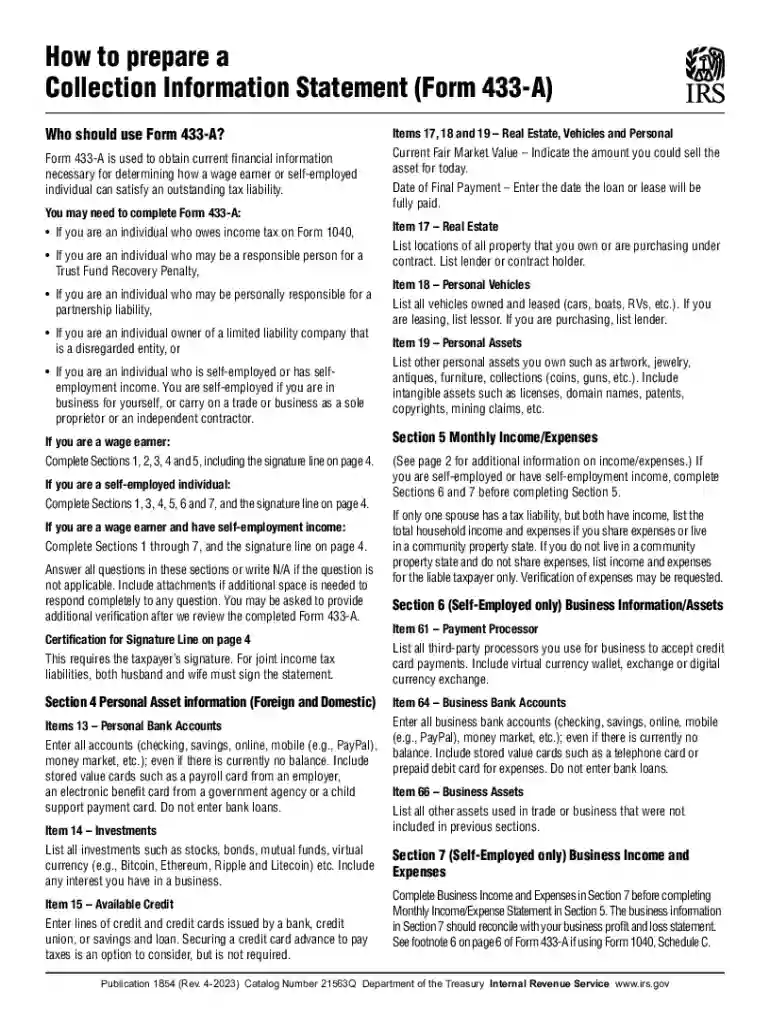
IRS Form 433-A, also known as the Collection Information Statement for Wage Earners and Self-Employed Individuals, is a crucial document used by the Internal Revenue Service to assess the financial status of individuals who owe back taxes. This form gathers detailed information regarding an individual's assets, liabilities, income, and expenses. The primary objective of Form 433-A is to evaluate the ability of the taxpayer to pay their outstanding tax debts. This evaluation aids the IRS in determining potential agreements, such as installment plans or offers in compromise, which allow taxpayers to manage their debts without undue financial hardship.
Completing IRS Form 433-A involves several detailed steps, which require thorough and accurate reporting of financial details:
Personal Information: Start by filling out personal details such as name, Social Security Number, and contact information. Carefully list the dependence and their financial contributions, if any.
Employment and Income: Provide details about your current employment status, including employer information and monthly income. Self-employed individuals need to disclose business types and profits.
Assets and Liabilities: Accurately list all your assets, including cash, bank accounts, real estate, and vehicles, alongside any debts or liabilities associated with these assets.
Monthly Expenses: Document your personal and household expenses, ensuring they are necessary and accurate. This includes rent, utilities, groceries, insurance, and medical expenses.
Verify Expenses: Attach supporting documents to verify each expense and asset reported. This includes bank statements, pay stubs, and bills to substantiate claims.
IRS Form 433-A is typically used by wage earners and self-employed individuals who have outstanding tax liabilities and are unable to meet their tax obligations fully. The form provides a comprehensive picture of a taxpayer's financial situation, allowing for personalized tax debt solutions. It's particularly beneficial for those seeking to negotiate an installment agreement or an offer in compromise with the IRS, as it helps delineate their financial capacity and constraints.
Several key elements must be accurately reflected in Form 433-A to ensure its proper function:
Asset Reporting: Details on liquid and fixed assets, including checking and savings accounts, property, and valuable holdings.
Income Details: Comprehensive reporting of all income sources, including wages, self-employment earnings, social security, and other benefits.
Expense Verification: Accurate and verifiable expense reports, with necessary documentation attached, to illustrate financial obligations.
Liability Listings: An exhaustive list of current liabilities, including loans, mortgages, and credit card debts.
Consider a self-employed consultant who cannot pay tax dues due to recent business losses. By using Form 433-A, the consultant details all assets, income fluctuations, and essential expenses, providing the IRS with the information needed to potentially set up an installment plan within their current financial means. Another typical scenario could involve a wage earner facing unexpected medical expenses; this use case shows how Form 433-A enables accurate representation of financial distress, helping negotiate terms with the IRS.
The IRS provides specific guidelines for completing Form 433-A, which include submitting all financial statements, recent pay stubs, mortgage statements, and documentation of assets. The form should encapsulate a truthful and full financial picture, as honesty and transparency are critical for IRS negotiations. Failure to provide complete and accurate information can delay the process or result in penalties.
Non-compliance with IRS Form 433-A requirements or providing false information can result in severe penalties. Consequences may include the rejection of payment plan proposals, levies on earnings or assets, and additional fines. It is crucial that all data is accurate and that taxpayers adhere to deadlines to avoid further complications.
Form 433-A can be submitted both online and by mail. For those opting for digital submission, ensuring electronic forms are correctly filled and securely sent through IRS-designated platforms is essential. If submitting by mail, send to the appropriate IRS address based on geographical location and division handling the case. Regardless of method, always retain copies for personal records.
By understanding these elements and ensuring compliance, taxpayers can effectively utilize the IRS Form 433-A to manage their tax liabilities with greater confidence and clarity.
We've got more versions of the IRS Form 433-A: Instructions and Purpose of this Statement form. Select the right IRS Form 433-A: Instructions and Purpose of this Statement version from the list and start editing it straight away!
At DocHub, your data security is our priority. We follow HIPAA, SOC2, GDPR, and other standards, so you can work on your documents with confidence.
I authorize the U.S. Treasury and its designated Financial Agent to initiate a monthly ACH debit (electronic withdrawal) entry to the financial institution
If you provide a current profit and loss (PL) statement for the information below, enter the total gross monthly income on line 17 and your monthly expenses on
What is the purpose of Form 433F? Form 433-F is used to obtain current financial information necessary for determining how a wage earner or self-employed.


