Irs form 8332 2010-2026

Get Form
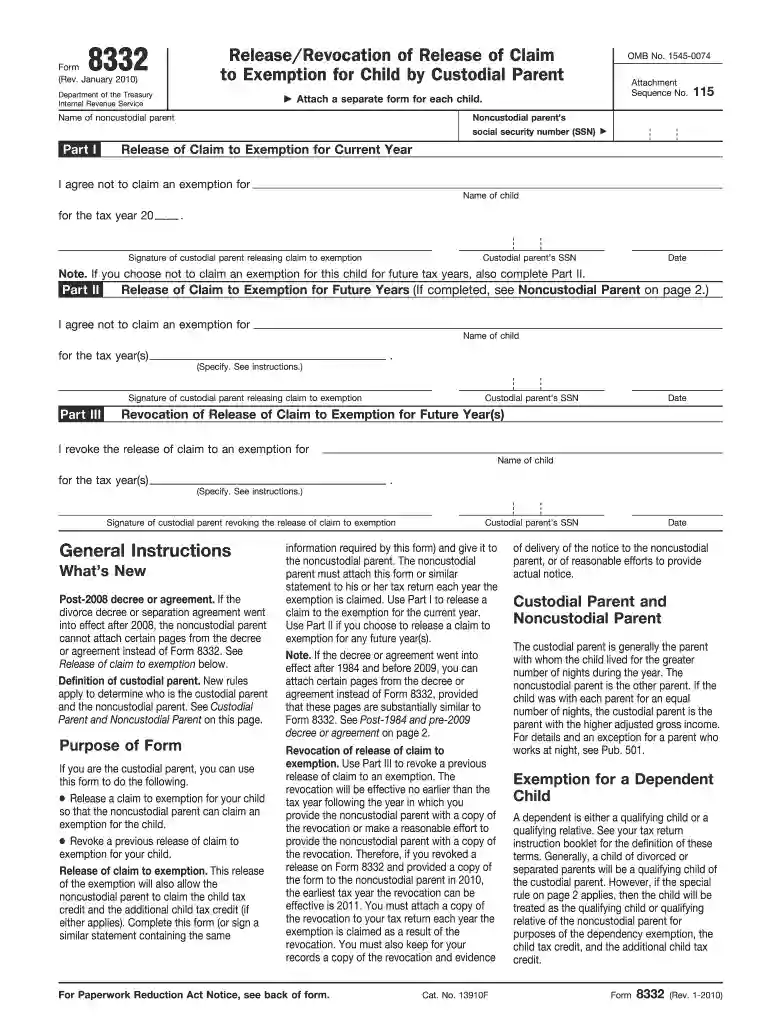
what is form 8332 Preview on Page 1

Here's how it works

01. Edit your what is form 8332 online
Type text, add images, blackout confidential details, add comments, highlights and more.

02. Sign it in a few clicks
Draw your signature, type it, upload its image, or use your mobile device as a signature pad.

03. Share your form with others
Send 8332 via email, link, or fax. You can also download it, export it or print it out.

Definition & Purpose of IRS Form 8332

IRS Form 8332 is used primarily by custodial parents to release their right to claim a child as a dependent on their tax return, allowing the noncustodial parent to claim the exemption instead. This is essential when parents are divorced, legally separated, or living apart and share custody of their child or children. The form specifies whether it is a one-time release for a single year or a continuous release for future tax years, providing clarity for both parents and the IRS.

Importance of IRS Form 8332

  • Custodial vs. Noncustodial Parent: Defines custodial as the parent with whom the child lived the greater number of nights during the year. Noncustodial parents can claim the dependent only if custodial parents use Form 8332 to release the claim.
  • Tax Benefits: Claiming a child as a dependent allows parents to take advantage of various tax benefits, including the child tax credit and potentially higher income tax refunds.

Steps to Complete IRS Form 8332

  1. Part I: Release:

    • Fill in the relevant tax year or specify "all future years" if applicable.
    • Provide the name of the child or children for whom exemptions are being released.
    • Include the noncustodial parent’s name who will claim the dependent exemption.
  2. Part II: Revocation:

    • Should a custodial parent decide to revoke the previously granted permission, Part II must be completed, specifying the tax year.
    • Notify the noncustodial parent in writing about the revocation for clear communication.
  3. Signature:

    • The custodial parent must sign and date the form for it to be valid.
    • No signature from the noncustodial parent is needed on Form 8332.

Tips for Accurate Completion

  • Always double-check form entries for the correct tax year and child’s details.
  • Attach the form to the noncustodial parent’s tax return for the respective year to authenticate the claim.

Who Typically Uses IRS Form 8332

This form is specifically used by divorced or separated parents who have agreed that the noncustodial parent will claim a child as dependent for tax purposes. Custodial parents must ensure they complete Form 8332 when they consent to transfer their right to the noncustodial parent.

Key Elements of IRS Form 8332

  • Child's Information: Full name and identifying number of each child to ensure clarity and avoid disputes.
  • Release to Noncustodial Parent: States the noncustodial parent’s name who is allowed to claim the exemption.
  • Signature Line: Required to confirm custody status and intention to allow the child to be claimed by the noncustodial parent.

Detailed Context

  • Identifying Number: Typically the child's Social Security Number.
  • Full Year or Specific Tax Year: Option to release exemption rights for future years or a single tax year.

Legal Use of IRS Form 8332

The release can be used only for tax purposes and does not affect legal custody arrangements. It is crucial for ensuring compliance with IRS guidelines on dependency exemptions, preventing unauthorized claims which may result in audits or penalties.

Possible Scenarios

  • Agreement Changes: If custody arrangements change, the custodial parent can revoke the release using Part II of Form 8332.
  • Legal Disputes: Possessing a signed Form 8332 protects the noncustodial parent from legal disputes over tax exemptions.

Obtaining IRS Form 8332

The form can be downloaded from the IRS website or requested in physical copy by calling the IRS directly.

Access Options

  • Online: Visit IRS official site and navigate to forms and publications.
  • Mail or Physical Office: Request via mail or pick it up from an IRS office if needed.

IRS Guidelines & Compliance

IRS guidelines stipulate that the form must accompany the noncustodial parent’s tax return for the exemption to be valid. Following IRS instructions for submission is essential to ensure compliance and avoid tax complications.

Filing Deadlines and Important Dates

While there is no specific filing deadline for Form 8332 as it depends on the filing date of the noncustodial parent, it is advisable to complete it well before the tax return deadline to avoid any last-minute issues.

  • Tax Return Deadline: Align form completion with the annual April 15th tax return deadline.
  • Expiration: Forms authorizing future exemptions should indicate their expiration clearly if applicable.

Required Documentation

  • Child’s Birth Certificate: While not submitted, ensures the parent has the right to claim or release.
  • Court Agreements: Legal documents may outline custody arrangements relevant to tax claims.

Checklist for Submission

  • Completed Form 8332
  • Noncustodial parent’s return documents where exemptions are claimed

By fully understanding IRS Form 8332, its purpose, the process of using it, and compliance guidelines, both custodial and noncustodial parents can manage tax benefits effectively in cases of shared custody.

See more irs form 8332 2010 versions

We've got more versions of the irs form 8332 2010 form. Select the right irs form 8332 2010 version from the list and start editing it straight away!
Versions Form popularity Fillable & printable
2018 4.7 Satisfied (117 Votes)
2010 4.4 Satisfied (530 Votes)
1996 4.3 Satisfied (32 Votes)
1993 4 Satisfied (30 Votes)
be ready to get more

Complete this form in 5 minutes or less

Get form

Security and compliance

At DocHub, your data security is our priority. We follow HIPAA, SOC2, GDPR, and other standards, so you can work on your documents with confidence.

Learn more
ccpa2
pci-dss
gdpr-compliance
hipaa
soc-compliance