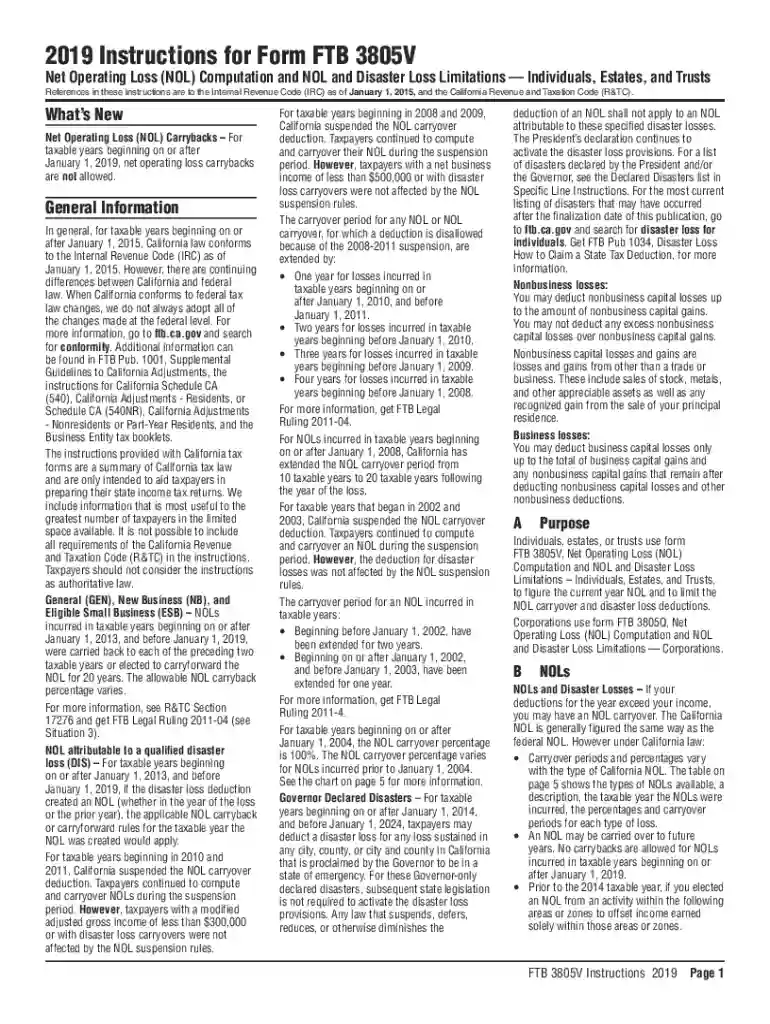
2018 Instructions for Form FTB 3805V, Net Operating Loss (NOL) Computation and NOL and Disaster Loss-2026

Get Form
2018 Instructions for Form FTB 3805V, Net Operating Loss (NOL) Computation and NOL and Disaster Loss Preview on Page 1

Here's how it works

01. Edit your form online
Type text, add images, blackout confidential details, add comments, highlights and more.

02. Sign it in a few clicks
Draw your signature, type it, upload its image, or use your mobile device as a signature pad.

03. Share your form with others
Send it via email, link, or fax. You can also download it, export it or print it out.

Definition and Meaning

The 2018 Instructions for Form FTB 3805V serve as a guide for taxpayers in California to accurately compute and report Net Operating Losses (NOL) and disaster losses. This form is essential for individuals, businesses, estates, and trusts that need to calculate NOLs, as these losses can impact tax returns by allowing taxpayers to offset taxable income. Understanding the nuances of this form helps ensure compliance with state tax regulations and maximizes potential tax benefits.

Key Elements of the Form

The instructions for Form FTB 3805V outline several critical elements necessary for accurate completion. Key components include:

  • NOL Calculation: Detailed procedures for calculating current-year NOLs.
  • Carryover Rules: Guidelines on how NOLs can be carried over to future tax years, considering both state and federal differences.
  • Disaster Loss Provisions: Criteria for claiming disaster losses related to qualified California disasters.
  • Limitations: Specific restrictions and limits on deductible losses per California tax law.

Important Terms Related to NOL

Understanding specific terminology within the 2018 Instructions for Form FTB 3805V is crucial:

  • Net Operating Loss (NOL): The amount by which a taxpayer's business expenses exceed their income, which may be carried forward to offset future taxable income.
  • Carryover Period: The number of years losses can be carried over, subject to specific rules.
  • Disaster Loss: Losses that occur from officially declared disasters, offering special tax treatment under California law.
  • Taxable Income: The base upon which tax rates are applied, affected by NOL deductions.

Steps to Complete the Form

To complete the 2018 Instructions for Form FTB 3805V, taxpayers should follow these steps:

  1. Gather Required Documents: Collect financial statements, past tax returns, and records of any disaster losses.
  2. Review NOL Calculation: Use the form to calculate NOLs from the current tax year.
  3. Determine Carryover Eligibility: Assess which portion of the NOL can be carried forward.
  4. Fill in Personal and Entity Information: Ensure all identifying information is correctly entered.
  5. Submit the Completed Form: Adhere to submission guidelines, including deadlines and methods.

Eligibility Criteria

Eligibility for completing the 2018 Form FTB 3805V is determined by:

  • Taxpayer Type: Individuals, businesses, and certain estates or trusts in California.
  • Loss Type: Eligible if the taxpayer has experienced a business NOL or disaster loss.
  • Relevant Tax Year: The form specifically applies to the tax year 2018.
decoration image ratings of Dochub

State-Specific Rules

California has its own set of rules for NOLs and disaster losses, differing from federal guidelines:

  • No NOL Carrybacks: Unlike federal regulations, California does not allow NOL carrybacks for years starting after January 1, 2019.
  • Disaster Loss Treatment: Special statutes apply to losses arising from California-declared emergencies, which may not apply to federal filings.

Taxpayer Scenarios

Different taxpayer scenarios can affect how the Form FTB 3805V is completed:

  • Self-Employed Individuals: Should include business revenue and expenses to calculate NOLs accurately.
  • Corporations and Partnerships: They need to consider shareholder and partner distributions which may impact NOL calculations.
  • Retirees: Even those with passive income might need to file if they have other forms of income impacting NOL eligibility.
decoration image

Examples of Using the Form

Practical examples based on real-world situations clarify uses of the form:

  • Small Business Owner: A restaurant facing losses due to natural disasters can calculate NOLs to offset future income.
  • Tech Startup: A growing firm may use carryover NOLs from initial development years to reduce tax liabilities when profits increase.
  • Agricultural Business: A farm operating within a disaster-declared zone in California can claim special disaster loss deductions.

Filing Deadlines and Important Dates

Taxpayers must adhere to specific deadlines when dealing with the 2018 Instructions for Form FTB 3805V:

  • Filing Deadline: Matches the standard state tax filing deadline unless extensions are granted.
  • Amendment Deadlines: Amendments due to disaster losses or other changes need timely submission to be effective.

Penalties for Non-Compliance

Failure to comply with the form's requirements can lead to penalties:

  • Late Filing Penalties: Charges if the form is not submitted by the deadline.
  • Accuracy-Related Penalties: Additional fines for incorrect NOL calculations or carryovers.

Software Compatibility

Forms need to be compatible with various tax preparation applications:

  • TurboTax and QuickBooks: Ensure compatibility and up-to-date calculations for NOLs.
  • Official Websites: California's tax department provides digital tools and resources for electronic filing.

By providing comprehensive guidance and clarity, the 2018 Instructions for Form FTB 3805V help facilitate accurate reporting and compliance with California’s tax laws regarding NOL and disaster loss deductions.

See more 2018 Instructions for Form FTB 3805V, Net Operating Loss (NOL) Computation and NOL and Disaster Loss versions

We've got more versions of the 2018 Instructions for Form FTB 3805V, Net Operating Loss (NOL) Computation and NOL and Disaster Loss form. Select the right 2018 Instructions for Form FTB 3805V, Net Operating Loss (NOL) Computation and NOL and Disaster Loss version from the list and start editing it straight away!
Versions Form popularity Fillable & printable
2021 4.8 Satisfied (103 Votes)
2020 4.4 Satisfied (53 Votes)
2018 4.3 Satisfied (30 Votes)
2017 4.2 Satisfied (41 Votes)
2016 4 Satisfied (52 Votes)
2015 4 Satisfied (46 Votes)
2013 4.8 Satisfied (49 Votes)
2010 4.3 Satisfied (49 Votes)
2009 4 Satisfied (33 Votes)
2008 4 Satisfied (40 Votes)
be ready to get more

Complete this form in 5 minutes or less

Get form

Got questions?

We have answers to the most popular questions from our customers. If you can't find an answer to your question, please contact us.
Contact us
In general, your NOL deduction for tax years beginning after December 31, 2020, cannot exceed the sum of: (1) the NOLs carried to the year from tax years beginning before January 1, 2018; plus, (2) the lesser of: (a) the NOLs carried to the year from tax years beginning after December 31, 2017, or (b) 80% of the excess
Carryforward balances (or carryforward funds) are unexpended balances at the end of the year. Generally, these balances are calculated as current year budget appropriation and prior year balances, less current-year expenditures.
How To Calculate an NOL Start with your taxable income (or loss) before the NOL deduction itself. Add back any NOL carryovers from other years since these arent allowed when figuring the NOL for the current year. Remove nonbusiness deductions that exceed nonbusiness income.
Building a Tax Loss Carryforward Schedule Calculate the firms Earnings Before Tax (EBT) for each year. Create a line thats the opening balance of carryforward losses. Create a line thats equal to the current period loss, if any. Create a subtotal line.
The rules state that the amount of the NOL is limited to 80% of the excess of taxable income without respect to any 199A (QBI), 250 (GILTI), or the NOL. For example: In this example, tax is paid on $20,000 of income even though there was an NOL carryover more than the current years income.

Security and compliance

At DocHub, your data security is our priority. We follow HIPAA, SOC2, GDPR, and other standards, so you can work on your documents with confidence.

Learn more
ccpa2
pci-dss
gdpr-compliance
hipaa
soc-compliance

People also ask

A net operating loss (NOL) occurs when a companys deductions exceed its taxable income. NOLs can be carried forward indefinitely but are limited to offsetting 80% of taxable income.
In the U.S., a net operating loss can be carried forward indefinitely but are limited to 80 percent of taxable income.
If your deductions and losses are greater than your income from all sources in a tax year, you may have a net operating loss (NOL). You may be able to claim your loss as an NOL deduction. The NOL can be carried over to future tax years.

Related links