




01. Edit your form online
Type text, add images, blackout confidential details, add comments, highlights and more.

Type text, add images, blackout confidential details, add comments, highlights and more.

Draw your signature, type it, upload its image, or use your mobile device as a signature pad.

Send it via email, link, or fax. You can also download it, export it or print it out.
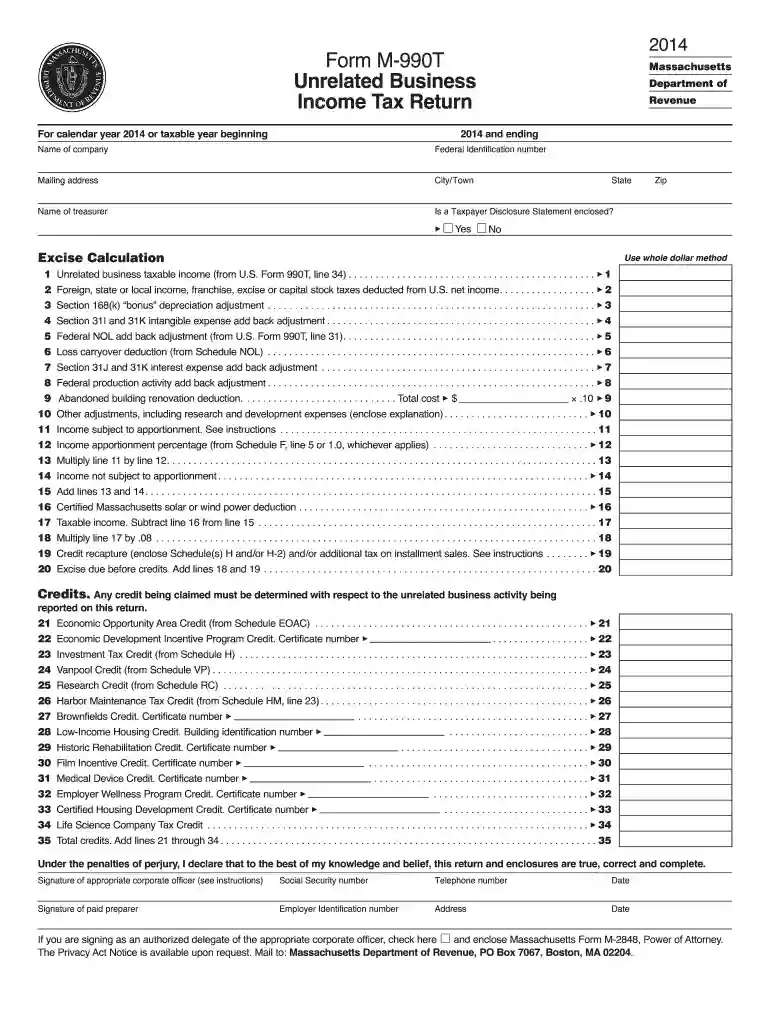
The 2014 Form M-990T, known as the Unrelated Business Income Tax Return for Massachusetts, is a critical document for organizations to report their unrelated business taxable income. This form provides a systematic method of detailing various financial elements such as adjustments, credits, and excise tax payments. It is primarily used by organizations to ensure compliance with tax regulations pertaining to unrelated business income.
The main purpose of the 2014 Form M-990T is to track and report income from business activities not directly related to an organization's primary exempt purpose. This allows the state of Massachusetts to collect taxes on income that falls outside of typical exemptions provided to certain organizations, like non-profits or educational institutions.
Understanding Unrelated Business Income is essential for correctly filing the M-990T form. UBI is generated from activities that do not align with the exempt purpose of the organization. It ensures that tax-exempt entities do not unfairly compete with taxable businesses by being taxed on similar business income.
Completing the 2014 Form M-990T requires attention to detail and familiarity with tax regulations. Below is a step-by-step guide to accurately filling out the form:
Gather Required Information:
Report Income:
Calculate and Apply Adjustments:
Determine Tax Liability:
Review and Sign:
For instance, a university operating a bookstore available to the general public may need to report income from the bookstore under this form, as it operates beyond educational purposes.
Understanding key elements of the M-990T form is crucial for accuracy and compliance. These elements include:
Income Reporting:
Adjustment and Credit Applications:
Signature and Verification:
The IRS provides specific guidelines that complement state requirements for reporting unrelated business income:
Clarification on UBI:
Deduction Policies:
Ensuring compliance with IRS directives is crucial. This includes understanding what income is considered unrelated, tracking revenue appropriately, and maintaining detailed records.
Understanding specific terms related to the M-990T form aids in correct filing:
Exempt Purpose Activities:
Excise Tax:
Determining eligibility is fundamental for entities deciding to file an M-990T form:


Revenue Threshold:
Nature of Operations:
Massachusetts has particular rules that entities need to be aware of when filing the M-990T:
Tax Rates:
Reporting Adjustments:
While similar to federal regulations, Massachusetts-specific guidelines require additional attention for appropriate reporting and compliance.
Adhering to deadlines ensures compliance and avoids penalties:
Annual Filing Deadline:
Extensions and Exceptions:
Ignoring the requirements or failing to file the M-990T can lead to significant penalties:
Financial Penalties:
Legal Repercussions:
Utilizing the right software can aide efficient filing of the M-990T form:
Accounting Software:
Integration Features:
We've got more versions of the m990t 2014 form form. Select the right m990t 2014 form version from the list and start editing it straight away!
| Versions | Form popularity | Fillable & printable |
|---|---|---|
| 2022 | 4.7 Satisfied (56 Votes) | |
| 2021 | 4.6 Satisfied (39 Votes) | |
| 2020 | 4.8 Satisfied (75 Votes) | |
| 2019 | 4.3 Satisfied (174 Votes) | |
| 2018 | 4.3 Satisfied (175 Votes) | |
| 2017 | 4.3 Satisfied (78 Votes) | |
| 2016 | 4.3 Satisfied (116 Votes) | |
| 2015 | 4.3 Satisfied (162 Votes) | |
| 2014 | 3.9 Satisfied (41 Votes) | |
| 2013 | 4 Satisfied (20 Votes) | |
| 2009 | 4 Satisfied (32 Votes) |
At DocHub, your data security is our priority. We follow HIPAA, SOC2, GDPR, and other standards, so you can work on your documents with confidence.
Aug 11, 2015 MASSACHUSETTS FORM M-990T. SEPTEMBER 30, 2014. GRIFFIN HOSPITAL. 130 DIVISION STREET. DERBY, CT 06418. CROWE HORWATH, LLP. 175 POWDER FORESTRead more
TAX RETURN FILING INSTRUCTIONS MASSACHUSETTS FORM M-990T FOR THE YEAR ENDING JUNE 30, 2021 PREPARED FOR: LASELL UNIVERSITY : THE AUTHORIZED INDIVIDUAL(S). FORM


