






Definition and Purpose of the Minnesota M1NR Form 2013
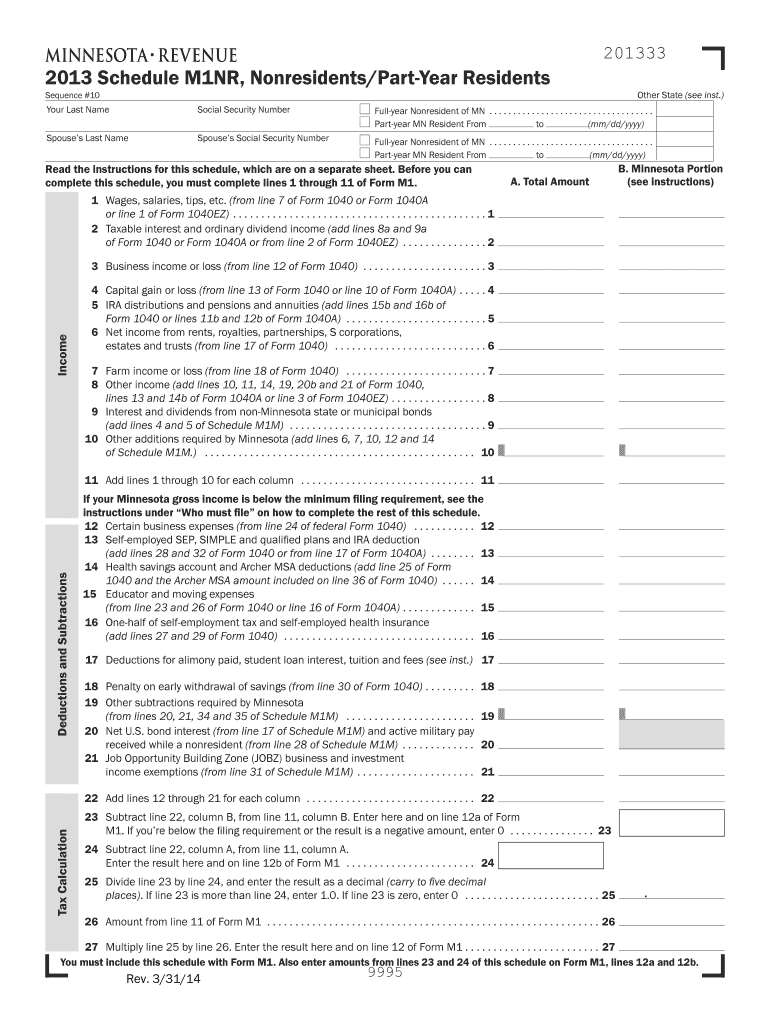
The 2013 Schedule M1NR is a crucial part of the Minnesota Individual Income Tax Return, tailored specifically for nonresidents and part-year residents of Minnesota. This form helps individuals accurately report their Minnesota-source income and calculate their tax obligations to the state. It is mandatory for those whose Minnesota-source income exceeds $10,000. Its primary purpose is to determine the portion of income subject to Minnesota tax laws, considering different income sources and deductions applicable to nonresidents and part-year residents.
Steps to Complete the Minnesota M1NR Form 2013
-
Gather Documentation: Before starting, collect all necessary documents, including your federal tax return and any documents reflecting Minnesota-source income.
-
Review Eligibility: Verify that you meet the criteria as either a nonresident or part-year resident for the tax year 2013. Ensure you have exceeded the $10,000 income threshold.
-
Fill Out Personal Information: Enter your name, address, and Social Security Number at the top of the form.
-
Report Income: Accurately report your income earned from Minnesota sources. This includes wages, business income, rental income, and capital gains attributable to Minnesota.
-
Complete Applicable Sections: Follow the instructions on the form to complete specific sections related to your type of income and applicable deductions.
-
Calculate Tax: Use the form to calculate the Minnesota tax owed based on the reported income and applied deductions.
-
Review and Sign: Thoroughly review the completed form for accuracy and sign it before submission.
Key Elements of the Minnesota M1NR Form 2013
- Income Reporting Section: This is where all income earned from Minnesota sources must be documented.
- Deductions and Adjustments: Sections that allow nonresidents and part-year residents to apply allowable deductions, ensuring an accurate taxable income calculation.
- Tax Calculation: Detailed instructions on determining your tax liability based on Minnesota income.
- Signature Line: This section is vital for validation, ensuring that the submitted information is correct and complete.
Who Typically Uses the Minnesota M1NR Form 2013?
This form is intended for:
- Nonresidents: Individuals who lived outside Minnesota for the entirety of 2013 but earned income from within the state.
- Part-Year Residents: Those who only resided in Minnesota for a portion of 2013 and earned income both from within and outside the state during their residency.


Legal Use and Compliance
Filing the Minnesota M1NR Form 2013 is a legal requirement for all qualifying individuals. Adhering to the form's guidelines is crucial to avoid penalties for tax evasion or inaccurate reporting. In the case of discrepancies, taxpayers should seek professional advice or consult the Minnesota Department of Revenue for clarification.
Important Terms Related to the Form
- Nonresident: An individual who does not reside in Minnesota but earns income there.
- Part-Year Resident: Someone who has only lived in Minnesota for part of the year.
- Minnesota-Source Income: Includes all income generated from activities in Minnesota, such as employment and business operations.
How to Obtain the Minnesota M1NR Form 2013
The form can be obtained by:
- Downloading from the Minnesota Department of Revenue: Available as a PDF from the official website.
- Mail Request: Requesting a paper form to be mailed directly by contacting the Department of Revenue.
Filing Deadlines and Important Dates
- Tax Filing Deadline: The form must be submitted by April 15, 2014, for the 2013 tax year. Extensions may apply, but these must be arranged prior to the deadline.
- Extension Application Deadline: If additional time is needed, ensure any extension applications are submitted before the original filing deadline.
Software Compatibility for Filing
Taxpayers may use popular tax software like TurboTax or QuickBooks, which support state-specific forms including the M1NR. These platforms often guide users through the completion process, ensuring compliance with Minnesota tax laws while streamlining the filing procedure.