
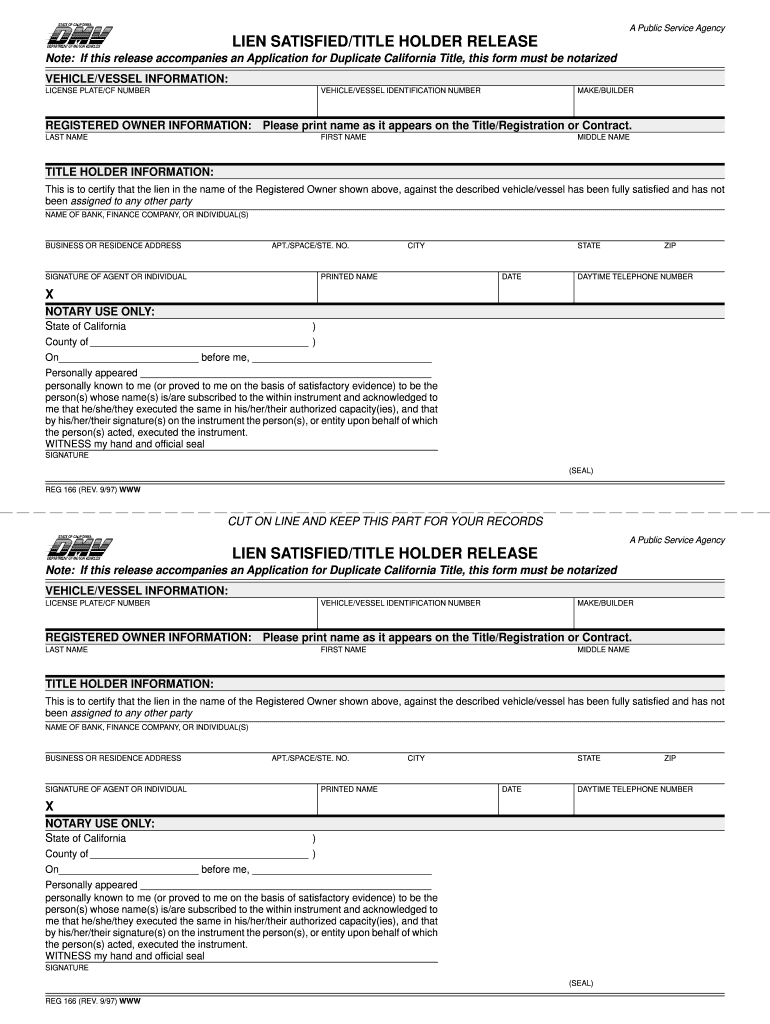







Definition & Purpose of the Reg 166 Form
The "Reg 166 Form," officially known as the "Lien Satisfied/Title Holder Release," is a document used by public service agencies in California. It serves to verify that a lien on a vehicle or vessel has been fully satisfied and has not been transferred to another party. This form is essential in ensuring that the ownership of the vehicle is clear of any financial encumbrances before it is transferred to a new owner or when applying for a duplicate title. The form must include specific details such as the vehicle's description, registered owner's information, and title holder details to confirm the lien's release officially.
How to Obtain the Reg 166 Form
To obtain the Reg 166 Form, individuals need to visit the official website of the California Department of Motor Vehicles (DMV) or go to a local DMV office. The form can be downloaded directly from the DMV's website in a PDF format, which can then be printed and filled out manually. Alternatively, hard copies of the form are also available at all DMV locations. In some cases, a lienholder might provide the form once the lien is satisfied. It's crucial to ensure that the most recent version of the form is used to avoid any delays or issues during submission.
Steps to Complete the Reg 166 Form
-
Gather Information: Collect all necessary details, including the lienholder's name, the vehicle's make, model, and vehicle identification number (VIN), and the registered owner's name.
-
Fill Out the Form: Enter the required information accurately. Any discrepancies might cause processing delays.
-
Lienholder's Section: The lienholder must complete their section, which confirms the satisfaction of the lien against the vehicle.
-
Notarization Requirement: If the form accompanies a duplicate title application, it must be notarized. Ensure that a notary public witnesses the signature to meet this requirement.
-
Submit the Form: Once completed, submit the form to the DMV. This can be done in person or by mailing it to the appropriate DMV address.
Why the Reg 166 Form is Necessary
The Reg 166 Form is a critical document for the vehicle title transfer process, ensuring legal ownership transfer is free from prior financial obligations. It protects both the seller and buyer by certifying that the lien is fully satisfied. For sellers, it prevents future liability, while for buyers, it guarantees that they are not purchasing a vehicle with hidden financial burdens. The form thereby facilitates transparent and secure transactions in the sale or transfer of vehicles or vessels.
Who Typically Uses the Reg 166 Form
This form is primarily used by vehicle owners, lienholders, and the California DMV. Vehicle owners require it when selling a vehicle or transferring ownership to prove the absence of liens. Lienholders utilize the form to officially release a lien once all obligations are met. It is also a crucial document for the DMV to update their records and ensure clear title transfer during vehicle registration processes.


Key Elements of the Reg 166 Form
- Vehicle/Vessel Information: Includes make, model, year, and VIN.
- Lienholder Declaration: An affirmation that the lien has been satisfied in full.
- Registered Owner Details: Name and contact information of the person legally recognized as the vehicle owner.
- Notarization: Only required if the form is submitted with an application for a duplicate title.
- Signature Lines: Mandatory signatures from both the lienholder and registered owner to validate the form.
State-Specific Rules for the Reg 166 Form
California has particular regulations governing the use of the Reg 166 Form. It is essential to follow state-specific guidelines, such as the notarization requirement for duplicate title applications. Furthermore, deadlines might apply for submitting the form after the lien is satisfied to prevent any penalties or complications in title transfers. Familiarizing oneself with these rules ensures compliance and smooth processing of vehicle title changes.
Submission Methods for the Reg 166 Form
The form can be submitted either online, via mail, or in person at a local DMV office in California. For those opting for mail submission, it is important to use a reliable method to track delivery, ensuring that it reaches the DMV office without delays. In-person submissions afford immediate processing and clarification of any issues on the spot. Online submission options depend on the specific DMV guidelines and may involve uploading a scanned copy of the completed form along with supporting documents.




