
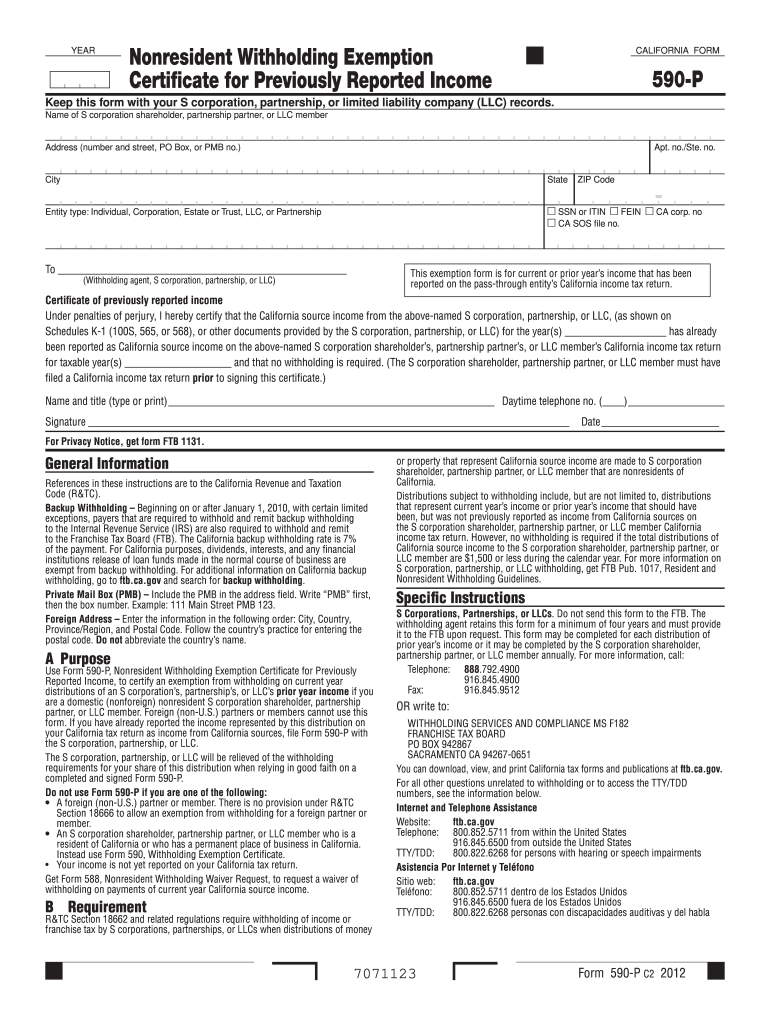







Definition and Context of California Form 590-P
California Form 590-P, or the Nonresident Withholding Exemption Certificate for Previously Reported Income, is utilized by nonresident shareholders of S corporations, partners in partnerships, and members of LLCs. This document serves as a certification that income for a prior year has been duly reported on a California tax return. Consequently, this exempts the current year's distributions from withholding. The form is distinctive in that it is retained by the issuing entity rather than being submitted directly to the California Franchise Tax Board.
How to Use Form 590-P
To appropriately use Form 590-P, entities should first ensure that all past distributions have been reported. The form then acts as a statement of exemption for future withholdings on current-year distributions. Key to the form's utility is its use in facilitating smoother tax management for nonresident entities involved with Californian business entities.
Steps to Complete Form 590-P
- Obtain Necessary Information: Gather all prior tax information related to distributions from the entity.
- Fill Out Personal and Entity Information: Include details like name, address, and identification number of the recipient.
- Certification Section: Certify that prior incomes have been reported, thereby affirming exemption status.
- Retain the Form: Retain the completed form within entity records, rather than submitting it to the state tax board.
Who Typically Uses Form 590-P
The form is primarily used by nonresident investors such as:
- Nonresident shareholders in S corporations.
- Partners in partnerships.
- Members of LLCs that distribute earnings related to California-source income.
The intent is to relieve these entities from redundant withholding on income that has already been reported, ensuring an efficient reporting process.
Legal Use and Compliance Requirements
Understanding the legal framework surrounding Form 590-P is crucial. It is specifically designed for previously reported income, demanding accuracy in prior filings to qualify for its use. Entities failing to correctly report previously accumulated income may be subject to penalties and back withholding.
Penalties for Non-Compliance
Failure to correctly apply Form 590-P can result in:
- Unanticipated withholding requirements.
- Potential audits by the Franchise Tax Board.
- Financial penalties levied for incorrect filings.
Key Elements of the Form
Identification
- Taxpayer Identification Number: This must be provided succinctly to avoid issues with legitimacy and identification.
- Entity Information: Clear delineation of the business entity type is necessary.
Certification Statement
The core of the form, where nonresidents certify prior year income reporting, sets the legal premise for withholding exemption.
State-Specific Rules and Regulations
California-specific taxation rules apply to Form 590-P, aligning with broader state tax codes:
- Nonresidents dealing with California-source income must follow stringent reporting rules.
- State-specific exemptions and reporting processes influence form usage and accuracy.
Filing Methods and Availability
While Form 590-P is not submitted to the tax board, understanding its availability is crucial. Many entities integrate it into their digital processing systems, although paper versions can be retained for traditional records.
Digital vs. Paper Version
Entities venturing into digital record-keeping systems should ensure compatibility with platforms like DocHub, offering integration with cloud storage and document editing and signing capabilities.
Real-World Examples and Case Studies
Given its function, practical examples include:
- A nonresident shareholder ensuring tax-exempt status for distributions from a California-based software company.
- An LLC member receiving income from partnerships without double taxation due to validated prior year income reporting, utilizing Form 590-P.
These scenarios highlight strategic tax benefits when applicable circumstances align with Form 590-P qualifications.
Software Compatibility and Integrated Platforms
For entities looking to streamline tax form management, compatibility with software like TurboTax or QuickBooks enhances efficiency, allowing for seamless form completion and integration into broader tax accounting practices. DocHub, with its strong Google Workspace integration, also supports this approach.
Working with a knowledgeable tax advisor familiar with state-specific compliance can further enhance understanding and successful execution of Form 590-P procedures.




