




01. Edit your form online
Type text, add images, blackout confidential details, add comments, highlights and more.

Type text, add images, blackout confidential details, add comments, highlights and more.

Draw your signature, type it, upload its image, or use your mobile device as a signature pad.

Send it via email, link, or fax. You can also download it, export it or print it out.
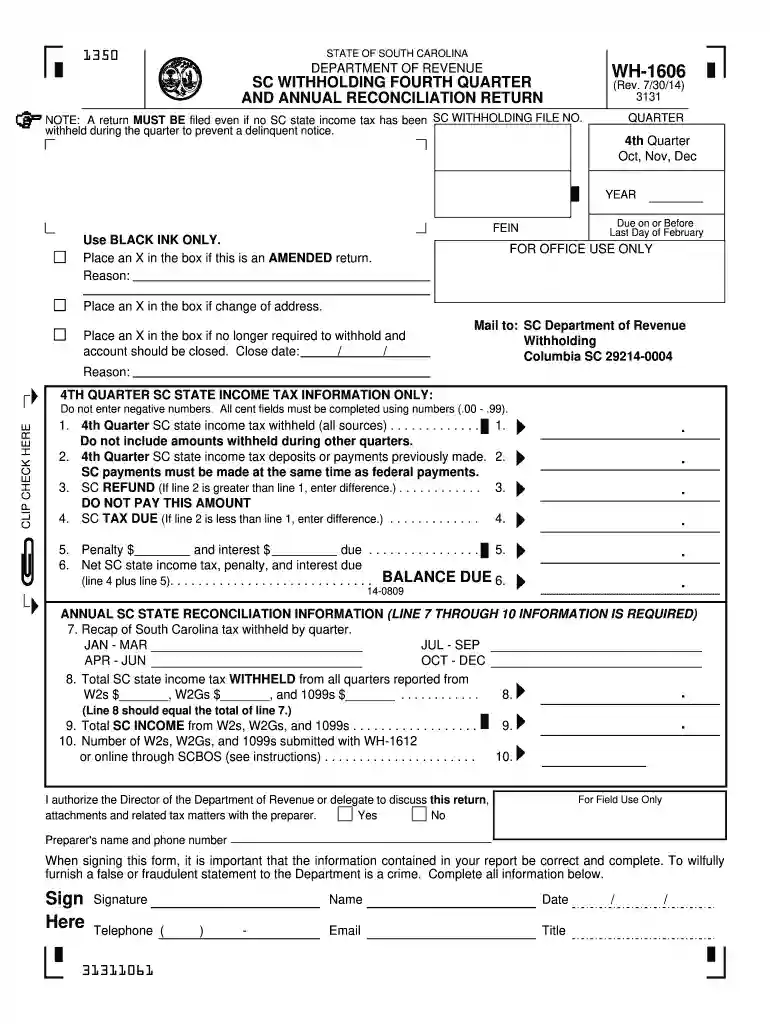
The WH- form is a tax document used for the Fourth Quarter and Annual Reconciliation Return of state income tax withholding in South Carolina. This form captures the total amount of state income tax withheld from employee wages throughout the year. Employers are required to reconcile the sum withheld with the deposits made during the fiscal year. The successful completion of this form ensures compliance with state tax laws and helps avoid potential penalties for discrepancies or non-submission.
Employers begin using the WH- form by gathering all relevant payroll data from the year's final quarter as well as the annual total. This form facilitates a detailed review of withheld taxes versus what has been deposited. Employers enter the total withheld amount and compare this figure with deposits made and any pending balances. Regardless of whether any tax was withheld, the form must be filed to report the year-end reconciliation status formally.
Gather Necessary Information: Start by collecting all relevant payroll records for the year, including total tax withheld from employee wages.
Fill Out the Tax Withholding Section: Report the total state income tax withheld during the year.
Account for Deposits: Document all tax deposits made to the state during the year. Make sure these match the total withheld amounts.
Identify Any Discrepancies: Note any differences between the amount withheld and the total deposits.
Complete Submission Details: Fill out the required personal and business information, including employer identification numbers and contact details.
Review for Accuracy: Double-check all entries to ensure accuracy before submission. This is critical to avoid inadvertent penalties or the need for subsequent amendments.
The WH- form can be accessed in several ways. Employers may retrieve a copy directly from the South Carolina Department of Revenue's official website, which provides printable versions for manual filing. Additionally, this form might be included in tax preparation software packages, which streamline the process with pre-filled data. Local tax offices can also provide physical copies upon request for those who prefer traditional paper submissions.
Withholding Tax: The portion of an employee's wages that is held by the employer and submitted to the state as a prepayment of income tax liabilities.
Reconciliation: The process of verifying that the amounts withheld and the deposits made align with each other over a specific tax period.
Employer Identification Number (EIN): A unique number assigned to a business entity for tax reporting purposes.
South Carolina mandates that all employers, regardless of whether they have withheld any taxes, must file the WH- form annually. Compliance ensures accurate state records and financial transparency. Failure to file can result in state-assessed penalties and interest charges. It is crucial for employers to be aware of extensions or policy changes that may affect filing requirements or deadlines.
Employers who fail to file the WH- form or submit inaccurate information may face financial penalties, including fines and potentially accruing interest on unpaid taxes. The state also reserves the right to issue delinquency notices, which, if ignored, can escalate into more severe actions such as garnishments or liens.
The WH- form has a fixed filing deadline aligned with the end of the fiscal year. Employers must submit this document by the last day of January following the calendar year in question. Meeting this deadline helps ensure the smooth processing of tax records and the avoidance of late-filing penalties.
South Carolina offers multiple submission methods for the WH- form. Employers can choose between mailing a completed paper form to the state tax office or submitting it electronically via the state's online tax portal. Electronic submission offers advantages such as immediate confirmation of receipt and faster processing times, which can be beneficial during the busy tax season.
We've got more versions of the wh 1606 2014 form form. Select the right wh 1606 2014 form version from the list and start editing it straight away!
| Versions | Form popularity | Fillable & printable |
|---|---|---|
| 2023 | 4.5 Satisfied (39 Votes) | |
| 2022 | 4.8 Satisfied (84 Votes) | |
| 2019 | 4.8 Satisfied (68 Votes) | |
| 2017 | 4.3 Satisfied (35 Votes) | |
| 2016 | 4.3 Satisfied (347 Votes) | |
| 2016 | 4.4 Satisfied (670 Votes) | |
| 2014 | 4 Satisfied (46 Votes) | |
| 2012 | 4 Satisfied (45 Votes) | |
| 2010 | 4.4 Satisfied (60 Votes) | |
| 2007 | 4 Satisfied (44 Votes) | |
| 2004 | 4.3 Satisfied (64 Votes) | |
| 2002 | 4 Satisfied (42 Votes) |
At DocHub, your data security is our priority. We follow HIPAA, SOC2, GDPR, and other standards, so you can work on your documents with confidence.
Jan 9, 2020 The business must use pre-printed Forms WH-1605Z and WH-1606Z provided by the Department to claim the job development credit. These forms must
Find instructions, returns, applications, and other forms. Use the search and filters below to find the documents you need.Read more


