




01. Edit your form online
Type text, add images, blackout confidential details, add comments, highlights and more.

Type text, add images, blackout confidential details, add comments, highlights and more.

Draw your signature, type it, upload its image, or use your mobile device as a signature pad.

Send it via email, link, or fax. You can also download it, export it or print it out.
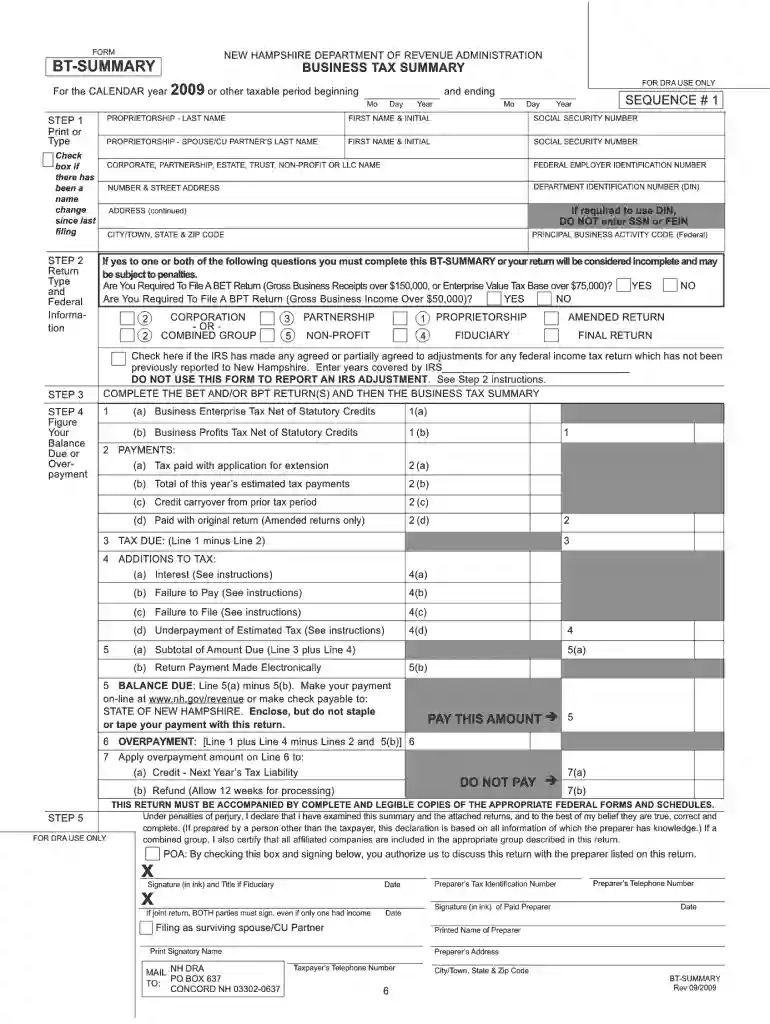
The Business Tax Summary Form, often referred to as the BT Summary 2009 Form, is crucial for businesses operating within New Hampshire. Issued by the New Hampshire Department of Revenue Administration, this form consolidates critical business tax data for the calendar year 2009. It is designed to streamline the process of reporting necessary tax information and ensure accurate compliance with state tax obligations.
For stakeholders such as proprietorships, corporations, partnerships, and non-profits, this form facilitates the reporting of tax liabilities, identifying overpayment opportunities, and verifying essential tax identification numbers. Failure to complete the form correctly can result in penalties, making thorough understanding and completion of this form essential for maintaining fiscal responsibility and compliance.
Using the BT Summary 2009 Form effectively requires a clear understanding of its structure and content requirements. The form is divided into sections that address various business tax-related aspects. Here is a step-by-step guide to navigating its use:
Gather Required Information: Before starting, ensure you have all necessary business information, including identification numbers and financial records relevant to the 2009 calendar year.
Complete Identification Sections: Enter all required business identification data and ensure all entries match official state records to avoid discrepancies.
Report Tax Information: Accurately report the taxable income and any associated tax credits or deductions. It is crucial to cross-verify this data with your internal financial statements.
Verify Overpayments: Enter details of any tax overpayments to ensure they are recognized and potentially refunded by the department.
Review and Close: Once all sections are complete, review the entirety of the form to ensure there are no errors or missing information.
Using resources like DocHub can simplify this process by allowing you to make edits and add annotations directly on digitally uploaded copies of the form.
Completing the BT Summary 2009 Form involves several detailed stages:
Download or Obtain the Form:
Compile Business Financials:
Enter Business Information:
Detail Taxable Revenue and Deductions:
Summarize Tax Due or Refunds:
Review for Accuracy:
Submit the Form:
By addressing each of these steps carefully, businesses can ensure proper tax filing and adherence to state requirements.
The BT Summary 2009 Form contains critical components that businesses must address:
Business Identification: This includes the business's name, address, and identification numbers.
Revenue Reporting: Provide a detailed account of all business revenues accrued in 2009.
Deductions and Credits: Accurately report any applicable deductions and credits to reduce taxable income.
Overpayment Section: Allows the declaration of overpayments previously made and seeks necessary refunds.
Filing Section: Confirms the method of filing and submission, ensuring compliance with Department of Revenue protocols.
Each element plays a significant role in ensuring the completeness and accuracy of the tax filing.
Understanding the terminology related to this form is crucial for accurate completion:
Grasping these terms facilitates effective and accurate completion of the form, reducing the risk of errors.
The BT Summary 2009 Form must be completed within the legal framework established by the New Hampshire Department of Revenue. Compliance with these rules is mandatory:
Accuracy of Information: Businesses are legally obligated to provide accurate and truthful information.
Deadlines: Adhering to submission deadlines is essential to avoid late penalties or interest charges.
Confidentiality: The information shared on the form is protected under state confidentiality laws. Unauthorized disclosure can lead to legal action.
Legal compliance ensures your business avoids unnecessary legal complications and possible fines.
New Hampshire has specific regulations governing the submission and completion of the BT Summary 2009 Form:
State Tax Rate: Be aware of the tax rate particular to New Hampshire businesses for 2009.
Local Regulations Compliance: Depending on the business's location within the state, additional local requirements may apply.
Document Retention: Businesses must retain copies of submitted forms and relevant documents for a specific period as stipulated by state law.
Observing these rules ensures that businesses maintain compliance with state-level tax filing requirements.
Understanding practical applications of the BT Summary 2009 Form can help illustrate its utility:
Scenario for a Small Corporation: A New Hampshire-based corporation with revenue from multiple states might use this form to isolate and report profits specifically attributed to its New Hampshire operations for 2009.
Partnership Use: A partnership identifying and reporting various streams of revenue can ensure each partner's tax liability is accurately depicted.
Non-Profit Organization: A local non-profit could employ the form to report its operations' administrative income and expenses accurately, ensuring only unrelated business income is taxed.
Each of these scenarios highlights diverse applications of the form, demonstrating its versatility for different business types.
By providing comprehensive details and examples across these sections, businesses can position themselves to utilize the BT Summary 2009 Form effectively and in accordance with New Hampshire state tax laws.
We've got more versions of the bt summary 2009 form form. Select the right bt summary 2009 form version from the list and start editing it straight away!
| Versions | Form popularity | Fillable & printable |
|---|---|---|
| 2025 | 4.2 Satisfied (39 Votes) | |
| 2024 | 4.9 Satisfied (58 Votes) | |
| 2022 | 4.7 Satisfied (37 Votes) | |
| 2021 | 4.8 Satisfied (129 Votes) | |
| 2020 | 4.1 Satisfied (37 Votes) | |
| 2019 | 4.4 Satisfied (170 Votes) | |
| 2018 | 4.3 Satisfied (111 Votes) | |
| 2017 | 4.3 Satisfied (167 Votes) | |
| 2016 | 4 Satisfied (50 Votes) | |
| 2010 | 4.4 Satisfied (444 Votes) | |
| 2009 | 4 Satisfied (20 Votes) | |
| 2008 | 4.3 Satisfied (71 Votes) |
At DocHub, your data security is our priority. We follow HIPAA, SOC2, GDPR, and other standards, so you can work on your documents with confidence.
Aug 23, 2023 Betrayal trauma theory posits that there is a social utility in remaining unaware of abuse when the perpetrator is a caregiver. A 2009 summary
BT-5 Schedule A. Form Inst. Alcoholic Beverages Tax, Receipt of Tax Free Alcoholic Beverages Tax Summary of Inventory of Wholesalers and Manufacturers.Read more


