





Definition and Purpose of Montana Form PR-1 2017
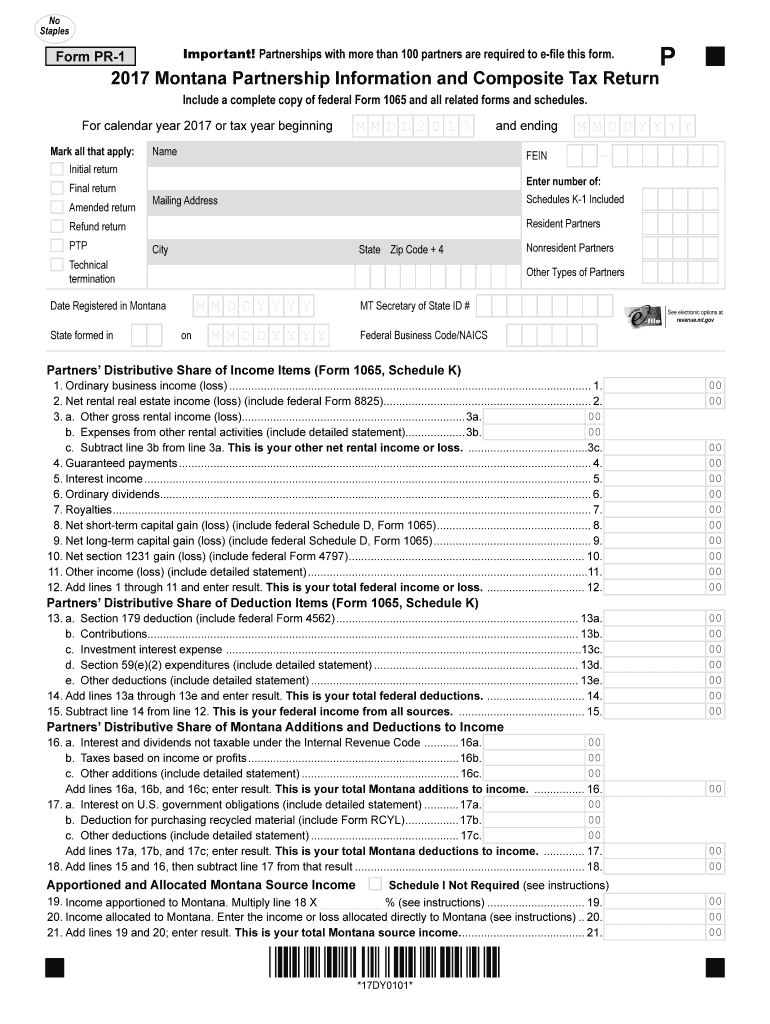
Montana Form PR-1 2017 is the annual Partnership Information and Composite Tax Return required by the state for partnerships, specifically those with over 100 partners. This form facilitates the reporting of combined financial activities, federal income, Montana source income, and any tax credits applicable to the entity. Partnerships use this form to comply with state tax regulations and enable the electronic filing of their financial data to the Montana Department of Revenue.
Key Components of the Form
- Federal Income Reporting: Partnerships must disclose their federal income, serving as the basis for determining Montana source income.
- Montana Source Income: This segment breaks down the portion of income attributed to Montana, influencing state tax obligations.
- Deductions and Credits: Document qualifying deductions and tax credits to potentially reduce the taxable income.
- Penalties: Facilitate transparency regarding any penalties incurred due to underpayment or late filing.
How to Use Montana Form PR-1 2017
Using the Montana Form PR-1 2017 involves a detailed process to ensure accurate submission. It's essential for partnerships to understand each section to maintain compliance and optimize their tax position.
- Preparation: Gather necessary financial records reflecting income, expenses, and distributions.
- Form Completion: Fill out sections relating to income, deductions, and credits per detailed instructions.
- Double Check Calculations: Verify numbers and apportionment factors, especially when operating in multiple states.
- Submission: Use the online e-filing system for convenience and efficiency.
Important Considerations
- E-Filing Requirement: Given the over 100-partner threshold, e-filing is enforced for practicality and accuracy.
- Updates and Revisions: Review any updates to the form specific to 2017 for compliance.
Steps to Complete Montana Form PR-1 2017
Completing Montana Form PR-1 2017 requires diligence and attention to detail.
- Review Instructions: Start with the official guidelines to ensure correct data entry.
- Income Section: Record both federal and Montana-sourced income.
- Detail Deductions: Ensure valid deductions are applied; consult tax professionals for clarification.
- Report Partner Information: List out partner details and their share of distributed income.
- Verify Final Calculations: Ensure all sections balance before submission.
Examples
- Multistate Operations: Businesses must accurately apportion income across states using preset factors.
- Large Partnerships: Special provisions may apply to influence decision-making processes within the partnership.
Who Typically Uses Montana Form PR-1 2017
The form is predominantly used by partnerships that:
- Feature over 100 partners: This requires mandatory electronic submission.
- Operate in multiple states: Such entities need to apportion income accurately.
- Engage in complex financial activities: Partnerships with varied sources of income, investments, and deductions.
Eligible Entities Include:
- Limited Partnerships
- Limited Liability Companies (LLCs) electing partnership taxation
- Multinational firms with domestic and foreign income
State-Specific Rules for Montana Form PR-1 2017
State regulations can differ significantly, impacting how partnerships report their financials.
- Montana Apportionment: Specific rules dictate how much income is taxed by Montana.
- Composite Returns: Montana requires this particular form to streamline partner and income tax compliance for partnerships.
Notable State Distinctions
- Unique Deductions: Montana allows for specific deductions not available federally, affecting the final taxable income.
- Non-Resident Partner Considerations: The state outlines requirements for managing non-resident partner obligations.
Penalties for Non-Compliance
Failure to comply with filing and payment guidelines can result in severe consequences.
- Late Filing Penalties: Fines apply if partnerships fail to meet the state’s deadlines.
- Underpayment Penalties: Partnerships omitting payments or reporting inaccuracies are subject to interest and penalty fees.
- Rectification Methods: Partnerships may amend filed returns or negotiate penalties depending on circumstances.
Real-World Scenarios
- Incorrect Apportionment: Misallocated state income can trigger audit and penalty repercussions.
- Non-Disclosure Penalties: Concealed partner data or income aspects could further enlarge penalties.
Filing Deadlines and Important Dates
Adhering to deadlines ensures compliance and avoids potential late fees.
- Initial Filing Deadline: Partnerships must submit their returns by a specific date, traditionally aligned with the federal deadlines for partnership returns.
- Extension Filing: Requests for filing extensions are permissible, though this does not absolve tax payment obligations.
- Important Tax Year Specific Dates: Each tax year may have unique deadlines contingent on calendar shifts and regulatory updates.
Required Documents and Form Submission Methods
Essential documentation supports the accurate filing of Montana Form PR-1 2017.
- Financial Statements: Comprehensive income statements and balance sheets.
- Partner Agreements: Documents detailing partner shares and income distributions.
- Submission Method: Encouraged use of e-filing through the state’s portal for accuracy and expedited processing times.
Submission Considerations
- Original Record Retail: Storing copies and receipts of submission to guard against discrepancies.
- Document Verification: Consistent checks on provided partner ID details and income statements prevent processing delays.