




01. Edit your form online
Type text, add images, blackout confidential details, add comments, highlights and more.

Type text, add images, blackout confidential details, add comments, highlights and more.

Draw your signature, type it, upload its image, or use your mobile device as a signature pad.

Send it via email, link, or fax. You can also download it, export it or print it out.
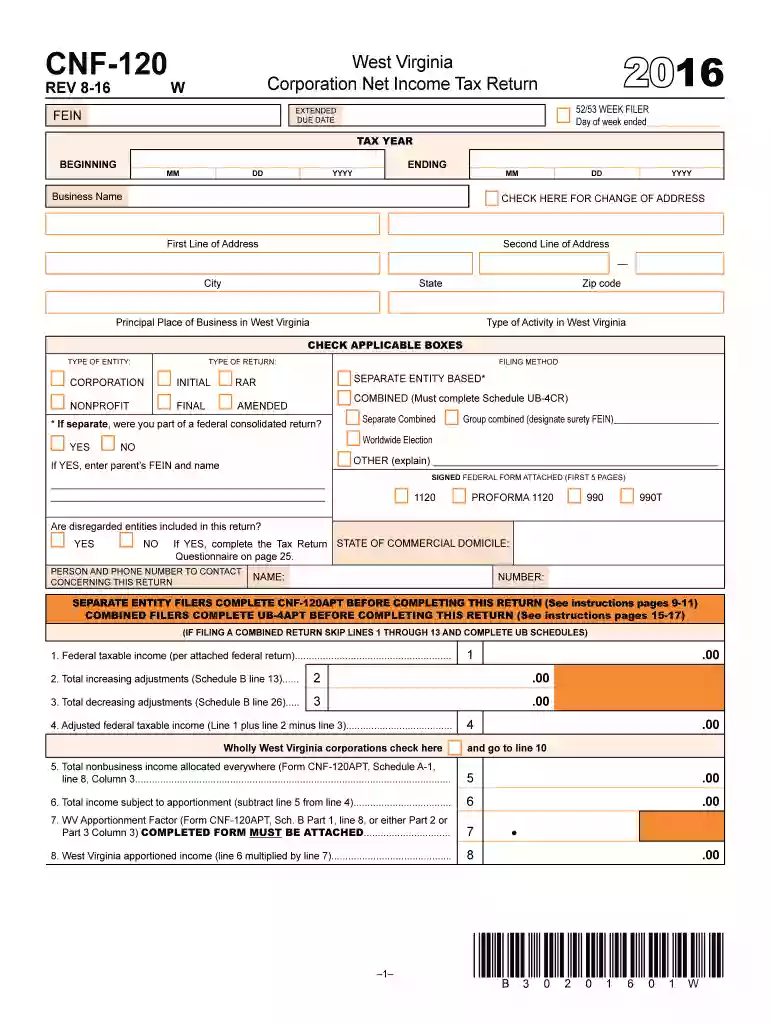
The CNF-120 Form, officially known as the West Virginia Corporation Net Income Tax Return, is designed for corporations that operate within West Virginia. This document serves as a means for corporations to report their net income and calculate the applicable state tax liability for the tax year 2016. It includes essential sections like corporate identification, income calculations, and adjustments to federal taxable income. Corporations must utilize this form to comply with the state's taxation requirements and claim any allowable tax credits, facilitating accurate tax reporting and payment.
Corporate Identification: Provide the corporation's legal name, address, and employer identification number.
Income Calculations: Calculate the net income as per federal guidelines, then apply state-specific modifications to this figure.
Adjustments to Federal Taxable Income: Account for any state-specific adjustments needed, such as disallowed deductions or nontaxable income items.
Apportionment Factors: For multistate businesses, calculate the apportionment factors that determine how income is divided across states, using property, payroll, and sales data.
Tax Credits and Payments: List any eligible tax credits and record estimated tax payments made throughout the year.
Sign and Date the Form: Ensure that a responsible corporate officer signs and dates the document to verify its accuracy.
Corporations can access the CNF-120 Form through the West Virginia Department of Revenue's official website. The form can be downloaded as a PDF for ease of printing and completion. Alternatively, businesses may request a physical copy by contacting the department directly. It's important for corporations to use the correct tax year version to ensure compliance and accurate reporting.
The CNF-120 Form is predominantly used by corporations operating within or across West Virginia. This includes C corporations, S corporations (to some extent, since some reporting might differ), and other entity types that derive income from business activities in the state. This form ensures that the corporation's state tax obligations are met and provides a structured method for reporting income and claiming credits.


Federal Taxable Income: The starting point for state income calculations, adjusted for state-specific factors.
Apportionment: The method by which a multistate business allocates its income to West Virginia for taxation purposes.
Tax Credits: Direct reductions to the calculated tax liability, which may include credits for investment, job creation, or other state incentive programs.
Net Income: The taxable income of a corporation after state-specific adjustments have been made to the federal taxable income figure.
Key components of the CNF-120 Form include:
Schedules for Income Reporting: These sections detail income sources and applicable modifications.
Apportionment Worksheets: Used to determine the apportionment ratio for multistate entities.
Credits and Debits Sections: Allow for claiming credits and recording estimated taxes paid.
Understanding these elements is crucial as they directly impact the accuracy of reported tax liabilities and the resulting payments or refunds.
The deadline for filing the CNF-120 Form for the 2016 tax year was generally April 15, 2017, unless an extension was applied for and approved. Extensions typically allowed for additional time to file without incurring late penalties, but not for late payment of taxes due. It's vital for corporations to adhere to these deadlines to avoid penalties and interest charges for non-compliance.
Corporations must prepare and retain various supporting documents when submitting the CNF-120 Form:
Federal Tax Return Copy: As reference for state adjustments.
Financial Statements: Detailing income, expenses, and other relevant financial data.
Apportionment Calculations: If applicable, documents supporting the apportionment of income.
Credit Documentation: Proof of eligibility for any credits claimed on the return.
Accurate documentation ensures compliance and may be required in the event of an audit or query from the tax authorities.
Failure to file or pay taxes due using the CNF-120 Form can result in various penalties and interest charges. These may include a percentage of the unpaid tax for each month the return is late, up to a specified maximum. Inaccurate reporting or underpayment can lead to further assessments and penalties. Corporations should ensure timely and correct filing to avoid these additional costs.
We've got more versions of the CNF-120 West Virginia 2016 - tax form. Select the right CNF-120 West Virginia 2016 - tax version from the list and start editing it straight away!
At DocHub, your data security is our priority. We follow HIPAA, SOC2, GDPR, and other standards, so you can work on your documents with confidence.
a (Form CNF-120) W Calculation of West Virginia Business Capital 2016. Federal depreciation/amortization. Multistate corporations must use CNF-120aPT, taxable
All sales to the Commission, Council and the Governing Boards are exempt from West Virginia consumer sales tax or excise tax by blanket state exemption


