




01. Edit your form online
Type text, add images, blackout confidential details, add comments, highlights and more.

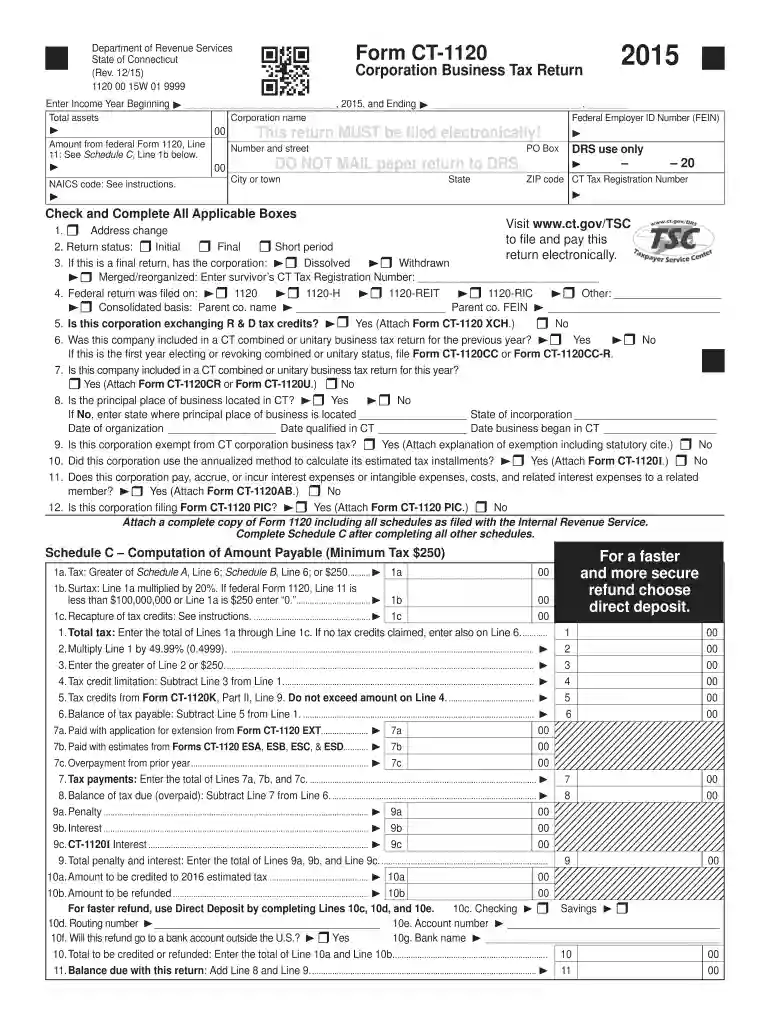
Type text, add images, blackout confidential details, add comments, highlights and more.

Draw your signature, type it, upload its image, or use your mobile device as a signature pad.

Send it via email, link, or fax. You can also download it, export it or print it out.
The Form CT-1120 is a Corporation Business Tax Return specifically for the State of Connecticut for the year 2015. This tax return form is a critical financial document that corporations located in Connecticut use to report their income, assets, and related tax obligations. The form ensures that corporations comply with state tax regulations by providing detailed information required for the annual taxation process. It includes sections that cover corporate details, financial calculations, and tax dues, making it an integral part of the business's fiscal responsibilities.
Corporations need to meticulously fill out the Form CT-1120 for the 2015 tax year, ensuring accurate financial reporting. The process involves:
Corporations may find it useful to consult financial advisors or tax professionals to ensure the form is filled out correctly and in compliance with the legal requirements.
Completing the Form CT-1120 involves a structured approach to ensure compliance and accuracy:
Gather Financial Records: Collect all relevant financial documents from the fiscal year 2015, including revenue statements, expense records, and previous tax filings.
Fill Corporate Information: Accurately enter corporate details such as the business name, address, and Connecticut Tax Registration Number.
Income Reporting: List all income earned by the corporation during the tax year, ensuring all sources are reported.
Calculate Deductions: Identify eligible expenses and deductions to determine taxable income.
Compute Tax Liability: Use the instructions to calculate total tax due based on taxable income.
Review and Confirm: Carefully review the form for accuracy before submission.
Key sections of the Form CT-1120 for 2015 include:
Understanding these key elements ensures that forms are completed correctly and reduces the risk of errors.
For the 2015 tax year, the standard deadline for filing the Form CT-1120 was March 15, 2016. Corporations must ensure timely filing to avoid penalties. In cases of extensions, Connecticut allowed for an automatic six-month extension, provided specific criteria were met, such as payment of estimated taxes by the original due date. Late filing may incur penalties and interest on unpaid taxes, making it essential to understand and adhere to these deadlines.
Connecticut encourages electronic submission of Form CT-1120 to streamline processing and enhance data security. The form can be filed through the Connecticut Department of Revenue Services’ online portal. Alternatively, forms could be submitted by mail, although this method requires additional processing time. Online filing is preferred due to its efficiency and reduced likelihood of processing errors. Corporations may choose the method best suited to their needs but should prioritize online filing for its convenience and reliability.
The Form CT-1120 is utilized by corporations in Connecticut to legally report their 2015 financial activities. It serves as a mandatory document for calculating and paying state corporate taxes. Failure to accurately complete or submit the form may result in legal consequences, including fines and increased scrutiny from the state tax authorities. Legal compliance highlights the importance of accurately capturing all financial transactions and adhering to state-specific tax codes and requirements.
Connecticut-specific rules governing the 2015 tax return require:
For example, Connecticut offers specific deductions or tax credits that are not available at the federal level, which should be considered when completing the form.
Failure to comply with Form CT-1120 requirements for 2015 could lead to penalties, including but not limited to:
These penalties emphasize the importance of accurate and timely submission to avoid additional financial burdens.
Consider a corporation with multiple revenue streams and business activities in Connecticut. To properly use Form CT-1120, the corporation would:
These examples highlight the form’s role in adjusting and reporting varied corporate financial dynamics and demonstrate its utility in maintaining compliance with state tax laws.
We've got more versions of the form ct 1120 2015 form. Select the right form ct 1120 2015 version from the list and start editing it straight away!
| Versions | Form popularity | Fillable & printable |
|---|---|---|
| 2025 | 4.8 Satisfied (24 Votes) | |
| 2024 | 4.9 Satisfied (56 Votes) | |
| 2022 | 4.2 Satisfied (22 Votes) | |
| 2021 | 4.4 Satisfied (65 Votes) | |
| 2020 | 4.2 Satisfied (115 Votes) | |
| 2019 | 4.4 Satisfied (272 Votes) | |
| 2018 | 4.3 Satisfied (85 Votes) | |
| 2016 | 4.4 Satisfied (408 Votes) | |
| 2015 | 4 Satisfied (50 Votes) | |
| 2014 | 4 Satisfied (53 Votes) | |
| 2013 | 4 Satisfied (45 Votes) | |
| 2012 | 4.2 Satisfied (39 Votes) | |
| 2010 | 4.3 Satisfied (262 Votes) |
At DocHub, your data security is our priority. We follow HIPAA, SOC2, GDPR, and other standards, so you can work on your documents with confidence.
Form CT-1120 Corporation Business Tax Return Department of Revenue Services State of Connecticut. Attach a schedule of corporate officers names, titles, and
The performing entity is required to file any entity level returns such as Form CT-1065/CT-1120SI or Form CT-1120, Corporation Business Tax Return, 2015(5) is


