




01. Edit your irs disabled form online
Type text, add images, blackout confidential details, add comments, highlights and more.

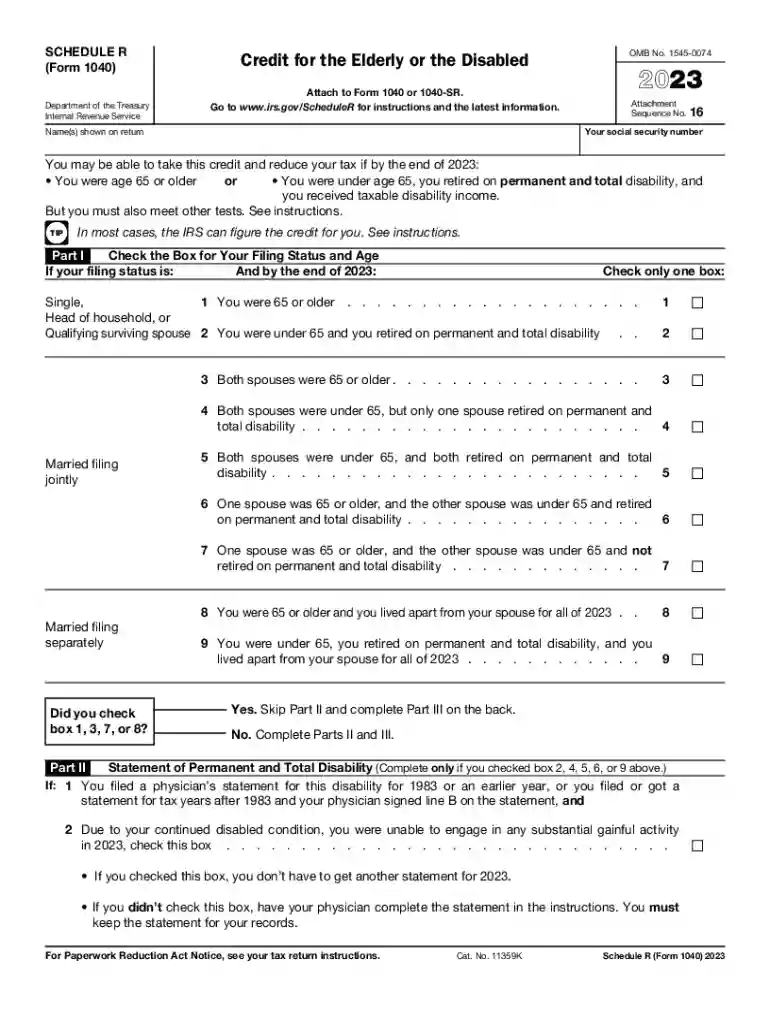
Type text, add images, blackout confidential details, add comments, highlights and more.

Draw your signature, type it, upload its image, or use your mobile device as a signature pad.

Send credit elderly form via email, link, or fax. You can also download it, export it or print it out.
Schedule R (Form 1040) is a crucial tax document for individuals seeking to claim the Credit for the Elderly or the Disabled. This form is utilized to calculate tax credits, which can significantly reduce the tax liability for eligible individuals. Primarily, this form is targeted at taxpayers who are aged 65 or older, or those under 65 who are permanently and totally disabled. Understanding the complexities of this form can provide significant tax relief, making it essential for eligible taxpayers to be familiar with its requirements and benefits.
Eligibility for Schedule R involves meeting age or disability criteria, along with income and filing status considerations. For individuals aged 65 or older, simply meeting the age requirement may suffice if the income criteria are also met. For those younger than 65, qualifying as permanently and totally disabled and receiving disability retirement benefits before the mandatory retirement age is necessary. Additionally, income limits apply, including specific thresholds for adjusted gross income and non-taxable parts of social security and other nontaxable pensions.


You can obtain IRS Schedule R (1040 form) from various resources, including the IRS website. This form becomes part of your complete tax filing process when claiming the credit. It is crucial to understand each part of the form, including the eligibility declaration, credit computation, and any requisite attachments to your main 1040 form.
Completing Schedule R involves several specific steps to accurately calculate and claim the credit. Each step requires attentive detail to ensure eligibility and correctness in determining the amount of credit expected.
The form includes essential sections that taxpayers must understand, such as eligibility verification and income calculation for determining credit amounts. These components are pivotal in successful completion and claiming of the credit.
The IRS provides comprehensive guidelines to ensure proper compliance and to maximize the opportunity for eligible credits. Adhering to these guidelines is critical in successful form completion and credit claiming.
The timeliness of filing can impact the success of your credit claim. Aligning with IRS deadlines is critical to ensure tax benefits without penalties.
Failure to submit IRS Schedule R accurately can lead to missed credits or penalties. Understanding these potential pitfalls emphasizes the importance of precision and timely submission.
By understanding these blocks, taxpayers can navigate the IRS Schedule R (Form 1040) efficiently, ensuring compliance and maximizing potential tax credits.
We've got more versions of the irs disabled form form. Select the right irs disabled form version from the list and start editing it straight away!
| Versions | Form popularity | Fillable & printable |
|---|---|---|
| 2025 | 4.8 Satisfied (45 Votes) | |
| 2024 | 4.7 Satisfied (21 Votes) | |
| 2023 | 4.8 Satisfied (57 Votes) | |
| 2022 | 4.3 Satisfied (40 Votes) | |
| 2021 | 4.8 Satisfied (87 Votes) | |
| 2020 | 4 Satisfied (46 Votes) | |
| 2019 | 4.1 Satisfied (36 Votes) | |
| 2018 | 4.4 Satisfied (182 Votes) | |
| 2017 | 4.3 Satisfied (71 Votes) | |
| 2016 | 4.4 Satisfied (398 Votes) | |
| 1995 | 4.7 Satisfied (43 Votes) |
At DocHub, your data security is our priority. We follow HIPAA, SOC2, GDPR, and other standards, so you can work on your documents with confidence.
Mar 30, 2026 Use Schedule R (Form 1040) to figure the credit for the elderly or the disabled. Current revision. Schedule R (Form 1040) PDF Instructions forRead more
Statement of Permanent and Total Disability (Complete only if you checked box 2, 4, 5, 6, or 9 above.) 1. Schedule R (Form 1040) 2000. 2. If your filing statusRead more


