




01. Edit your schedule 1 tax form online
Type text, add images, blackout confidential details, add comments, highlights and more.

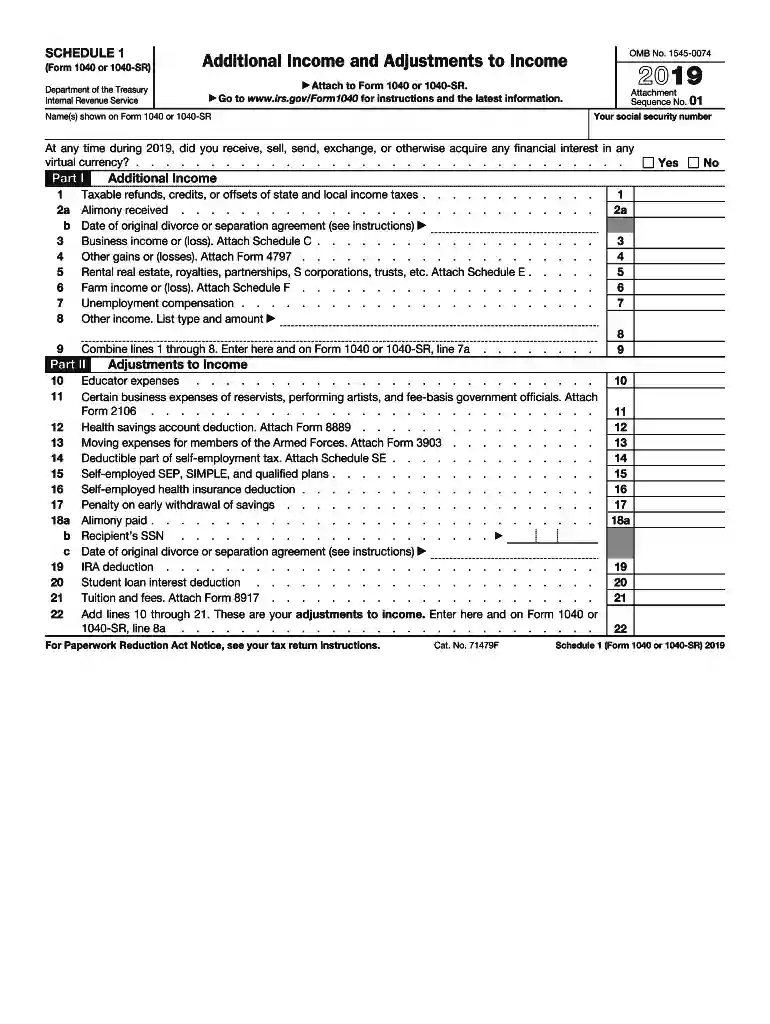
Type text, add images, blackout confidential details, add comments, highlights and more.

Draw your signature, type it, upload its image, or use your mobile device as a signature pad.

Send 2019 1040 schedule 1 form via email, link, or fax. You can also download it, export it or print it out.
Schedule 1 (Form 1040 or 1040-SR) is an integral part of the U.S. tax system, designed for taxpayers to report additional income and specific adjustments to income. This form is an attachment to the primary tax forms, 1040 or 1040-SR, allowing the IRS to comprehensively assess a taxpayer's financial situation. Primarily, Schedule 1 captures detailed information not typically included on the main forms, such as capital gains, business income, unemployment compensation, and other adjustments like educator expenses and health savings account deductions. By accurately completing Schedule 1, taxpayers provide the IRS a holistic view of their incomes and exemptions, thereby ensuring correct tax assessment.
Using Schedule 1 involves a systematic approach to itemizing additional income and justified adjustments that might not fit directly onto the standard Form 1040. Taxpayers must first identify all income streams not originally included, such as capital gains, rental income, or alimony received. Additionally, adjustments like educator expenses and student loan interest deductions must be identified. Once gathered, the taxpayer meticulously fills in each section of the form, ensuring that every figure correlates correctly with supporting documentation. Essential steps include checking all calculations, confirming compliance with IRS guidelines, and finally attaching the completed Schedule 1 to the Form 1040 before submission.
Gather Required Information: Before filling out the form, taxpayers must compile all financial documents that detail additional income sources and applicable deductions.
Complete Part I - Additional Income:
Complete Part II - Adjustments to Income:
Review and Verify:
Attach to Form 1040:
Schedule 1 contains several key components that are critical to its completion:
Part I: Additional Income: Encompasses sections for a wide array of incomes beyond wages, including taxable refunds, business income, and alimony.
Part II: Adjustments to Income: Lists adjustments allowing reductions to gross income, like contributions to IRAs and student loan interest.
Each part is devised to not only capture relevant financial inputs but also enable taxpayers to benefit from potential deductions, which can significantly impact their taxable income.
The IRS provides comprehensive guidelines to assist taxpayers in completing Schedule 1 accurately. These guidelines highlight the kind of additional incomes that should be reported and emphasize the criteria for eligible adjustments. The IRS stresses accuracy to ensure taxpayers benefit fully from available deductions without encountering common errors that could result in penalties or additional taxes. Taxpayers are cautioned to remain updated with annual amendments to tax laws that might influence how Schedule 1 should be filled out.
To align with federal tax obligations, taxpayers must submit Schedule 1 concurrently with their Form 1040 by April 15th, unless an extension is filed, which extends the deadline to October 15th. Taxpayers are advised to monitor IRS announcements for any changes in filing deadlines. It’s pivotal for them to file on time to avoid penalties and interest accrued due to late submission, while also providing ample time for corrections if necessary.
Schedule 1 is utilized by a broad spectrum of taxpayers, including self-employed individuals, investors with capital gains, and those receiving various forms of partnership or S corporation income. Additionally, it’s pertinent for taxpayers who aim to deduct adjustments such as student loan interest or other educator-related expenses. Essentially, any taxpayer with extra streams of income or qualifying deductions outside the standard Form 1040 is likely to require Schedule 1. This includes retirees, freelancers, and small business owners who need to report diverse financial activities.


The legal requirement for filling out Schedule 1 stems from the need for accurate financial disclosure to the IRS. By incorporating all additional incomes and eligible deductions, taxpayers adhere to federal tax laws, avoiding legal repercussions such as audits, penalties, and fines. Proper completion of Schedule 1 ensures that taxpayers fulfill their responsibilities under the Internal Revenue Code, fostering transparency and compliance. Legal compliance also offers protection against claims of tax evasion or underreporting, underscoring the form's significance in maintaining tax law integrity.
We've got more versions of the schedule 1 tax form form. Select the right schedule 1 tax form version from the list and start editing it straight away!
At DocHub, your data security is our priority. We follow HIPAA, SOC2, GDPR, and other standards, so you can work on your documents with confidence.




Schedule 1 is used to report types of income that arent listed on the 1040, such as capital gains, alimony, unemployment payments, and gambling winnings.Read more
1. 1. 2. 2. Returns and allowances. 3. 3. Subtract line 2 from line 1. 4. 4. Cost of goods sold (from line 40 on page 2). 5. Gross profit.Read more
Jul 25, 2025 For 2025, enter the amount reported to you on Form(s) 1099-K that was included in error or for personal items sold at a loss .Read more


