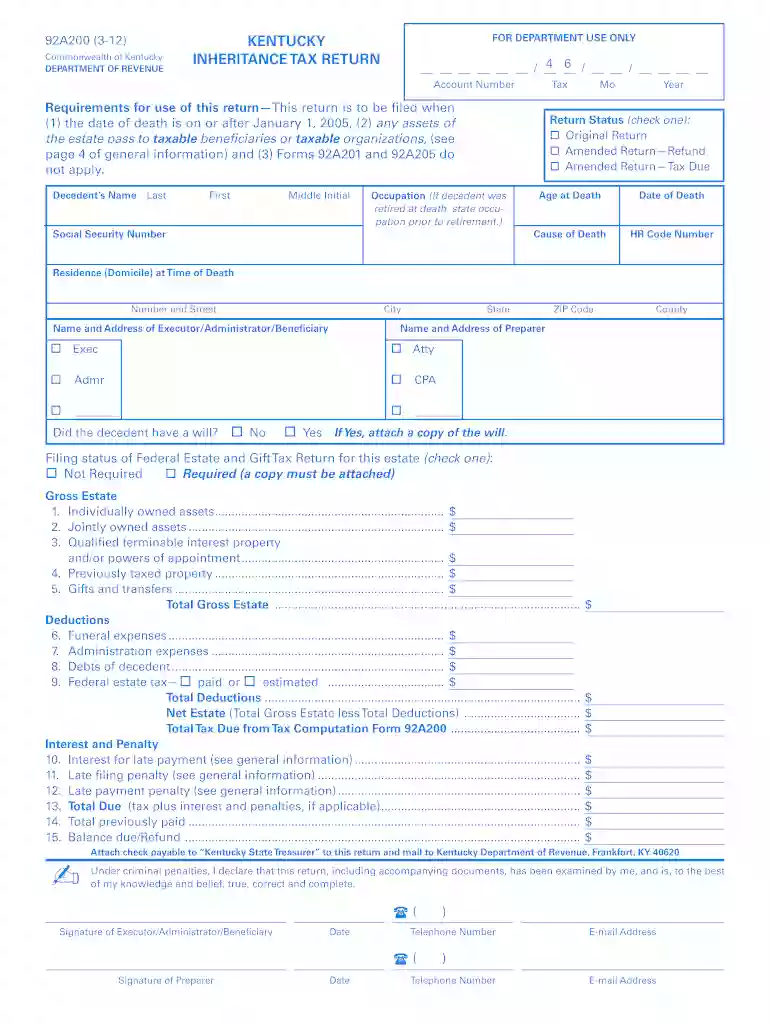
92a200 (3-12) - Kentucky: Department of Revenue 2026

Get Form
92a200 (3-12) - Kentucky: Department of Revenue Preview on Page 1

Here's how it works

01. Edit your form online
Type text, add images, blackout confidential details, add comments, highlights and more.

02. Sign it in a few clicks
Draw your signature, type it, upload its image, or use your mobile device as a signature pad.

03. Share your form with others
Send it via email, link, or fax. You can also download it, export it or print it out.

Definition & Meaning

The 92A200 (3-12) - Kentucky: Department of Revenue form is primarily utilized in the process of filing a Kentucky Inheritance Tax Return. This tax form is mandatory for estates where a decedent's assets are transferred to beneficiaries who are subject to tax, effective from January 1, 2005. The form captures essential details about the deceased and their estate, ensuring that all individual and joint assets, terminable interest properties, and other relevant items are appropriately reported.

Inheritance Tax Context

  • Inheritance Tax Definition: It is a tax assessed on the portion of the estate inherited by beneficiaries after an individual's death, differing across jurisdictions and subject to specific state rules.
  • Kentucky Specifics: In Kentucky, this form is a mechanism to establish and report the tax liabilities of estates, complying with state revenue laws.

How to Use the 92A200 Form

Using the 92A200 correctly involves understanding the necessary details and sections required for comprehensive filing.

Detailed Procedure for Completion

  1. Gather Information About the Decedent: Collect data such as date of death, social security number, and any documents that detail ownership of assets.

  2. Asset Reporting: Identify all assets, categorizing them into individually owned, jointly owned, or gifts and transfers. These have specific sections on the form.

  3. Expense and Debt Reporting: Document funeral expenses, administrative costs, and any debts the decedent owes, which can be deducted before tax calculation.

  4. Provide Beneficiary Details: Enter information about each beneficiary, including relationship to the deceased and their portion of the estate.

Required Data Points

  • Personal Identification: Social security, address, and date of death.
  • Asset Valuations: Accurately assess real and personal property values.

Steps to Complete the 92A200 Form

Filing the 92A200 form involves a sequential approach to ensure compliance and accuracy.

Step-by-Step Instructions

  1. Identification Section: Fill out the decedent’s personal and estate identification details.
  2. Asset and Property Schedules: Complete schedules for each category of assets owned by the decedent.
  3. Debts and Expense Schedules: Detail any outstanding debts and allowable administration expenses.
  4. Beneficiary Details: For each beneficiary, indicate their share and relationship to the decedent.
  5. Tax Computation: Use the provided schedules to calculate the total and taxable estate, leading to the tax owed.
  6. Review and Sign: Thoroughly review for accuracy before signing.

Required Documents

Ensuring you have all necessary documentation beforehand simplifies filling out the 92A200.

Essential Document List

  • Death Certificate: Official document confirming the passing of the decedent.
  • Asset Valuation Records: Professional appraisals or market statements for real estate, stocks, and other investments.
  • Debt and Expense Proofs: Receipts or statements of debts and funeral costs.
  • Beneficiary Statements: Any legal documents supporting the allocation of estate shares to heirs.

Filing Deadlines / Important Dates

Adhering to specific deadlines is critical when filing the 92A200 form to avoid penalties.

Key Submission Deadlines

  • Standard Filing Period: Typically within nine months of the decedent's date of death. Extensions may be requested under certain conditions.
  • Penalty Avoidance: Filing before the deadline without errors helps avoid interest and penalty assessments.

Penalties for Non-Compliance

Failing to properly file the 92A200 form can result in significant penalties.

Consequences of Late or Inaccurate Filing

  • Monetary Penalties: Interest charges and financial penalties for overdue taxes.
  • Legal Repercussions: Possible legal action for significant discrepancies or fraudulent reporting.

Digital vs. Paper Version

The choice between digital and paper versions can impact filing efficiency and accuracy.

Comparison of Filing Methods

  • Digital Filing: Allows for automatic calculations and error-checking features, reducing manual mistakes.
  • Paper Filing: Suitable for those more comfortable with hard copy submissions but may require more manual checks.

State-Specific Rules

Different states have varying requirements, and understanding Kentucky-specific regulations is crucial.

Kentucky Inheritance Tax Rules

  • Exemptions and Deductions: Specific exemptions apply, and some deductions may only be claimed based on Kentucky law.
  • Filing Requirements: Kentucky mandates tax filing for taxable estates exceeding a certain asset threshold, requiring detailed reporting as per state provisions.

These comprehensive details ensure clarity and precise filing of the 92A200 form, accommodating the nuanced requirements of estates within Kentucky under the Department of Revenue guidelines.

See more 92a200 (3-12) - Kentucky: Department of Revenue versions

We've got more versions of the 92a200 (3-12) - Kentucky: Department of Revenue form. Select the right 92a200 (3-12) - Kentucky: Department of Revenue version from the list and start editing it straight away!
Versions Form popularity Fillable & printable
2016 4.9 Satisfied (280 Votes)
2015 4.4 Satisfied (50 Votes)
2012 4.2 Satisfied (49 Votes)
2003 4.3 Satisfied (50 Votes)
be ready to get more

Complete this form in 5 minutes or less

Get form

Got questions?

We have answers to the most popular questions from our customers. If you can't find an answer to your question, please contact us.
Contact us
Where do I mail my forms? For Refunds: Kentucky Department of Revenue, PO Box 856970, Louisville, KY 40285-6970. For Balance Due: Kentucky Department of Revenue, PO Box 856980, Louisville, KY 40285-6980.
You can call (502) 564-4581 to speak to an examiner for information on any additional refund issued after the original refund. Enter the primary social security number on your Kentucky tax return. You must enter your complete 9-digit Social Security Number.
Kentucky inheritance taxes affect only estates or beneficial interests passing to Classes B and C beneficiaries. Class B beneficiaries have a $1,000 exemption; the remainder of assets are taxable at a rate of 4% to 16%. Class C beneficiaries receive a $500 exemption and 6% to 16% tax rate.
Class A beneficiaries include: surviving spouse, parent, child, grandchild, brother, sister, half-brother, and half-sister. If the date of death is after June 30, 1998, all Class A beneficiaries are exempt from paying Kentucky inheritance tax.
Affidavit of Exemption It is not necessary to file a No Tax Due Inheritance Tax Return with the Department of Revenue. If an Affidavit of Exemption is submitted to the Court, do not send a copy of the affidavit to the Kentucky Department of Revenue.

Security and compliance

At DocHub, your data security is our priority. We follow HIPAA, SOC2, GDPR, and other standards, so you can work on your documents with confidence.

Learn more
ccpa2
pci-dss
gdpr-compliance
hipaa
soc-compliance

People also ask

Transfer assets to a trust Trusts are another way that you can reduce or avoid inheritance tax. This is because any money, property, investments or other assets that are transferred into the ownership of a trust and its trustees will be outside of your estate for inheritance tax purposes.
Generally, beneficiaries do not pay income tax on money or property that they inherit, but there are exceptions for retirement accounts, life insurance proceeds, and savings bond interest. Money inherited from a 401(k), 403(b), or IRA is taxable if that money was tax deductible when it was contributed.
In Kentucky, if you have no will, your spouse only gets all your property if you die and leave no descendants, parents, siblings, or descendants of siblings. If you have descendants but no spouse, your descendants inherit everything, divided equally among them.

Related links