




01. Edit your form online
Type text, add images, blackout confidential details, add comments, highlights and more.

Type text, add images, blackout confidential details, add comments, highlights and more.

Draw your signature, type it, upload its image, or use your mobile device as a signature pad.

Send it via email, link, or fax. You can also download it, export it or print it out.
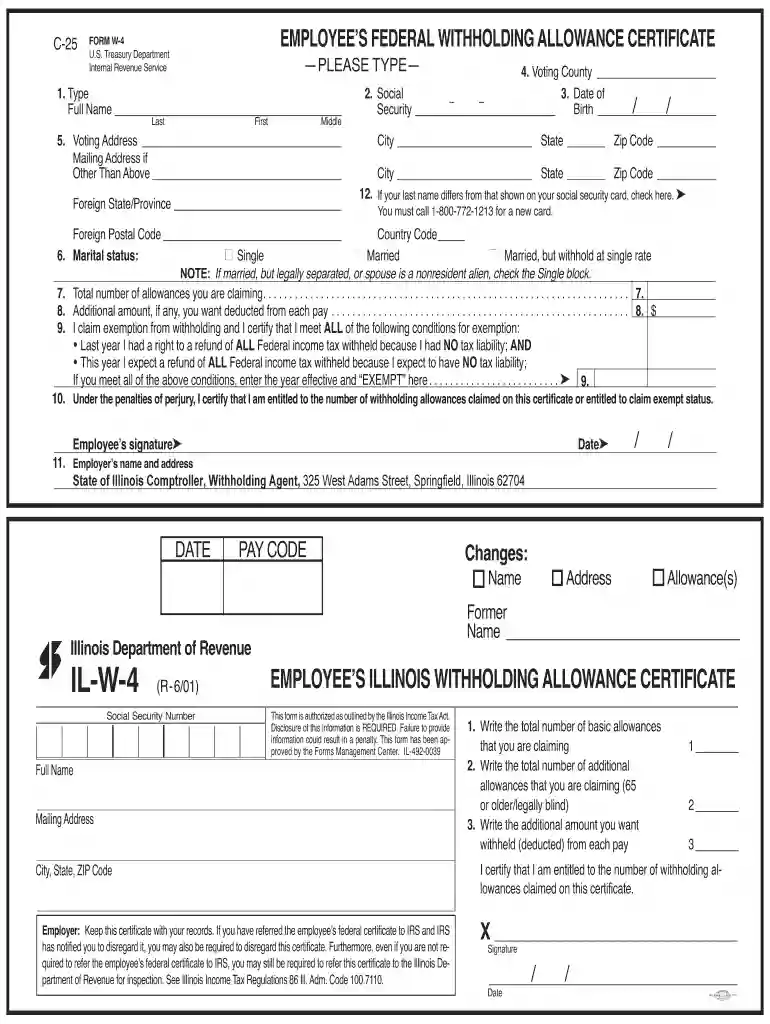
The Tax Form W-4, also known as the Employee’s Withholding Certificate, plays a crucial role in determining the amount of federal income tax an employer withholds from an employee's paycheck. Recent changes to Form W-4 emphasize the need for accurate completion to ensure the correct tax amount is withheld throughout the year. This section elaborates on the significance of recent adjustments and how they impact both employees and employers.
The recent changes in Form W-4 have streamlined withholding categories, removing allowances and focusing instead on more straightforward inputs like filing status, number of dependents, and any additional income or deductions an employee may have. The revised form facilitates a transparent and straightforward calculation, reducing complexities encountered with the previous version. It also introduces new worksheets to help taxpayers refine their withholding amounts more accurately.
Completing the revised W-4 form involves a clear, sequential process aimed at capturing accurate tax particulars.
These steps are designed to cater to varying employment and personal tax scenarios, ensuring the form aligns more closely with an individual's financial situation.
Workday tax elections serve to automate and facilitate changes in an employee’s tax withholding preferences within a corporate HR system. Employees can adjust their W-4 settings based on life changes such as marriage or having children, directly through Workday’s platform. Notifications and easy access links ensure that employees can manage these life-stage adjustments seamlessly, ensuring their withholding remains accurate.
Form W-4 is legally significant, requiring accuracy in the data provided to prevent under- or over-withholding. IRS guidelines mandate that employees submit an updated W-4 upon significant lifestyle or job changes affecting tax liabilities. Employers use this information to comply with federal withholding requirements, directly impacting employee take-home pay and avoiding IRS penalties.
Failure to comply can result in IRS penalties for both the employee and employer. Employees who under-report allowances risk owing taxes and penalties at the year's end. Employers bear the legal responsibility to withhold taxes accurately and transmit them to the IRS, making adherence to updated W-4 forms imperative.
While the W-4 primarily concerns federal withholdings, state-specific tax certificates, like the Illinois W-4, mirror its purpose at the state level. Each state may have variations in withholding forms reflecting its unique tax statuses and brackets, which must also be completed to ensure accurate state income withholding.
Comprehensive documentation ensures accuracy when filling out W-4 forms and managing Workday tax elections.
Having the correct documentation facilitates a smooth process when updating withholding preferences, whether through manual form submission or digital Workday updates.
The IRS releases alternate forms for different purposes; however, the W-4 remains central to withholding allowances. Even with digital integrations like Workday, the standard W-4 remains a baseline for tax elections, with state equivalents supplementing federal mandates. Employers and employees should remain vigilant for updates to the W-4 to ensure compliance with annual tax law amendments.
Personal and privacy concerns surrounding the data captured in W-4 forms and through Workday platforms are important. Employers must assure employees that their financial details are securely handled, adhering to privacy laws like the GDPR and confidentiality protocols. Workday’s secure interface encrypts data to mitigate unauthorized access and ensure compliance with IRS regulations regarding taxpayer information.
By understanding these comprehensive aspects of Form W-4 and Workday elections, both employees and employers can better navigate their tax responsibilities, ensuring compliance and financial accuracy in withholding processes.
We've got more versions of the Important: Tax Form W-4 changes and Workday tax elections form. Select the right Important: Tax Form W-4 changes and Workday tax elections version from the list and start editing it straight away!
At DocHub, your data security is our priority. We follow HIPAA, SOC2, GDPR, and other standards, so you can work on your documents with confidence.


