




01. Edit your form online
Type text, add images, blackout confidential details, add comments, highlights and more.

Type text, add images, blackout confidential details, add comments, highlights and more.

Draw your signature, type it, upload its image, or use your mobile device as a signature pad.

Send it via email, link, or fax. You can also download it, export it or print it out.
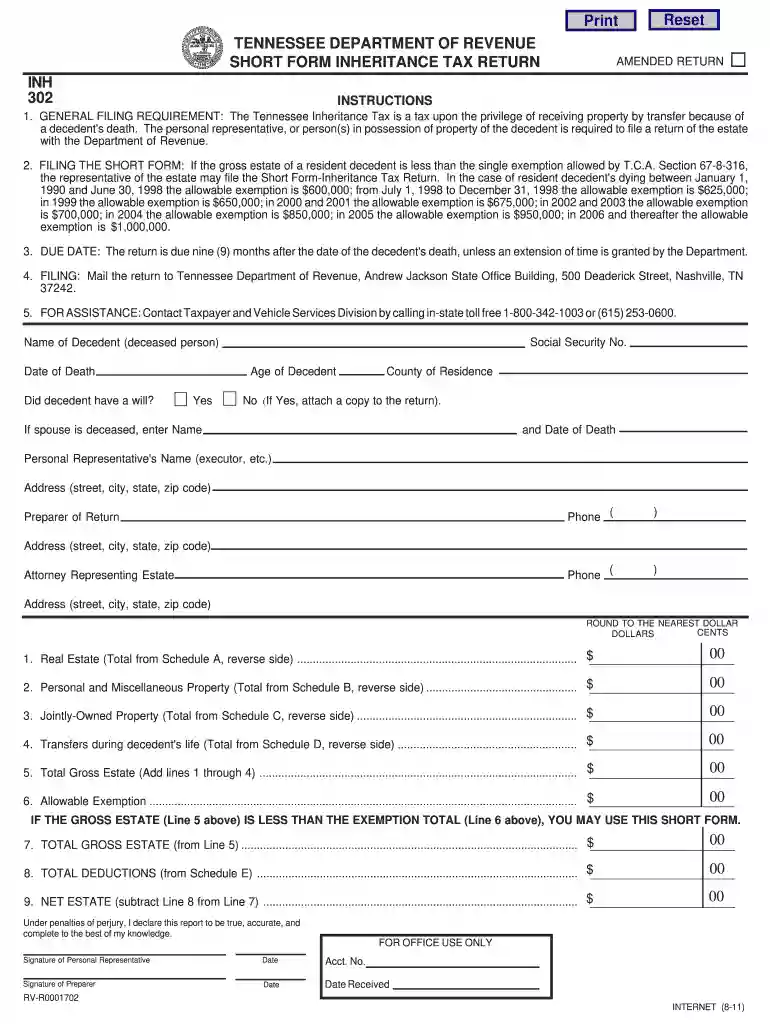
The Tennessee Form Inheritance Tax 2011, officially known as the Tennessee Department of Revenue Short Form Inheritance Tax Return (INH 302), is a document used for reporting inheritance tax obligations following a decedent's death. It is specifically designed to cater to estates that meet certain criteria regarding the gross value, ensuring streamlined processing for eligible estates. The form outlines the tax due, exemptions available, and conditions under which the short form is applicable, providing a crucial tool for estate administrators in Tennessee.
To properly utilize the Tennessee Form Inheritance Tax 2011, estate representatives must first assess whether the estate qualifies for this form based on its gross value and any applicable exemptions. If eligible, the executor must accurately complete the form by detailing assets, liabilities, and any taxable transfers. It is essential to adhere to the instructions for filing and submitting any required supporting documents to avoid complications. This process facilitates the determination and payment of the correct inheritance tax amount due.
The Tennessee Form Inheritance Tax 2011 must be filed within nine months following the decedent’s death. This deadline is critical to avoid penalties or interest accruing on any taxes owed. Executors should plan the filing process promptly to ensure enough time is allocated for potential corrections or additional document acquisition before submission.
Completing the Tennessee Form Inheritance Tax 2011 requires various supporting documents to verify the details of the estate:
The form comprises several key sections that must be completed:
Tennessee imposes specific rules and exemptions that can influence the inheritance tax owed. It is important to remain informed about these stipulations, as state-specific exemptions or credits may vary from other jurisdictions:
Using the Tennessee Form Inheritance Tax 2011 legally requires following all state-prescribed protocols. Executors must ensure that the form is filled and submitted truthfully and accurately, with all necessary supporting documentation. Deviations or falsifications in the reporting process can lead to legal liabilities, penalties, or invalidation of the form. Executors should consult a tax attorney or professional for guidance when complexities arise.
Failure to file the Tennessee Form Inheritance Tax 2011 within the stipulated timeline or inaccurately can result in significant penalties. The state enforces financial penalties, including interest accrual on unpaid taxes, which can increase the estate's liabilities. Non-compliance may also subject the estate to audits or legal scrutiny, imposing further burdens on estate representatives.
In compiling this information, the focus has been on documenting explicit and intricate details necessary for managing the Tennessee Form Inheritance Tax 2011 with precision. The inclusion of comprehensive explanations and practical scenarios ensures adequate preparation for estate administrators handling this process.
We've got more versions of the tennessee form inheritance tax 2011 form. Select the right tennessee form inheritance tax 2011 version from the list and start editing it straight away!
At DocHub, your data security is our priority. We follow HIPAA, SOC2, GDPR, and other standards, so you can work on your documents with confidence.
The first four pages of the Inheritance Tax return are to be completed in its entirety. If a Federal Estate Tax return (Form. 706) was filed attach copies ofRead more
Dec 17, 2010 On August 5, 2011, the IRS stated that Form 8939 must be filed by November 15, 2011,28 and that Form 8939 was to be used to opt out of theRead more


