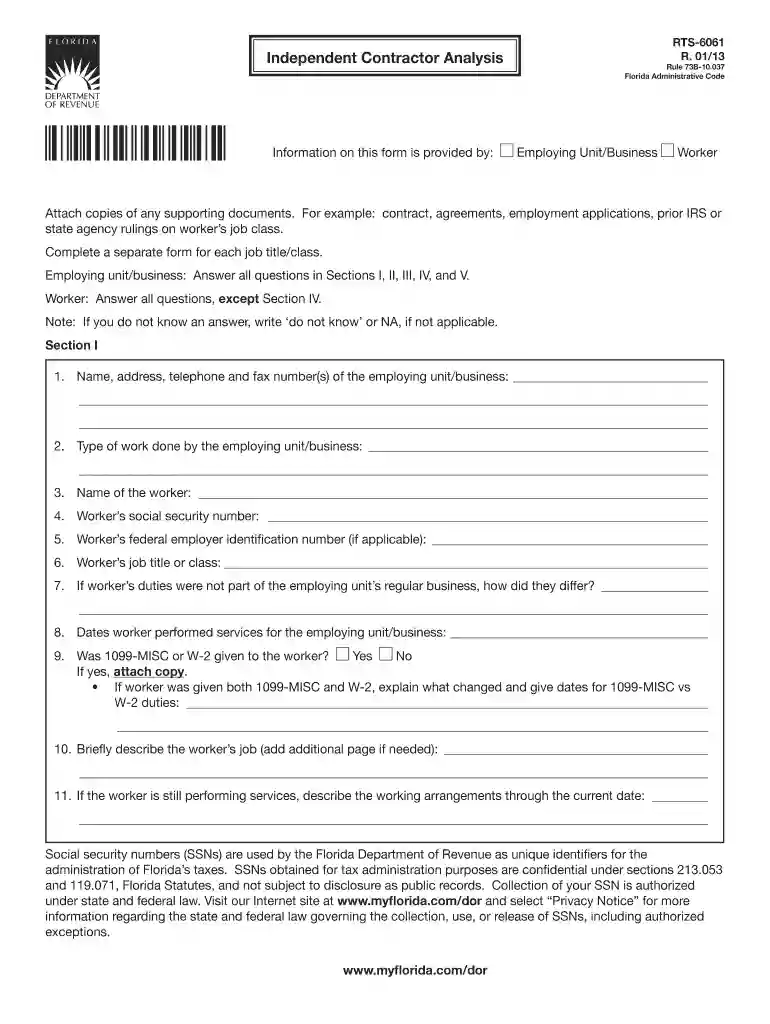
Independent Contractor Analysis - Florida Department of Revenue 2026

Get Form
Independent Contractor Analysis - Florida Department of Revenue Preview on Page 1

Here's how it works

01. Edit your form online
Type text, add images, blackout confidential details, add comments, highlights and more.

02. Sign it in a few clicks
Draw your signature, type it, upload its image, or use your mobile device as a signature pad.

03. Share your form with others
Send it via email, link, or fax. You can also download it, export it or print it out.

Definition & Purpose of the Independent Contractor Analysis

The Independent Contractor Analysis - Florida Department of Revenue is a critical form used to determine the employment classification of a worker. It helps establish whether an individual should be classified as an independent contractor or an employee. This distinction affects how taxes are filed, liability issues, and compliance with state laws. The form requires detailed information from both the worker and the business, including work nature, payment methods, and conditions of employment.

Key Elements of the Analysis

  • Nature of Work: Describing the kind of services rendered by the worker.
  • Payment Methods: Details about how the worker is compensated, such as by the hour or project.
  • Working Conditions: Information about supervision, schedule flexibility, and training provided by the business.

Steps to Complete the Independent Contractor Analysis

  1. Gather Required Information: Collect details from both parties about job functions, payment, and working conditions.
  2. Complete Business Section: The employing unit fills out details concerning their operations and the relationship with the worker.
  3. Fill Out Worker Information: The worker provides information related to job tasks and responsibilities.
  4. Review for Accuracy: Double-check all entries to ensure they are correct and truthful.
  5. Sign and Submit: Both the employer and worker must sign the form before submission to the Florida Department of Revenue.

Important Terms Related to the Analysis

  • Independent Contractor: A self-employed individual performing services under a contract.
  • Employee: A person who works under the control and direction of the hiring entity.
  • Misclassification: Wrongly classifying a worker which can lead to penalties.

State-Specific Rules for Florida

The Florida Department of Revenue has tailored guidelines that must be adhered to when utilizing the Independent Contractor Analysis form. These guidelines emphasize the correct categorization of workers to ensure compliance with state tax laws and labor regulations. Florida's rules may differ slightly from general federal guidelines, so understanding these state-specific criteria is essential for proper form completion.

Legal Use and Compliance

The form's legal purpose is to ensure that all parties involved comply with state employment and tax laws. Properly completing and submitting the Independent Contractor Analysis aids in avoiding misclassification issues that could result in financial penalties and legal disputes. There are legal disclaimers within the form addressing confidentiality and the penalties for false statements, reinforcing the need for honesty and accuracy.

Filing Deadlines and Important Dates

Adhering to specific deadlines is crucial for legal compliance. Typically, the form should be completed and submitted as soon as the working relationship is established to avoid discrepancies in employment classification and penalties for late filing. Some companies may be required to evaluate their contractor relationships periodically, and deadlines may vary depending on organizational needs or legislative changes.

Examples of Using the Independent Contractor Analysis

  • New Business Ventures: When starting a new business in Florida and hiring workers, understanding their correct classification can provide clarity on tax obligations.
  • Subcontracting Projects: Companies engaging independent contractors for specific projects need to evaluate each relationship to ensure proper tax treatment.
  • Regular Review: Businesses increasingly conducting worker audits may use the form as part of a broader compliance strategy to verify correct classifications.

Penalties for Non-Compliance with the Independent Contractor Analysis

Failure to accurately complete the Independent Contractor Analysis or misclassifying workers can lead to significant legal and financial repercussions, such as back taxes, fines, and potential lawsuits. The state of Florida imposes strict penalties to enforce correct worker classification, reflecting the necessity of diligent form completion and honesty in reporting.

Who Typically Uses This Analysis

The form is indispensable for businesses, HR departments, and legal professionals who must ensure compliance with employment classifications in Florida. It is often used by companies across various industries that engage independent contractors regularly for projects or services. Understanding this analysis’s importance helps prevent common pitfalls associated with employment classifications.

See more Independent Contractor Analysis - Florida Department of Revenue versions

We've got more versions of the Independent Contractor Analysis - Florida Department of Revenue form. Select the right Independent Contractor Analysis - Florida Department of Revenue version from the list and start editing it straight away!
Versions Form popularity Fillable & printable
2016 4.8 Satisfied (101 Votes)
2013 4.2 Satisfied (66 Votes)
2010 4.1 Satisfied (60 Votes)
be ready to get more

Complete this form in 5 minutes or less

Get form

Got questions?

We have answers to the most popular questions from our customers. If you can't find an answer to your question, please contact us.
Contact us
The primary test Florida uses is a multi-factor analysis derived from common law principles, which is more flexible than the strict ABC test used in some other states. The burden of proof falls squarely on the employer to demonstrate that a worker is genuinely an independent contractor.
This includes both income tax and self-employment tax, which covers Social Security and Medicare. In Florida, there is no state income tax, which can be a relief for many. However, self-employed individuals still need to pay federal income tax and self-employment tax.
1. How much is the self employment tax for Florida? The Florida self employment tax is 15.3%, divided into two parts. The first 12.4% is for Social Security (old-age, survivors, and disability insurance) and the second 2.9% is for Medicare or hospital insurance.
Sole proprietors, freelancers, independent contractors, and one-person LLCs in the Sunshine State are subject to a variety of taxes, including Florida state taxes and federal taxes.
Tax Deductions Florida LLCs can reduce taxable income by deducting business expenses such as startup costs, salaries, travel, equipment, health benefits, and marketing expenses. State Taxes in Florida While Florida LLCs themselves dont pay state income tax, members pay personal income tax on their distributions.

Security and compliance

At DocHub, your data security is our priority. We follow HIPAA, SOC2, GDPR, and other standards, so you can work on your documents with confidence.

Learn more
ccpa2
pci-dss
gdpr-compliance
hipaa
soc-compliance
be ready to get more

Complete this form in 5 minutes or less

Get form

People also ask

The Department of Labor (DOL) has issued a new rule that changes the way businesses classify independent contractors. On March 11, 2024, the new rule will take effect and will make it more difficult for businesses to determine whether someone is an employee or an independent contractor.
A general rule is to set aside 25-35% of your income for federal, state, and self-employment taxes. Consult with a tax professional to get a more accurate understanding of your tax liability. Self-Employment Tax (15.3%): This covers Social Security (12.4%) and Medicare (2.9%).
Independent contractors are required to take care of their own state and federal taxes and are not W2 employees. They will report their earnings on a 1099-MISC form, and they do not receive overtime pay. When employers report the work of staff on a W2, this automatically changes their status to that of the employee.

Related links