




01. Edit your financial aid declaration form online
Type text, add images, blackout confidential details, add comments, highlights and more.

Type text, add images, blackout confidential details, add comments, highlights and more.

Draw your signature, type it, upload its image, or use your mobile device as a signature pad.

Send it via email, link, or fax. You can also download it, export it or print it out.
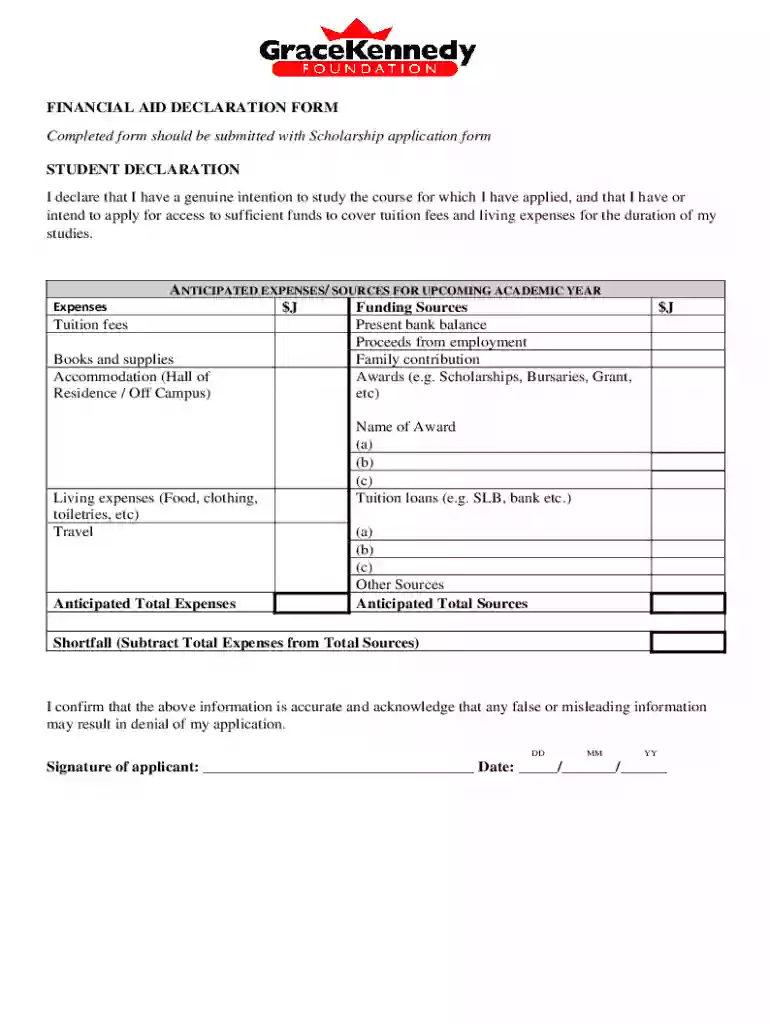
The Financial Aid Declaration Form serves as a vital document for students seeking financial assistance for their academic pursuits. This form is a declaration of intent to study, and it comprehensively outlines anticipated educational expenses and various funding sources for the upcoming academic year. Typically categorized into areas such as tuition fees, living expenses, and other financial contributions, the form plays an essential role in ensuring accurate and honest disclosure of a student's financial situation. It is intended to help educational institutions assess a student's eligibility for financial aid through a structured outline of their financial commitments and resources.
Effectively using the Financial Aid Declaration Form requires a systematic approach to completing each section. Students should begin by gathering all necessary financial information regarding their anticipated expenses and funding. This includes tuition costs, accommodation fees, textbook expenses, and other related costs. Each section requires careful attention to detail to ensure all information is as accurate as possible. Completing the form accurately is crucial as it directly impacts the assessment of financial aid eligibility. It is advisable to review each section thoroughly before submission to prevent any errors or omissions.
Gather Necessary Documentation: Begin by collecting all documents that provide evidence of tuition fees, living expenses, and other potential financial contributions.
Fill Out Personal Information: Accurately input personal details such as name, student ID, and contact information.
Declare Tuition and Fees: Clearly specify the projected tuition costs for the academic year.
Outline Living Expenses: Provide estimates for housing, utilities, food, and ancillary costs.
List Other Expenses: Include costs related to course materials, travel, and any other relevant expenses.
Detail Funding Sources: Specify any scholarships, grants, familial support, or loans that will fund your education.
Review and Confirm: Double-check all entered information for accuracy.
Submit the Form: Send the completed form to the relevant department via the submission method decided by your institution.
Student Information: Details including name, registration number, and contact information, which are vital for administrative tracking.
Educational Institution Details: Information about the institution, including departmental contacts for processing purposes.
Expense Estimates: Breakdown of all expected educational expenses such as tuition fees, accommodation, meals, and transportation.
Funding Sources: A detailed account of all anticipated income sources such as scholarships, family contributions, or loans that will offset expenses.
Affirmation of Accuracy: A confirmation section where the student verifies the accuracy and completeness of the provided information under penalty of academic sanction for falsification.
Eligibility to use the Financial Aid Declaration Form typically requires enrollment or conditional acceptance in an educational program. Often, forms are specific to students in need of financial support, evidenced through their school's financial aid office criteria. The application process generally involves submitting the form along with any supporting documentation that proves financial need and potential funding sources. After submission, students might engage in further processes depending on the institution's requirements for additional documentation or interviews.
Tuition Fees: The amount charged by an educational institution for instruction.
Living Expenses: Costs incurred for accommodation, food, and utilities while studying.
Financial Contributions: Any scholarships, grants, or personal savings contributing towards educational expenses.
Funding Sources: Different financial means that aid students in managing their academic costs.
Verification: The process by which provided information is checked for accuracy and authenticity.
This form must adhere to privacy and financial laws, ensuring that all information is used solely for determining eligibility for financial aid. Students are obligated to provide truthful information, as inaccuracies may lead to loss of financial aid or disciplinary actions by their institution. Schools may enforce compliance by conducting audits or verifications to confirm the information submitted matches the supporting documentation.
Students who submit false or misleading information on their Financial Aid Declaration Form may face serious consequences. Potential penalties include cancellation of financial aid, repayment of disbursed funds, and even disciplinary action up to expulsion from the institution. It is critical that all information provided on the form is accurate and truthful to avoid these repercussions.
The Financial Aid Declaration Form may be available in both digital and paper formats. The digital version often allows for easier submission remotely and may include features such as auto-filled fields and digital signatures, which streamline the process. Paper forms, although less common in digital-centric institutions, provide an alternative for students who prefer physical documentation. Each version requires the same accurate and comprehensive information for processing, although the submission process may differ in terms of delivery and acknowledgment of receipt.
We've got more versions of the financial aid declaration form form. Select the right financial aid declaration form version from the list and start editing it straight away!
At DocHub, your data security is our priority. We follow HIPAA, SOC2, GDPR, and other standards, so you can work on your documents with confidence.


