
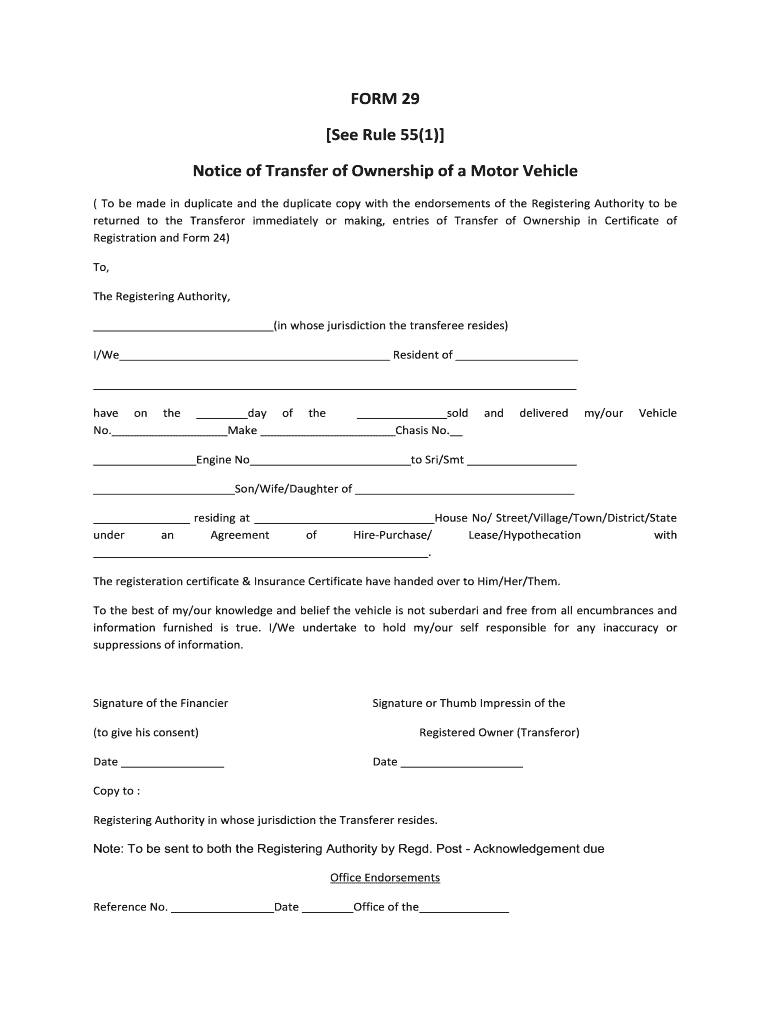







Definition & Meaning of Form 29 and 30
Form 29 is designated as a Notice of Transfer of Ownership for motor vehicles. This document is crucial in the vehicle ownership transfer process, serving as the formal agreement that outlines the responsibilities of both the transferor (current owner) and the transferee (new owner). Form 30 complements this process by providing additional details for registration or transfer requirements in certain jurisdictions. Both forms are typically utilized when a vehicle changes ownership, ensuring that all legal requirements are met and recorded accurately with the relevant Registering Authority.
In essence, Form 29 acts as a record for proving ownership transfer, while Form 30 might include other necessary details pertaining to application or registration processes. This dual form usage helps streamline transactions between private sellers and buyers, dealerships, and others involved in motor vehicle exchanges.
Steps to Complete the Form 29 and 30
Filling out Form 29 and Form 30 requires careful attention to detail. Here are the sequential steps involved in the completion process:
-
Gather Required Information: Before beginning, collect all necessary details, such as the vehicle's make, model, year, Vehicle Identification Number (VIN), and the names and addresses of both the transferor and transferee.
-
Fill Out Form 29:
- Vehicle Details: Accurately enter information about the vehicle, including the VIN and any registration numbers.
- Parties’ Information: Include the names and addresses of the transferor and transferee.
- Transfer Declaration: Indicate the transfer's date and type (e.g., sale, gift).
- Signature: The transferor must sign the form to verify the accuracy of the provided information.
-
Fill Out Form 30 (if applicable):
- Registration Details: Note any registration requirements specific to your state, which may involve additional requirements.
- Confirmation of Information: Review and verify all details before submission.
-
Review: Ensure there are no discrepancies or missing information that might hinder processing.
-
Submit: Depending on state regulations, submit both forms together to the appropriate Registering Authority, either online, by mail, or in person.
Important Terms Related to Form 29 and 30
Understanding specific terminology associated with Form 29 and Form 30 is crucial for effective communication and processing. Here are several key terms:
- Transferor: The current owner of the vehicle who is transferring ownership.
- Transferee: The new owner who receives the vehicle.
- Vehicle Identification Number (VIN): A unique code assigned to every motor vehicle for identification.
- Registering Authority: The governmental body responsible for vehicle registration and title transfers, often the Department of Motor Vehicles (DMV) in various states.
- Notarization: Some jurisdictions may require the signature on these forms to be witnessed or notarized to prevent fraud.
Who Typically Uses Form 29 and 30
Form 29 and Form 30 are primarily utilized by individuals and entities involved in vehicle transactions, including:
- Private Sellers and Buyers: Individuals buying or selling vehicles directly.
- Dealerships: Businesses that sell vehicles and need to transfer ownership for trade-ins or sales.
- Financial Institutions: Banks or credit unions involved in financing vehicles may require these forms during the loan process.
- Corporate Entities: Companies transferring vehicle ownership or managing fleet vehicles also utilize these forms to comply with regulatory requirements.
State-Specific Rules for the Form 29 and 30
While Form 29 and Form 30 serve broadly similar purposes across the United States, specific rules and requirements can vary significantly by state. For instance:
- Filing Process: Some states might require these forms to be filed directly with their local DMV, while others allow for online submissions.
- Supplemental Documents: Certain states may request additional documents to be submitted alongside these forms, such as proof of insurance or emissions testing certifications.
- Fee Structure: Fees associated with vehicle transfer can differ, necessitating research based on state regulations.
- Notarization Requirements: In some states, forms may need to be notarized to be legally binding, while in others, simply a signature will suffice.
Familiarity with local regulations ensures compliance and expedites the vehicle transfer process.
Examples of Using Form 29 and 30
Practical examples illustrate how Form 29 and Form 30 are leveraged in real-world situations:
- Private Sale Scenario: When John sells his car to Sarah, he completes Form 29 to document the transfer. Sarah fills out Form 30 to ensure the car is registered under her name at the DMV, complying with state regulations.
- Dealership Transaction: A car dealership might use Form 29 when a customer trades in their vehicle. The dealership then uses the information from Form 30 to facilitate a smooth registration process for the new buyer.
- Corporate Transfer: An enterprise transferring fleet vehicles to a new owner requires completion of both forms. The human resources department manages this documentation to ensure that all vehicles are properly accounted for during the transition.
By following the correct procedures and understanding the requirements associated with Form 29 and Form 30, users can ensure legal compliance and facilitate smooth ownership transfers.


