




01. Edit your city alarm permit application online
Type text, add images, blackout confidential details, add comments, highlights and more.

Type text, add images, blackout confidential details, add comments, highlights and more.

Draw your signature, type it, upload its image, or use your mobile device as a signature pad.

Send it via email, link, or fax. You can also download it, export it or print it out.
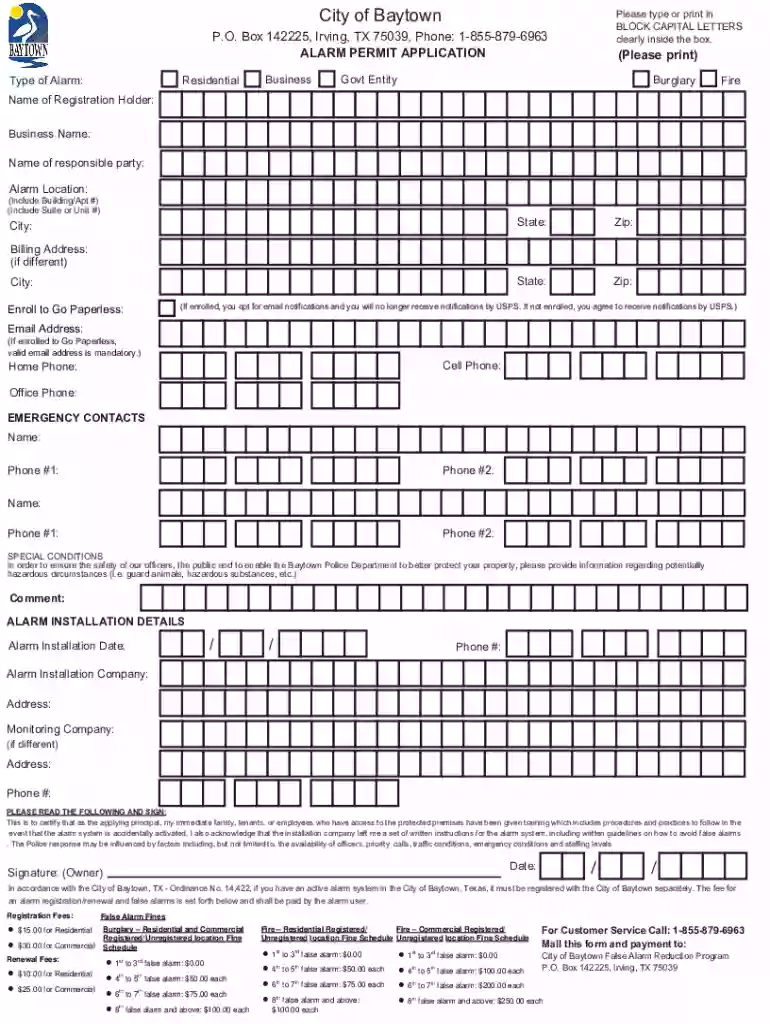
The city alarm permit application is a form required by many municipalities across the United States to register an alarm system, either in residential or commercial properties. This process ensures that local emergency services, such as the police and fire departments, have a database of alarm-equipped properties, facilitating faster and more accurate responses in the event of an alarm activation. The application serves not only as a registration document but also as a legal acknowledgment by the property owner of the municipal regulations surrounding the use of alarm systems.
Alarm permits typically need to be renewed on an annual basis, and the application may vary depending on the specific requirements of each jurisdiction. The primary objective of registering an alarm system includes reducing the number of false alarms and ensuring compliance with local ordinances. Municipalities often use collected fees from these applications to fund local emergency response resources.
Applicants can typically obtain a city alarm permit application from their municipal government’s website, or, in some cases, by visiting a local police or city office in person. These applications may also be available at community centers or mailed upon request for those without internet access. Many cities are increasingly offering online submission options, making the process more convenient.
Before applying, it is important for the applicant to verify the specific regulations and requirements of their local area. This can include checking whether the application needs to be notarized or if any additional documentation is required. It is advisable to prepare any necessary documents ahead of time to avoid delays in processing the application.
Gather Necessary Information: Collect all relevant details about the alarm system, including the installation date, type, address of installation, and contact information for both the property owner and alarm service provider.
Review Local Ordinances: Each city may have unique ordinances related to alarm system registration. Ensure that you are familiar with these to complete the application accurately.
Fill Out the Application Form: Download or obtain the form, either through the city’s website or local offices. Complete all sections, paying close attention to ensure that all information is accurate and up-to-date.
Include Required Documents: Attach any necessary documents, such as proof of ownership or a copy of your contract with the alarm service provider if required by the city.
Submit the Application: Submit the filled application form either online, by mail, or in person, depending on what methods are available and preferred in your city.
Pay the Application Fee: A fee is often required. Payment modalities may vary from city to city, so ensure you understand the acceptable forms of payment.
Await Confirmation: Once submitted, the applicant usually receives a permit number or confirmation letter, which should be kept for reference.
Applicant Details: Full name, address, and contact information of the person applying for the permit.
Property Information: Address and description of the property where the alarm system is installed.
Alarm Service Provider Information: Details about the company providing alarm services, including contact details and contract number.
Type of Alarm System: Information on the system type, whether it is for intrusion, fire, or another emergency service.
Fee Details: Information on the amount and method of payment for the application or renewal fee.
These elements are critical for processing the application smoothly and ensuring timely registration.
Failure to register an alarm system with the local municipality can result in several penalties. Most cities impose fines for unregistered systems, especially if an unregistered alarm results in emergency services being dispatched. Additionally, repeated non-compliance might lead to increased fines, revocation of the alarm system permit, or other legal actions.
Understanding and adhering to permit requirements is crucial to avoid the financial and legal consequences of non-compliance. Many municipalities have implemented these penalties to reduce the strain of false alarms on emergency services.
City alarm permit applications can typically be submitted in several ways, depending on the city’s protocols:
Online Submission: Many municipalities provide an online portal for completing and submitting the application form, which is often the most convenient method.
Mail: Completed applications can be mailed to the designated municipal office, usually requiring a check or money order for any fees.
In-Person: Some applicants may choose to deliver the application to the city’s police department or designated office for direct submission.
Each method may have different processing times, so applicants should choose based on their need for timely processing.
While the premise of the city alarm permit application is consistent across various jurisdictions, the state-specific differences can greatly affect the process. For example:
Fee Structures: States may have different fee requirements or exemptions for certain types of properties, such as government or non-profit entities.
Renewal Periods: Some states require annual renewals, while others may have bi-annual or more extended periods.
Variations in Required Information: The details and documentations demanded can vary significantly based on local regulations.
Applicants should refer to state-specific guidelines to ensure compliance with both state and local laws.
False Alarm: A false trigger of an alarm system, often resulting in unnecessary dispatch of emergency services.
Permit Number: A unique identifier assigned to each registered alarm system for tracking and reference.
Alarm Registration Fee: A mandatory payment often required to process the application and contribute to local emergency resources.
Understanding these terms can assist in better navigating the application process and ensuring all requirements are met.
We've got more versions of the city alarm permit application form. Select the right city alarm permit application version from the list and start editing it straight away!
At DocHub, your data security is our priority. We follow HIPAA, SOC2, GDPR, and other standards, so you can work on your documents with confidence.


