




01. Edit your fidelity w9 online
Type text, add images, blackout confidential details, add comments, highlights and more.

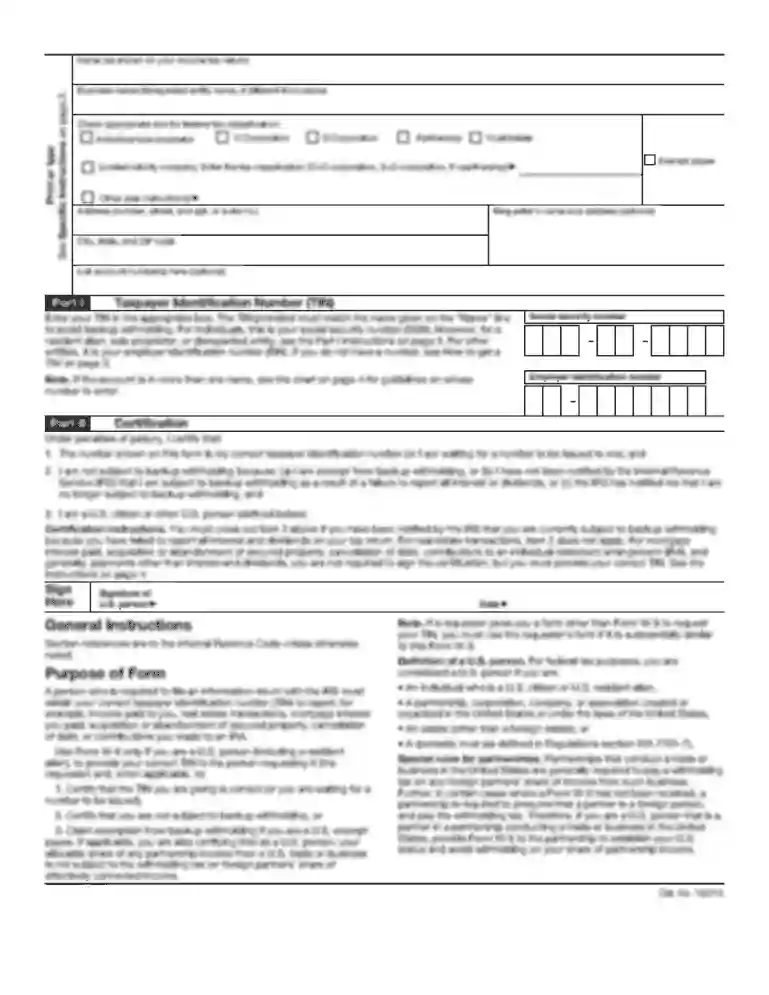
Type text, add images, blackout confidential details, add comments, highlights and more.

Draw your signature, type it, upload its image, or use your mobile device as a signature pad.

Send fidelity com w 9 via email, link, or fax. You can also download it, export it or print it out.
The Fidelity W-9 Form is a critical document used by U.S. persons to certify their taxpayer identification number (TIN) and provide information regarding backup withholding. This is a substitute Form W-9 utilized by Fidelity for its account holders to comply with IRS regulations. It helps in verifying the identity of individuals and ensures accurate reporting of income to the IRS. The form is frequently requested by financial institutions, ensuring that the account holder’s information is up-to-date.
Provide Personal Information: Start by entering your full name as it appears on your tax return. If you’re filling it out for a business or entity, enter the business name or disregarded entity name, if applicable.
Business and Tax Classification: Select the box indicating your federal tax classification (e.g., Individual/Sole proprietor, C Corporation, S Corporation, Partnership, Trust/estate). This section may include additional options like Limited Liability Company (LLC).
Enter Taxpayer Identification Number: Input your Social Security Number (SSN) or Employer Identification Number (EIN) in the relevant field. This number is fundamental for tax reporting and compliance.
Address and Contact Information: Fill out your complete mailing address, following it with your city, state, and ZIP code as required.
Certification and Signature: Read the certification statements thoroughly and sign the form. The certification acknowledges that the information provided is correct, reflects your TIN, and you are exempt from backup withholding, if applicable.
The Fidelity W-9 Form can be easily acquired through multiple channels.
Online Access: Visit your financial institution’s portal, particularly Fidelity’s website, to download the form directly. Ensure you’re accessing the document from a reputable source.
Request via Mail: Contact Fidelity’s customer service to have a physical copy mailed to your address. This might be useful for those who prefer a hard copy.
Branch Visit: If convenient, you can also acquire the form by visiting a Fidelity branch office, where a representative can provide both the form and assistance in filling it out.
Taxpayer Identification Number (TIN): A unique identifier used by the IRS in the administration of tax laws. For individuals, this is usually their Social Security Number; for businesses, it often takes the form of an Employer Identification Number.
Backup Withholding: A tax withholding requirement on certain payments if a payee fails to provide a correct TIN or fails to meet certain conditions, as specified by the IRS.
Disregarded Entity: A business entity with a single owner that is not recognized separately for tax purposes. Typically associated with Sole Proprietorships or Single-Member LLCs.
The Internal Revenue Service (IRS) provides comprehensive guidance regarding the use and requirements of the W-9 Form. The IRS outlines that individuals and entities must complete this form when requested by a payer or institution, especially in contexts involving payment collection or account establishment.
Compliance: Ensures that all payables and reports are correctly identified under a valid TIN.
Audit Trail: Provides a reliable method to trace and verify payments for tax purposes, reducing the risk of errors or fraudulent activities.
Individual Investors: Retail investors using Fidelity services to manage their investment accounts.
Business Account Holders: Companies utilizing Fidelity’s brokerage services for corporate investment or retirement accounts.
Trusts and Estates: For entities managing trusts or estates with accounts at Fidelity needing to report income and distributions.


Failing to accurately complete and provide a W-9 Form when requested can lead to serious repercussions. The implications can include:
Backup Withholding: Automatic deduction of 24% of payments if the correct TIN is not provided or if no form is submitted.
IRS Penalties: Non-compliance might incur penalties which vary based on the infraction, such as failing to report income.
Ensuring timely and precise submission of the Fidelity W-9 Form helps individuals and businesses avoid these penalties, ensuring smooth financial operations.
The completed Fidelity W-9 Form can be submitted through various methods:
Online Submission: Many prefer submitting through an online portal provided by Fidelity, allowing for quick verification and processing.
Mailing: Completed forms can be sent through traditional mail to Fidelity’s designated processing address.
In-Person: Visiting a Fidelity branch for a more direct handover of the document, with an option for immediate verification assistance.
These options cater to different preferences, ensuring that users can manage their document submissions effectively.
At DocHub, your data security is our priority. We follow HIPAA, SOC2, GDPR, and other standards, so you can work on your documents with confidence.


