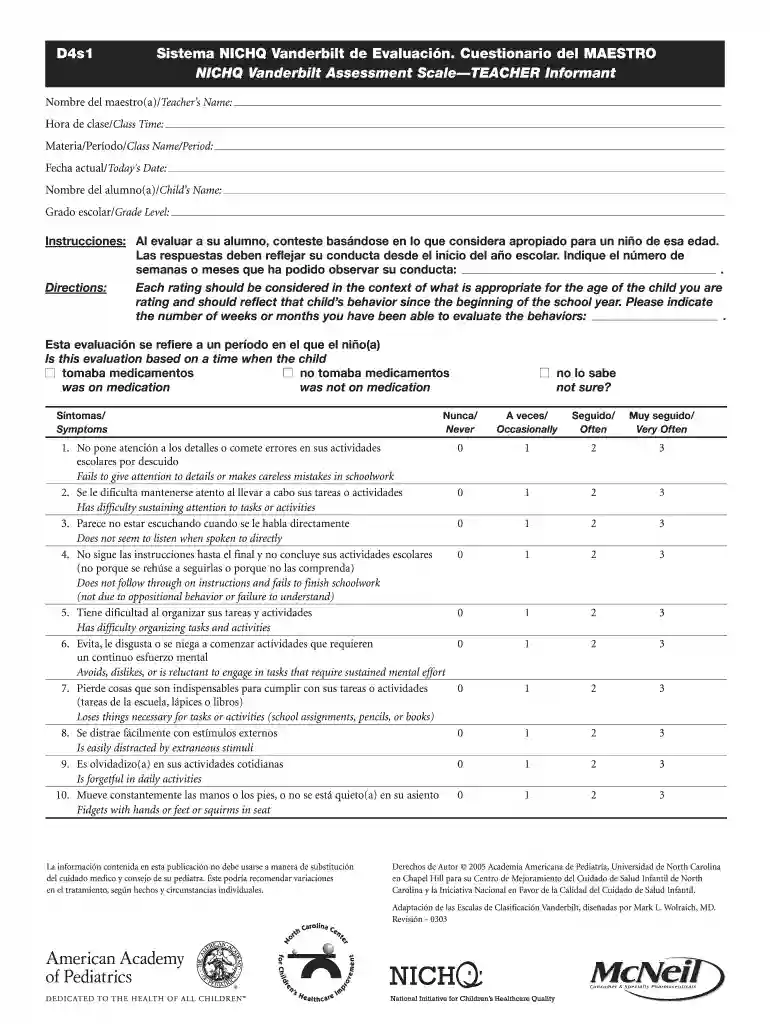
Adhd teacher follow up vanderbilt 2026

Get Form
adhd assessment form Preview on Page 1

Here's how it works

01. Edit your adhd assessment form online
Type text, add images, blackout confidential details, add comments, highlights and more.

02. Sign it in a few clicks
Draw your signature, type it, upload its image, or use your mobile device as a signature pad.

03. Share your form with others
Send adhd teacher follow up vanderbilt via email, link, or fax. You can also download it, export it or print it out.

How to use or fill out ADHD Teacher Follow Up Vanderbilt with Our Platform

Form edit decoration
9.5
Ease of Setup
DocHub User Ratings on G2
9.0
Ease of Use
DocHub User Ratings on G2
  1. Click ‘Get Form’ to open the ADHD Teacher Follow Up Vanderbilt in the editor.
  2. Begin by entering the teacher’s name, class time, subject, today's date, child's name, and grade level in the designated fields at the top of the form.
  3. In the symptoms section, evaluate each behavior based on your observations since the start of the school year. Use a scale from 'Never' to 'Very Often' for each symptom listed.
  4. Indicate whether the evaluation is based on a period when the child was on medication or not. This context is crucial for accurate assessment.
  5. Continue filling out any additional symptoms and performance sections, providing ratings for academic performance and classroom behavior as required.
  6. Finally, add any comments that may help clarify your observations before submitting the form back to the designated address provided at the end.

Start using our platform today to easily complete and manage your ADHD assessments for free!

be ready to get more

Complete this form in 5 minutes or less

Get form

Got questions?

We have answers to the most popular questions from our customers. If you can't find an answer to your question, please contact us.
Contact us
In general, Vanderbilt Follow-up Teacher Assessments are recommended every 3 months but may be required frequently depending on how the patient is responding to medication or other interventions.
The VADRS showed good sensitivity (. 80) and adequate specificity (. 75) compared to diagnoses based on a structured interview with some corroboration by teachers.
To meet criteria for ADHD there must be at least 2 items of the performance set in which the child scores a 4, or 1 item of the performance set in which the child scores a 5; ie, there must be impairment, not just symptoms, to meet diagnostic criteria. The sheet has a place to record the number of positives (4s, 5s).
For the total score of the WURS-25, there is a cut score of 36 (sensitivity and specificity of 96%; Ward et al., 1993) and clients with scores of 36 or above have childhood symptoms that are consistent with adults who have an ADHD diagnosis.
Low: 19 or less. Mild to Moderate: 20-26. High: 27-32. Very High: 33 or more.

Security and compliance

At DocHub, your data security is our priority. We follow HIPAA, SOC2, GDPR, and other standards, so you can work on your documents with confidence.

Learn more
ccpa2
pci-dss
gdpr-compliance
hipaa
soc-compliance

People also ask

A standardized measure called a T-score helps your doctor compare your results. When your T-score is less than 60, it usually means you dont have ADHD. A score higher than 60 may indicate ADHD. And a T-score higher than 70 means your ADHD symptoms are more serious.
ing to Children and Adults with Attention-Deficit/Hyperactivity Disorder (CHADD), ADHD rating scale test questions often use a scale from either 0 to 3 or 0 to 4. On the scale, 0 means the behavior never happens, while 3 or 4 means it occurs frequently.
Adult ADHD Screener Results Section A: A score of 4 or more indicates that the patient has symptoms highly consistent with ADHD in adults and further investigation is warranted. Only a clinician can diagnose ADHD.

child adhd questionnaire pdf