Dte form 100 ex 2026

Get Form
dte form 100 ex Preview on Page 1

Here's how it works

01. Edit your form online
Type text, add images, blackout confidential details, add comments, highlights and more.
02. Sign it in a few clicks
Draw your signature, type it, upload its image, or use your mobile device as a signature pad.
03. Share your form with others
Send it via email, link, or fax. You can also download it, export it or print it out.

How to use or fill out dte form 100 ex with our platform

Form edit decoration
9.5
Ease of Setup
DocHub User Ratings on G2
9.0
Ease of Use
DocHub User Ratings on G2
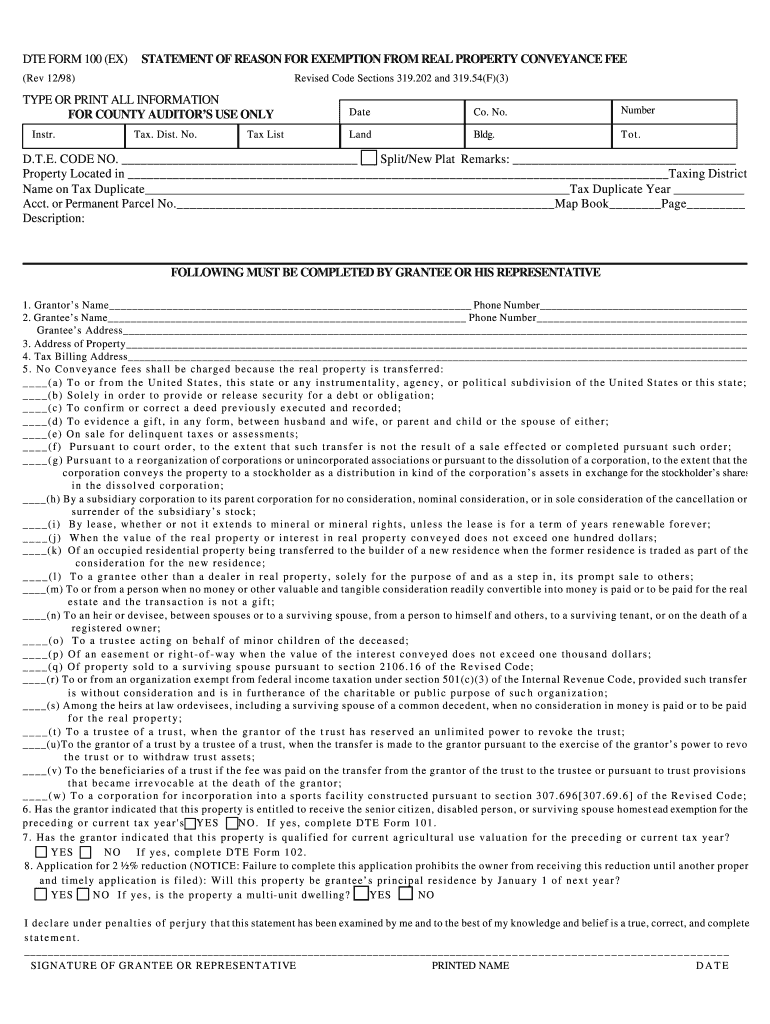
  1. Click ‘Get Form’ to open the dte form 100 ex in the editor.
  2. Begin by filling in the grantor’s name and phone number in Line 1. Ensure accuracy as this information is crucial for identification.
  3. In Line 2, enter the grantee’s name and their contact details. This should match the deed or other legal documents.
  4. Proceed to Line 3 to provide the complete address of the property being conveyed, including street number and name.
  5. For Line 4, specify the tax billing address where future tax bills should be sent. Remember, timely payment is essential.
  6. In Line 5, select one of the exemption options (a)-(w) that applies to your situation. Be prepared to provide supporting documentation if requested by the county auditor.
  7. Complete Lines 6 through 8 as applicable, ensuring all questions are answered truthfully to comply with Ohio Revised Code requirements.
  8. Finally, sign and date the form at the bottom, confirming that all information provided is accurate.

Start using our platform today for free to streamline your document editing and form completion!

See more dte form 100 ex versions

We've got more versions of the dte form 100 ex form. Select the right dte form 100 ex version from the list and start editing it straight away!
Versions Form popularity Fillable & printable
2016 4.8 Satisfied (160 Votes)
2014 4.3 Satisfied (124 Votes)
2012 4.4 Satisfied (407 Votes)
1998 4 Satisfied (33 Votes)
be ready to get more

Complete this form in 5 minutes or less

Get form

Got questions?

We have answers to the most popular questions from our customers. If you can't find an answer to your question, please contact us.
Contact us
Ohio has three types of Homestead Exemptions: (1) senior and disabled persons, (2) disabled veterans, and (3) surviving spouses of public safety personnel killed in the line of duty. This article focuses on the first two types of Homestead Exemption.
The real property conveyance fee is paid by persons who make sales of real estate or used manufactured homes. The base of the tax is the value of real estate sold or transferred from one person to another.
The tax shall be levied upon the grantor named in the deed and shall be paid by the grantor for the use of the county to the county auditor at the time of the delivery of the deed as provided in section 319.202 of the Revised Code and prior to the presentation of the deed to the recorder of the county for recording.
Major Exemptions The tax does not apply: to sales or transfers to or from the U.S. government or its agencies, or to or from the state of Ohio or any of its political subdivisions. to gifts from one spouse to another, or to children and their spouses. to surviving spouses or to a survivorship tenant.
If the property is sold for a very low amount or is transferred for free, such as between family members, it may be exempt from conveyance tax but may still be subject to estate tax.

Security and compliance

At DocHub, your data security is our priority. We follow HIPAA, SOC2, GDPR, and other standards, so you can work on your documents with confidence.

Learn more
ccpa2
pci-dss
gdpr-compliance
hipaa
soc-compliance
be ready to get more

Complete this form in 5 minutes or less

Get form

People also ask

The Ohio Revised Code provides certain categories of real property that are exempt from taxation. Properties owned and operated by a municipal corporation or belonging to the state or federal government and used exclusively for public purpose are exempt from taxation.

Related links