




01. Edit your 2018 form 1065 online
Type text, add images, blackout confidential details, add comments, highlights and more.

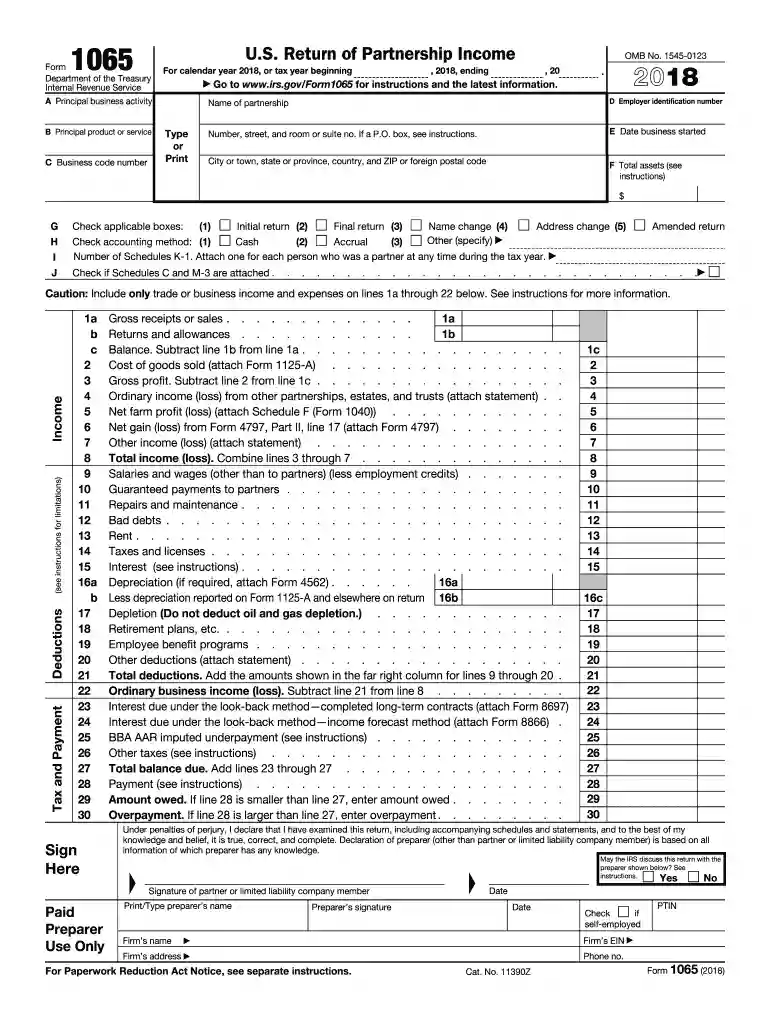
Type text, add images, blackout confidential details, add comments, highlights and more.

Draw your signature, type it, upload its image, or use your mobile device as a signature pad.

Send 2018 irs form 1065 via email, link, or fax. You can also download it, export it or print it out.
Form 1065, known as the U.S. Return of Partnership Income, is an IRS tax form used by partnerships to report their financial activities. This includes income, deductions, gains, losses, and other pertinent financial details. Unlike individual tax forms, partnerships do not pay tax directly. Instead, they pass the responsibility to the individual partners who report their share of the partnership's income or loss on their personal tax returns. Understanding the specific sections of Form 1065 is crucial for ensuring accurate reporting and compliance with IRS regulations.
Completing Form 1065 involves multiple steps that ensure all financial activities of the partnership are accurately documented.
Form 1065 is primarily used by business entities structured as partnerships. This includes:


The IRS provides specific instructions for completing Form 1065, which include detailed guidelines on calculating income, deductions, and the proper way to report each partner's share of tax items using Schedule K-1. The guidelines stress the importance of maintaining accurate records to support all figures reported on the form.
Partnerships must file Form 1065 by the 15th day of the third month following the end of their tax year. For partnerships operating on a calendar year basis, the deadline is typically March 15. If the due date falls on a weekend or public holiday, the deadline extends to the next business day.
The IRS imposes penalties on partnerships that fail to file Form 1065 on time or provide incomplete or inaccurate information. The standard penalty is assessed per partner for each month the form is late or incomplete.
Partnerships can submit Form 1065 electronically or via mail, though e-filing is preferred for its efficiency and potential error reduction.
By adhering to these guidelines, partnerships can ensure compliance with IRS requirements, manage their tax obligations effectively, and avoid common pitfalls associated with Form 1065 filing.
We've got more versions of the 2018 form 1065 form. Select the right 2018 form 1065 version from the list and start editing it straight away!
| Versions | Form popularity | Fillable & printable |
|---|---|---|
| 2025 | 4.6 Satisfied (56 Votes) | |
| 2024 | 4.3 Satisfied (48 Votes) | |
| 2023 | 4.4 Satisfied (52 Votes) | |
| 2022 | 4.9 Satisfied (24 Votes) | |
| 2021 | 4.8 Satisfied (81 Votes) | |
| 2020 | 4.3 Satisfied (145 Votes) | |
| 2019 | 4.4 Satisfied (171 Votes) | |
| 2018 | 4.3 Satisfied (138 Votes) | |
| 2017 | 4.3 Satisfied (233 Votes) | |
| 2016 | 4.4 Satisfied (678 Votes) | |
| 2015 | 4.2 Satisfied (57 Votes) | |
| 2014 | 4.1 Satisfied (30 Votes) | |
| 2013 | 4.3 Satisfied (36 Votes) | |
| 2012 | 4.2 Satisfied (30 Votes) | |
| 2011 | 4 Satisfied (42 Votes) |
At DocHub, your data security is our priority. We follow HIPAA, SOC2, GDPR, and other standards, so you can work on your documents with confidence.


Jul 13, 2016 Partnerships compute and report the filing fee on Form NJ-1065. DUE DATE. Returns are due on the 15th day of the fourth month after the end ofRead more
by CM Edwards 1936 The determination is often quite important. The second method, the net income per form 1065, may force one partner to assume a larger percentage of the taxable.Read more
Nov 25, 2025 G Check applicable boxes: (1). Initial return (2). Final return (3). Name change (4). Address change (5). Amended return.Read more


