




01. Edit your form 1120 2010 online
Type text, add images, blackout confidential details, add comments, highlights and more.

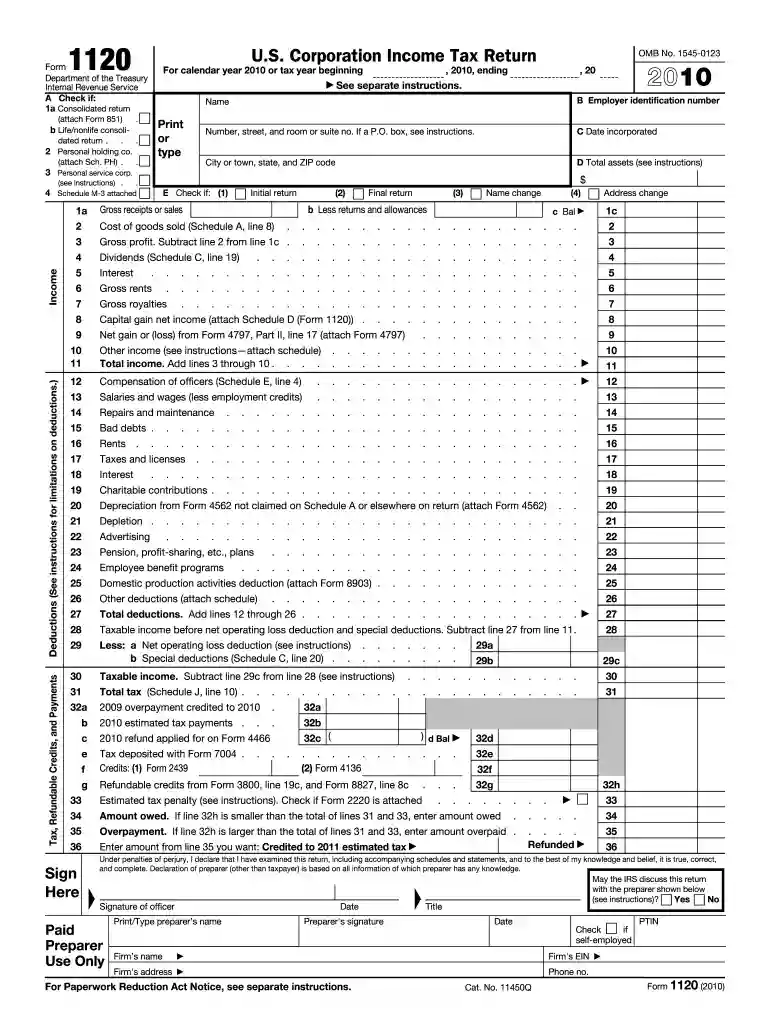
Type text, add images, blackout confidential details, add comments, highlights and more.

Draw your signature, type it, upload its image, or use your mobile device as a signature pad.

Send 2010 form 1120 via email, link, or fax. You can also download it, export it or print it out.
The 2010 Form 1120 is the U.S. Corporation Income Tax Return, which corporations use to report their income, deductions, and tax liabilities to the Internal Revenue Service (IRS) for the tax year 2010. This form is essential for ensuring accurate compliance with federal tax laws. It provides a comprehensive summary of the financial activities of a corporation and includes various sections like gross receipts, cost of goods sold, deductions, and taxable income. Understanding the specific components of this form is crucial for corporate accountants and tax preparers.
The Form 1120 includes several critical sections that need to be completed accurately:
Each of these elements requires precise calculation and proper documentation to ensure compliance and avoid penalties.
Filing the Form 1120 involves multiple steps:
Corporations must adhere to strict filing deadlines for the Form 1120 to avoid penalties. Generally, the form is due by the 15th day of the third month following the end of the corporation's tax year. For calendar-year corporations, this deadline typically falls on March 15th of the following year. It's important to note that if the deadline falls on a weekend or federal holiday, it shifts to the next business day.
The Form 1120 is primarily used by C corporations operating within the United States. This includes:
Understanding which entities are required to use Form 1120 is crucial for compliance.


To accurately complete the Form 1120, corporations need several supporting documents:
Ensuring all required documents are gathered before starting the form will facilitate a smoother filing process.
The Form 1120 serves several legal purposes within the IRS framework:
By fulfilling these legal requirements, corporations can avoid potential legal disputes with the IRS.
Failure to file the Form 1120 correctly or on time can result in substantial penalties:
Understanding and avoiding these penalties is critical for corporate financial health.
We've got more versions of the form 1120 2010 form. Select the right form 1120 2010 version from the list and start editing it straight away!
| Versions | Form popularity | Fillable & printable |
|---|---|---|
| 2025 | 4.4 Satisfied (37 Votes) | |
| 2024 | 4.6 Satisfied (32 Votes) | |
| 2023 | 4.2 Satisfied (33 Votes) | |
| 2022 | 4.8 Satisfied (59 Votes) | |
| 2021 | 4.8 Satisfied (80 Votes) | |
| 2020 | 4.3 Satisfied (37 Votes) | |
| 2019 | 4.4 Satisfied (228 Votes) | |
| 2018 | 4.3 Satisfied (133 Votes) | |
| 2017 | 4.3 Satisfied (98 Votes) | |
| 2016 | 4.4 Satisfied (267 Votes) | |
| 2015 | 4.3 Satisfied (34 Votes) | |
| 2014 | 4.2 Satisfied (35 Votes) | |
| 2014 | 4 Satisfied (59 Votes) | |
| 2013 | 4 Satisfied (42 Votes) | |
| 2013 | 4.8 Satisfied (25 Votes) |
At DocHub, your data security is our priority. We follow HIPAA, SOC2, GDPR, and other standards, so you can work on your documents with confidence.

Jan 31, 2012 If no date is specified, the. Notice 2010-13, 2010-4 I.R.B. 327 Include the Form 1120 computation with the worksheet computation you attach toRead more
Dec 1, 2011 Beginning January 1, 2011, settlement. Form 1120-SF, the paid preparers space spaces. If more space is needed on the.Read more
For Paperwork Reduction Act Notice, see separate instructions. Cat. No. 11450Q. Form 1120 (2010). Page 2. Form 1120 (2010). Page 2. Schedule A. Cost of GoodsRead more


