




01. Edit your fs3 malta online
Type text, add images, blackout confidential details, add comments, highlights and more.

Type text, add images, blackout confidential details, add comments, highlights and more.

Draw your signature, type it, upload its image, or use your mobile device as a signature pad.

Send fs3 form via email, link, or fax. You can also download it, export it or print it out.
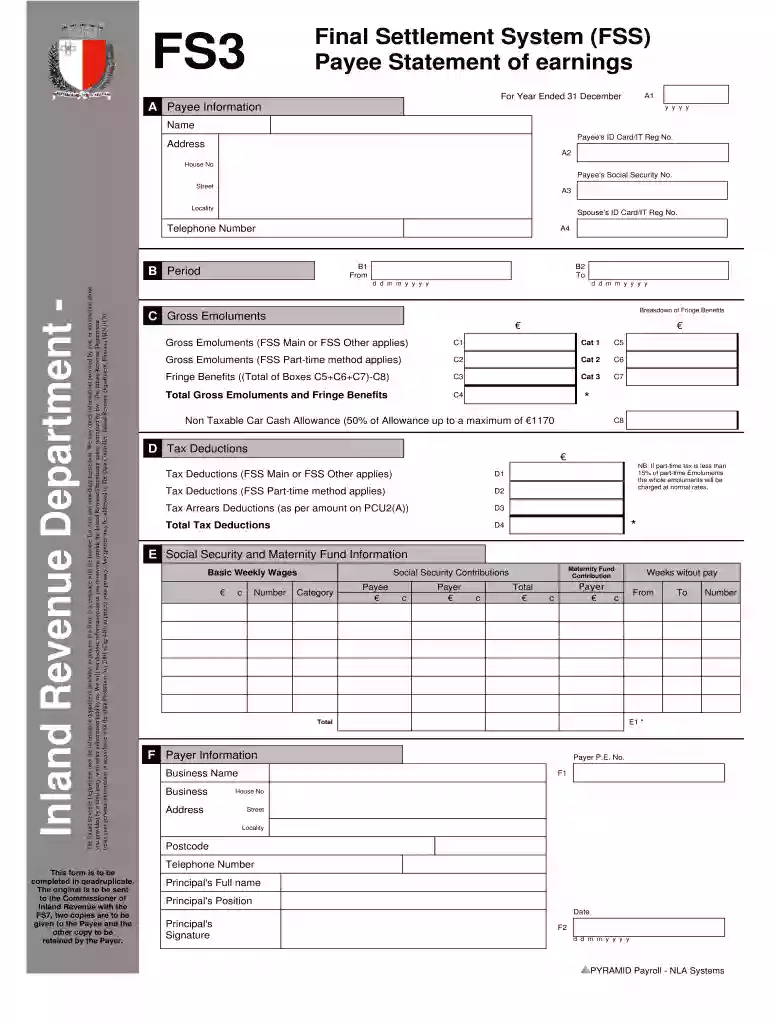
The final system FSS FS3 serves as a payee statement that captures detailed financial information regarding earnings for individuals in certain sectors. It is essential for accurately reflecting gross earnings, tax withholdings, social security contributions, and details about the payer. Entities such as employers and government bodies utilize the FSS FS3 to ensure compliance with tax regulations while providing essential documentation for both the payee and the tax authorities.
The form's primary function is to facilitate the reporting of earnings to the tax authorities, ensuring that individuals correctly disclose their income during tax filing. This compliance helps to mitigate discrepancies and reduces potential disputes regarding income reporting.
Completing the final system FSS FS3 involves specific steps that ensure all necessary information is accurately reported. To effectively fill out this form, follow these detailed steps:
Collect Required Information
Gather all relevant data beforehand, including your earnings statements, tax identification numbers, and relevant personal information.
Begin with Payee Information
Report Earnings
**Detail Deductions)
Payer Information
Review and Submit
When preparing to submit the final system FSS FS3, specific documents may be required to validate the information presented on the form. Key documents include:
The FSS FS3 form is legally recognized for use in reporting income and ensuring tax compliance. In accordance with tax regulations, entities must follow established guidelines when issuing this form:
Understanding practical scenarios can illustrate the significance of using the final system FSS FS3. Here are a couple of examples:
An Employee Scenario: An employee receives an annual salary from their employer. At year-end, the employer prepares the FSS FS3, detailing the employee's gross earnings, tax withholdings, and social security contributions to ensure tax compliance during their filing process.
Freelancer or Contractor Example: A freelancer who has received various payments throughout the year might utilize the FSS FS3 to report their cumulative earnings from multiple clients. This is essential when preparing their annual tax return, ensuring all income is accounted for and reported accurately.
Timely submission of the final system FSS FS3 is critical to avoid potential penalties. The key deadlines include:
The final system FSS FS3 is pivotal in documenting income and ensuring accurate tax reporting. Understanding its components, completion steps, and legal implications can significantly ease the process for individuals and businesses alike, fostering compliance and transparency in financial matters.
At DocHub, your data security is our priority. We follow HIPAA, SOC2, GDPR, and other standards, so you can work on your documents with confidence.
The following table summarizes the calculated effective FSs for end-use conditions with the acceptance limit, as provided by the licensee in Enclosure 1 toRead more
Scepter Rigid PVC conduit pipe and fittings are nonsparking and nonconducting, thereby eliminating the most dangerous second point of contact and phase toRead more
by AT Lesage 2012 Cited by 2 This research seeks to identify cold pools in surface observations retrieved from the Oklahoma Mesonet. First, however, it is necessary to define a convectiveRead more


