




01. Edit your interview appraisal sheet rev 4 2024 online
Type text, add images, blackout confidential details, add comments, highlights and more.

Type text, add images, blackout confidential details, add comments, highlights and more.

Draw your signature, type it, upload its image, or use your mobile device as a signature pad.

Send navcruit 1131 5 rev 4 2024 via email, link, or fax. You can also download it, export it or print it out.
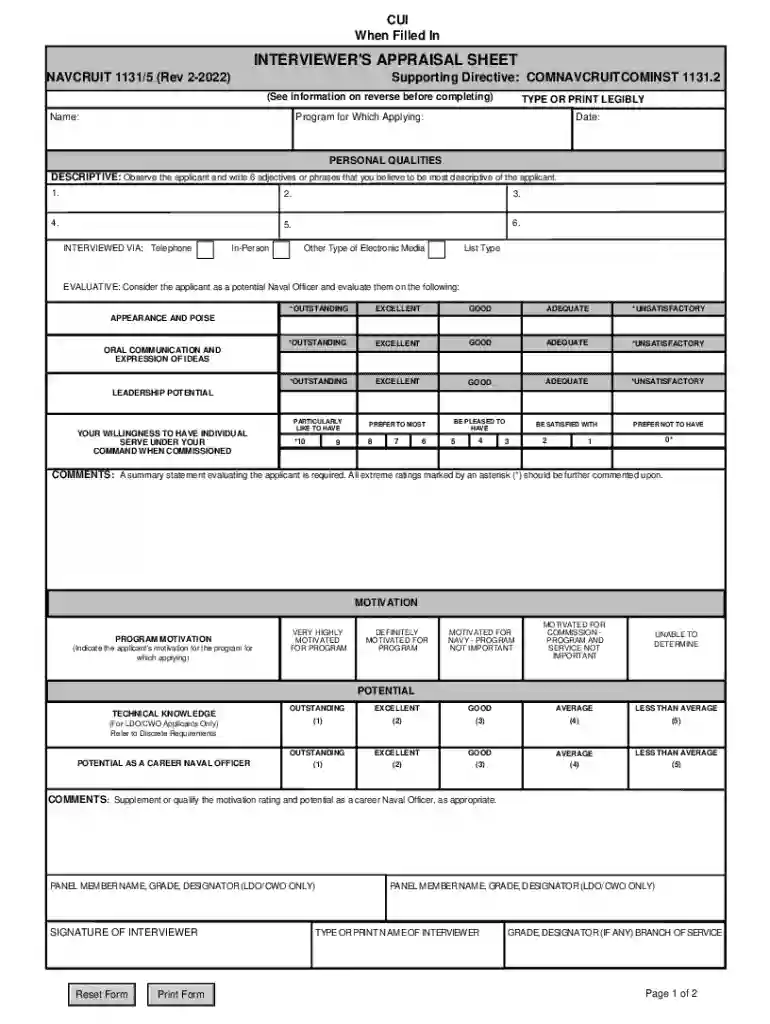
The Interviewer's Appraisal Sheet, specifically NAVCRUIT 1131/5, is a standardized form used in evaluating candidates applying for a naval officer position. This document plays a crucial role in assessing various attributes of candidates, such as communication skills, leadership potential, and personal qualities. By systematically organizing these evaluations, the form aids in delivering a fair and thorough review of an applicant's qualifications and motivations for serving in the Navy. This sheet ensures a structured approach to interviewing, emphasizing the importance of impartiality and detail in the candidate assessment process.
The Interviewer's Appraisal Sheet comprises several critical sections designed to capture essential information about a candidate. Major elements include:
These sections form the backbone of the appraisal process, guiding interviewers in documenting and scoring an applicant's competencies accurately.
Utilizing the Interviewer's Appraisal Sheet involves several methodical steps to ensure a comprehensive evaluation. These steps include:
Attention to detail and adherence to form guidelines are critical for ensuring accurate and impartial appraisals.
The Interviewer's Appraisal Sheet is primarily used by naval recruitment officers and interview panels responsible for evaluating candidates for officer positions. These individuals leverage the form to maintain a standardized evaluation process. This consistency is important not only for assessing individual candidates but also for comparing them against others in the recruitment pool.
Knowing who uses the form highlights its importance in structured recruitment processes within military contexts.


Completing the Interviewer's Appraisal Sheet requires following specific procedures to ensure accuracy:
Meticulous attention to detail in each step is essential to ensure a valuable, bias-free appraisal.
Real-world scenarios demonstrate the application's utility in naval recruitment:
These examples illustrate how the sheet supports nuanced candidate assessments leading to informed decision-making.
The Interviewer's Appraisal Sheet serves the dual purpose of compliance and defensibility in recruitment decisions:
The sheet’s design supports fair recruitment processes, safeguarding both the interviewers and candidates by underpinning decisions with documented evidence.
The Interviewer's Appraisal Sheet exists in both digital and paper formats, each offering distinct advantages:
Choosing between formats depends on the interview context, infrastructure availability, and recruitment needs. Both formats maintain the core function of generating consistent, unbiased recruitment assessments.
We've got more versions of the interview appraisal sheet rev 4 2024 form. Select the right interview appraisal sheet rev 4 2024 version from the list and start editing it straight away!
At DocHub, your data security is our priority. We follow HIPAA, SOC2, GDPR, and other standards, so you can work on your documents with confidence.
Apr 30, 2008 Interview Verification Form; NAVCRUIT 1131/5, Interviewers Appraisal Sheet; Applicant checklists. To determine applicants qualifications for
During this online interview, we gathered a large amount of information. The participants demonstrated a high awareness of food safety, with many having heardRead more
The interviewer should complete interview evaluation forms to assess each candidates overall qualifications. Rating Scale: 5 = Exceptional; 4 = Above Average;


