Enforce, Change, End Contact After Adoption Agreement 2026

Get Form
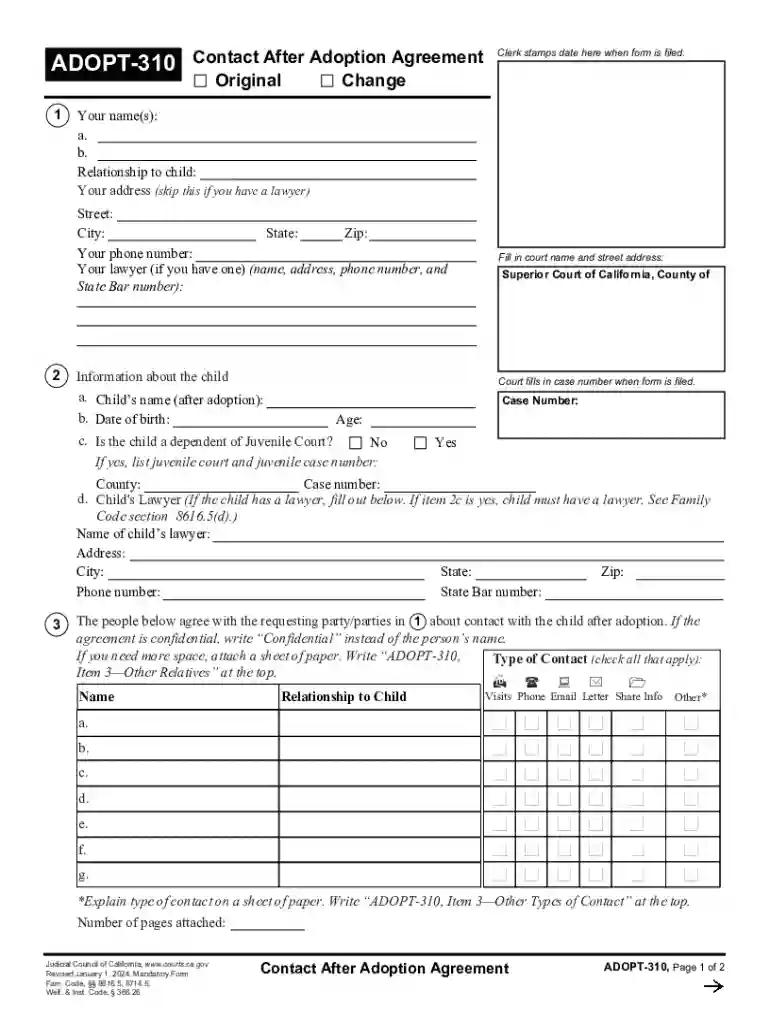
Enforce, Change, End Contact After Adoption Agreement Preview on Page 1

Here's how it works

01. Edit your form online
Type text, add images, blackout confidential details, add comments, highlights and more.

02. Sign it in a few clicks
Draw your signature, type it, upload its image, or use your mobile device as a signature pad.

03. Share your form with others
Send it via email, link, or fax. You can also download it, export it or print it out.

How to use or fill out Enforce, Change, End Contact After Adoption Agreement

Form edit decoration
9.5
Ease of Setup
DocHub User Ratings on G2
9.0
Ease of Use
DocHub User Ratings on G2
  1. Click ‘Get Form’ to open it in the editor.
  2. Begin by entering your name(s) and relationship to the child in the designated fields. If you have a lawyer, include their details as well.
  3. Provide information about the child, including their name after adoption and date of birth. If applicable, indicate if the child is a dependent of Juvenile Court and fill in the court's name and address.
  4. List any other relatives who agree with the contact terms. Specify the type of contact (visits, phone calls, etc.) for each individual listed.
  5. If there is a signed agreement regarding contact after adoption, attach a copy as instructed.
  6. Ensure all parties involved sign and date the form. If additional signatures are needed, attach a separate sheet as specified.

Start using our platform today to easily complete your Enforce, Change, End Contact After Adoption Agreement for free!

See more Enforce, Change, End Contact After Adoption Agreement versions

We've got more versions of the Enforce, Change, End Contact After Adoption Agreement form. Select the right Enforce, Change, End Contact After Adoption Agreement version from the list and start editing it straight away!
Versions Form popularity Fillable & printable
2024 4.9 Satisfied (35 Votes)
2018 4.8 Satisfied (80 Votes)
2003 4.4 Satisfied (260 Votes)
be ready to get more

Complete this form in 5 minutes or less

Get form

Got questions?

We have answers to the most popular questions from our customers. If you can't find an answer to your question, please contact us.
Contact us
Some of the less adoption-friendly states include California, Maine, Maryland, Ohio and Rhode Island. However, it is absolutely still possible to adopt in these states, and there are many local and national adoption professionals who can assist families in navigating the process and their states laws.
Once an adoption is finalized, the birth parents generally cannot reclaim their parental rights or take the child back. The legal process of adoption permanently transfers parental rights from the birth parents to the adoptive parents.
Unfortunately, this trust can be broken through adoption agency negligencea serious legal issue that can have devastating consequences for families and may warrant an adoption negligence lawsuit.
What is also unethical is that a child is expected to exchange his/her true identity and ancestry, and that of his/her descendents (in perpetuity), for a safe, nurturing environment with no guarantee that it will be provided. The child does not negotiate or consent to the transaction but is legally bound by it.
If you have a concern about the operations of an accredited or approved ASP, or its supervised providers in the United States or abroad, please begin by bringing the matter directly to the ASP. If that is not appropriate or not successful, we encourage you to file that concern with the Complaint Registry.

Security and compliance

At DocHub, your data security is our priority. We follow HIPAA, SOC2, GDPR, and other standards, so you can work on your documents with confidence.

Learn more
ccpa2
pci-dss
gdpr-compliance
hipaa
soc-compliance

People also ask

Adoption rules change based on the state you are in. Approximately 25 states (plus the District of Columbia) have laws that make contact agreements between birth parents and adoptive parents enforceable as long as the court agrees that the agreement is in the childs best interest.
It can occur at any part of the adoption process until the prospective birth mother signs their legal consent. A failed adoption can happen for various reasons, such as: An expectant parent chooses parenting, another family or another agency. Inadequate birth parent counseling.
Typically, the plaintiffs, adoptive parents, claim that they were wronged by agencies which failed to provide them with their childs full background information; that in doing so, the agency deprived them of the opportunity to make an informed decision as to whether to proceed with the adoption; and they were harmed

Related links