






Definition & Meaning
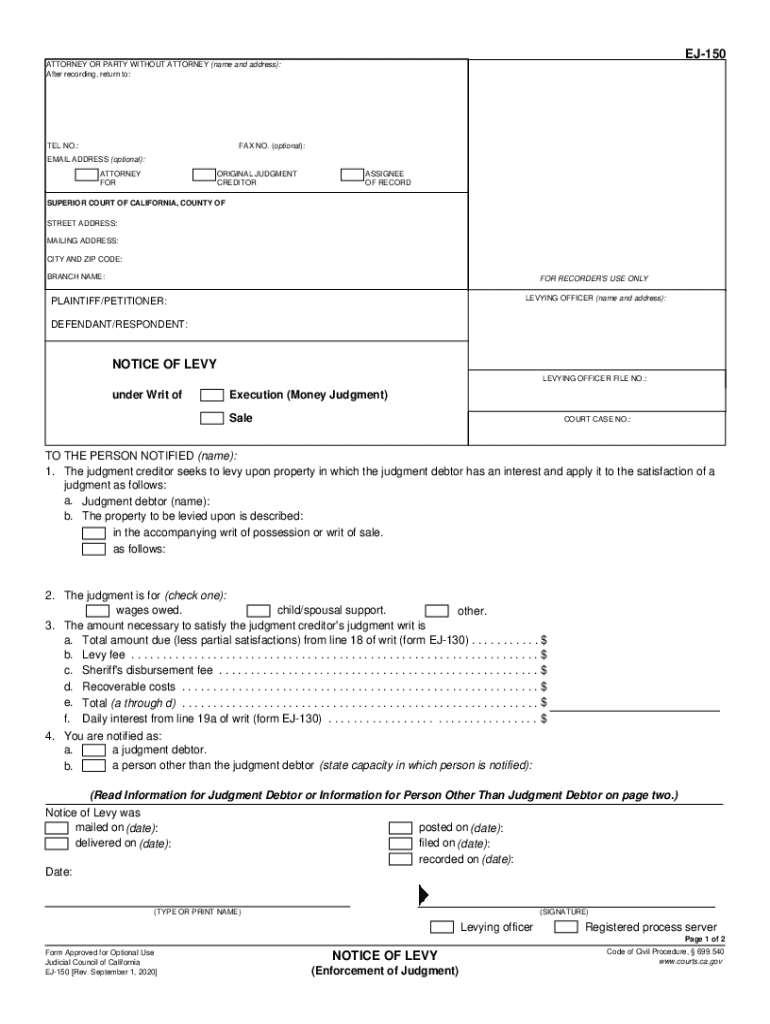
The enforcement of a judgment levy on personal property, such as a bank account, refers to the legal process by which a creditor seeks to satisfy a money judgment by levying against the personal property of the debtor. This usually involves the Superior Court of California issuing a Notice of Levy, like the EJ-150, to inform the debtor or a third party of the actions being taken to enforce the judgment. The primary objective is to legally seize funds or assets held in bank accounts to fulfill the debt owed under the judgment.
How to Use the Enforcement of Judgment Levy on Personal Property
To use an enforcement of judgment levy, you must follow a structured legal process that involves:
- Obtaining a writ of execution: This court order directs the sheriff or another levying officer to enforce the judgment.
- Submitting the Notice of Levy: Provide the notice to the debtor and relevant financial institutions, making them aware of the levy.
- Coordinating with a levying officer: Work closely with the officer who will serve the documents and oversee the levy process.
This process ensures the legal collection of debts through seizure of funds from the debtor’s bank accounts or other personal property.
Steps to Complete the Enforcement of Judgment Levy
- Secure a writ of execution from the court: Confirm the judgment and request this specific court document.
- Prepare the Notice of Levy: Complete the form that will notify involved parties of the levy and its implications.
- Serve the documents: Work with a levying officer to serve the writ of execution and Notice of Levy to the debtor and financial institutions.
- Follow up with institutions: Once served, communicate with banks to ensure the appropriate amount is retained to satisfy the judgment.
- Receive the collected funds: After the legal retention period, banks will remit the collected funds as directed by the court’s order.
Legal Use of the Enforcement of Judgment Levy
The enforcement is grounded in legal statutes which grant creditors the right to satisfy judgments by seizing assets. It ensures that creditors receive payment by leveraging the debtor's personal property, usually in a bank. The process requires strict adherence to state procedures and timelines to maintain legality and avoid challenges from debtors.
Important Terms Related to Enforcement of Judgment Levy
- Judgment Creditor: The party in a legal proceeding who has won a financial judgment.
- Judgment Debtor: The party who owes the debt as ruled in the court judgment.
- Writ of Execution: The court order authorizing enforcement actions.
- Levying Officer: Typically a sheriff or marshal who facilitates the levy process.
- Notice of Levy: Document alerting parties to the enforcement action on property.
State-Specific Rules for Enforcement
While the federal guidelines provide a basic framework, each state may have specific rules regarding how a judgment levy can be enforced. For example, California law specifies procedures for serving documentation and timelines for responding to a levy. Always consult with a local attorney to ensure compliance with regional differences.
Examples of Using the Enforcement of Judgment Levy
- Business Debt Recovery: A retail supplier enforces a judgment to collect unpaid invoices from a client’s bank account.
- Personal Loan Collection: A bank uses the process to recover a defaulted personal loan from a borrower’s checking account.
Required Documents
- Writ of Execution: Authorizes the start of levy actions.
- Notice of Levy (EJ-150): Notifies the debtor and third parties about the levy.
- Supporting Affidavit: Details the creditor’s claims and the judgment amount.
- Proof of Service Forms: Demonstrates the proper delivery of notices to relevant parties.
Filing Deadlines / Important Dates
- Seven-Day Notice Rule: The debtor often has seven days to respond to the levy notice.
- Return Dates: Defined by the court, specifying when collected funds should be remitted to the creditor.
These deadlines are crucial to ensure timely execution and legal compliance throughout the enforcement process.