




Definition & Meaning
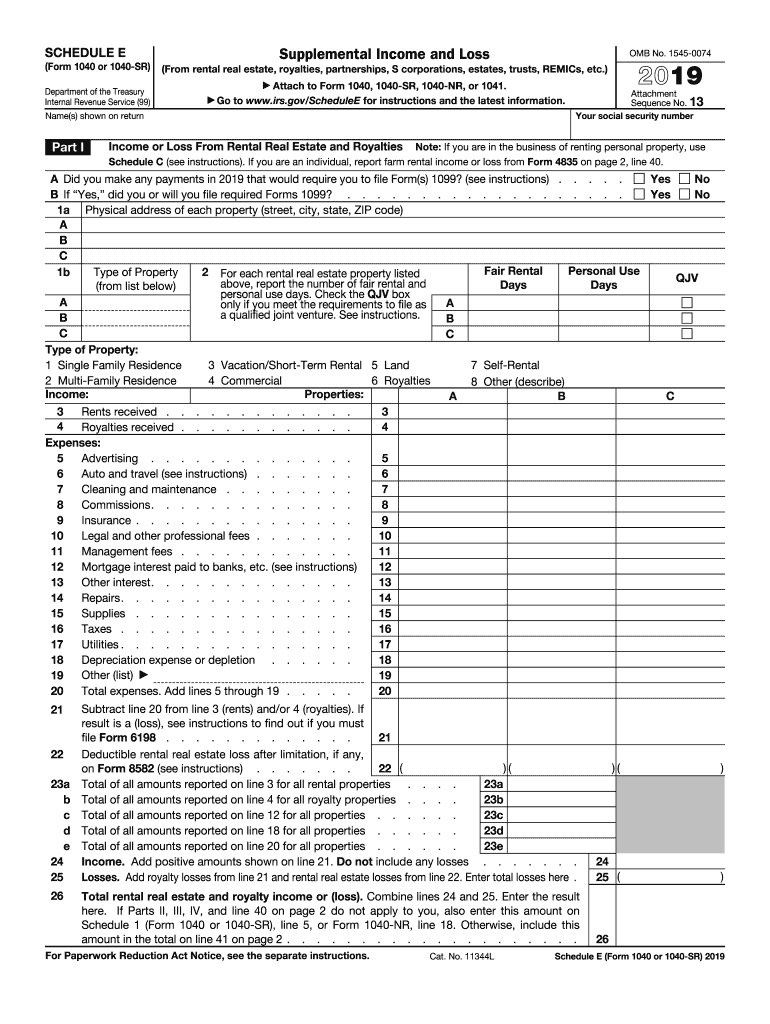
Schedule E (Form 1040 or 1040-SR) is a crucial document used to report supplemental income and loss from various sources such as rental real estate, royalties, partnerships, and S corporations. For the tax year 2019, it provides individuals with a means to detail their income, expenses, and losses associated with these activities. This form is not just about recording transactions; it requires detailed information about each income source, ensuring every financial movement is accurately captured for tax purposes.
Key Functions
- Rental Real Estate: If you own rental properties, Schedule E allows you to report income received from tenants, as well as deductible expenses such as maintenance and repairs.
- Royalties: Earnings from intellectual properties like books, music, or patents fall under this category.
- Partnerships and Corporations: For those involved in partnerships or S corporations, this form captures your share of income or loss.
Steps to Complete the Schedule E 2019
Completing Schedule E requires a systematic approach to ensure accuracy and compliance with IRS requirements.
- Gather Necessary Documents: Before starting, collect all relevant documents, such as rental income statements, partnership K-1s, and records of royalty payments.
- Enter Personal Information: Begin by filling in the taxpayer's name and Social Security number at the top of the form.
- Report Income and Expenses: For each income source, detail the associated earnings and allowable expenses. This includes depreciation, taxes, insurance, and other operational costs.
- Calculate Totals: Sum up income and expenses to determine net income or loss.
- Transfer Totals: The final amounts calculated need to be transferred to Form 1040 or 1040-SR.
Detailed Breakdown
- Rental Properties: Include income, operating costs, and depreciation.
- Partnership Income: Reflect your share as reported on Schedule K-1.
- Royalty Details: Specify the type and source of royalties.
How to Obtain the Schedule E 2019
Accessing Schedule E (2019) can be done through various methods, ensuring taxpayers can secure the form in a way that suits their needs.
Available Sources
- IRS Website: Download a printable PDF from the official IRS website, ensuring you have the latest version.
- Tax Software: Many tax preparation programs, like TurboTax, include Schedule E as part of their package.
- Tax Advisors: Certified public accountants or tax advisors can provide the form if you're working with them for tax preparation.
Important Terms Related to Schedule E 2019
Understanding terminologies associated with Schedule E is fundamental for accurate filing.
Key Terminologies
- Depreciation: Allocation of cost of tangible assets over its useful life.
- Schedule K-1: A form used to report income, deductions, and credits from partnerships and S corporations.
- Passive Income: Earnings derived from rental property, limited partnerships, or other enterprises in which a person is not actively involved.
IRS Guidelines
The IRS provides specific instructions for the completion and submission of Schedule E to ensure compliance.
Compliance Requirements
- Accuracy: Ensure entries are precise to prevent errors that may lead to penalties.
- Documentation: Maintain comprehensive records to support claims made on the form.
- Timeliness: Submit the form with your annual tax returns to avoid late penalties.
Filing Deadlines / Important Dates
Being aware of critical dates associated with Schedule E ensures timely submission and prevents penalties.
Key Deadlines
- Filing Date: Typically, Schedule E must be submitted by April 15 of the following tax year along with Form 1040.
- Extensions: If an extension is applied for, the deadline usually extends to October 15.
Software Compatibility
Utilizing software for filing taxes can streamline the process.
Recommended Software
- TurboTax and QuickBooks: These applications support Schedule E integration, enabling seamless import of data.
- Customization Options: Each software offers different features, such as tracking income and expenses, making the tax preparation process more efficient.
Taxpayer Scenarios: Unique Cases
Different taxpayer categories may have specific considerations when using Schedule E.

Scenarios
- Self-Employed: Tracking rental income alongside business income needs careful management.
- Retirees: Passive income streams could form a primary source of revenue, necessitating detailed reporting.
- Students with Investments: Young taxpayers with royalties or small-scale real estate must navigate unique tax thresholds.
Understanding these distinct cases promotes accurate and compliant tax filings, fitting various individual circumstances.
This structure emphasizes the comprehensive and detailed nature of the Schedule E (2019) form while ensuring readers get the maximum possible information pertinent to their circumstances.