
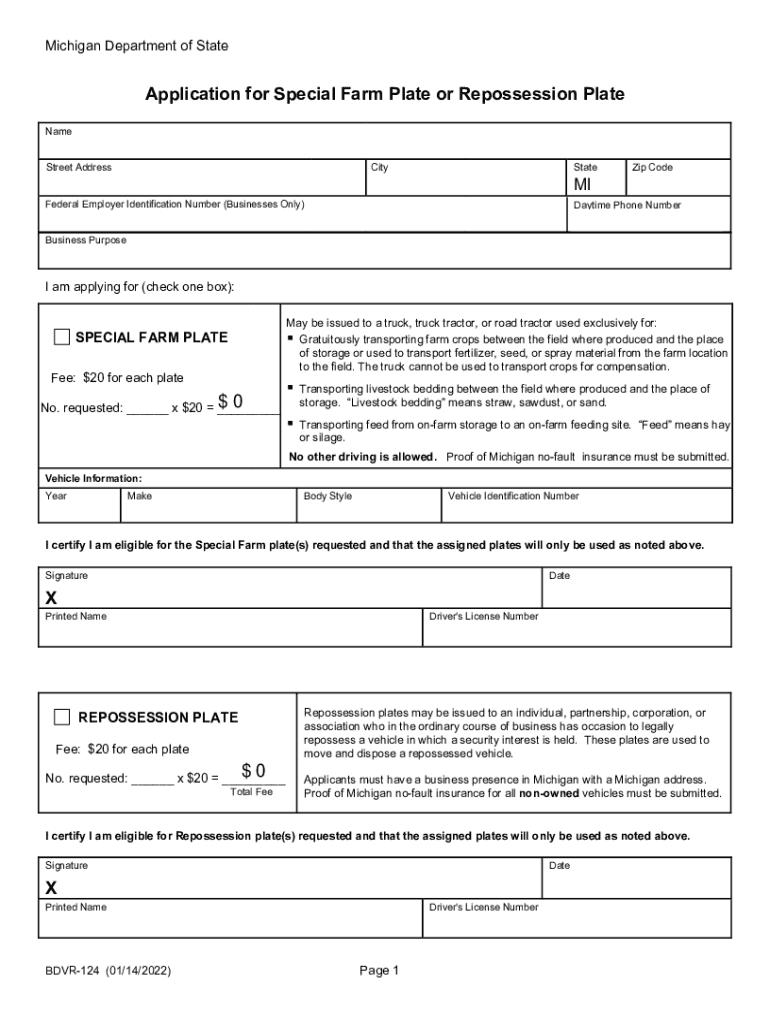







Definition & Meaning of the Application for Repossession, In-transit Repair, or Special
The "Application for Repossession, In-transit Repair, or Special" form is a legal document provided by the Michigan Department of State. This form is utilized by businesses or individuals seeking to obtain specific types of vehicle plates—namely, Repossession Plates, In-transit Repair Plates, and Special Farm Plates. Each plate type serves a unique purpose and comes with a set of eligibility criteria and restrictions. Repossession Plates are used by financial institutions and recovery agents to legally repossess vehicles, while In-transit Repair Plates are intended for the movement of vehicles needing repair. Special Farm Plates are allocated to vehicles involved in agricultural activities within the state. These plates ensure that vehicles used for these purposes are registered correctly, adhere to state regulations, and fulfill the legal requirements of their operation.
How to Use the Application for Repossession, In-transit Repair, or Special
To successfully use the application form, an applicant must first determine the type of plate they require based on their business needs or personal circumstances.
-
Identify Plate Type:
- Repossession Plates: Needed for entities engaged in vehicle repossession.
- In-transit Repair Plates: Suitable for businesses that transport vehicles for repair services.
- Special Farm Plates: For vehicles primarily used in farming operations.
-
Comply with Eligibility: Ensure that you meet the eligibility requirements for the desired plate type, which include providing personal or business credentials and proof of necessity for the plate.
-
Complete the Form: Accurately fill in all required fields in the application, ensuring every section related to personal, business, and vehicle information is correctly completed.
-
Attach Necessary Documentation: Provide supporting documents such as proof of insurance, business registration, and any specific certifications relevant to the type of plate being requested.
-
Submit the Application: The completed application, along with all required documents, should be submitted to the Michigan Department of State via their specified submission methods.
How to Obtain the Application for Repossession, In-transit Repair, or Special
To obtain the application form, interested parties can access it through the Michigan Department of State’s official website or by visiting a local Department of State branch office.
- Online Download: The form is available for download in PDF format, allowing applicants to print and fill it out at their convenience.
- In-Person Collection: Individuals can collect a physical copy of the form by visiting a branch office, where staff can also offer assistance with any queries related to the form.
Steps to Complete the Application for Repossession, In-transit Repair, or Special
The following sequence outlines the step-by-step process for completing the form:
-
Section A - Applicant Information: Fill in your full legal name, contact details, business information (if applicable), and any relevant identification numbers.
-
Section B - Plate Type Selection: Indicate the type of plate you are applying for by checking the appropriate box.
-
Section C - Vehicle Information: Provide details about the vehicle(s) such as make, model, year, VIN, and registration status.
-
Section D - Insurance Details: Include your Michigan no-fault insurance policy number and attach a copy of the insurance certificate.
-
Section E - Certification: Sign and date the application, certifying that all information provided is accurate to the best of your knowledge.
-
Section F - Additional Documentation: Ensure all required attachments are included, such as business licenses, proof of eligibilities like farming activities, and any other specified documentation.
Why Should You Use the Application for Repossession, In-transit Repair, or Special
Utilizing this application form is essential for legal compliance and efficient operation within the jurisdictions of repossession, vehicle repair transportation, and farm-related vehicular operations.
- Legal Compliance: Ensures adherence to Michigan state laws regulating vehicle operations in these specialized areas.
- Operational Efficiency: Streamlines the process of acquiring the necessary permits, reducing paperwork, and avoiding potential penalties for illegal use.
- Risk Management: Significantly lowers the risk of fines or legal issues by ensuring that vehicles used for repossession, repair, or farm use are properly registered.
Who Typically Uses the Application for Repossession, In-transit Repair, or Special
This form is used by a variety of entities:
- Repossession Agencies: Business owners and agents involved in asset recovery utilize these forms to secure legal plates ensuring they operate within the bounds of the law during repossessions.
- Automotive Repair Shops: Workshops and transportation services in need of In-transit Repair Plates are regular users, as these plates are crucial for moving vehicles from one location to another for repair tasks.
- Farm Owners: Individuals in the agricultural sector apply for Special Farm Plates for vehicles that are primarily part of their farming operations.


Key Elements of the Application for Repossession, In-transit Repair, or Special
Each section of the application is critical in determining both eligibility and compliance.
- Applicant Information: Ensures that the right individual or business entity is applying.
- Vehicle Information: Verifies that the vehicles in question meet state requirements for the specified plate use.
- Insurance Details: Validates that the applicant has the necessary insurance coverage.
- Certification: Provides a legal agreement to the accuracy of the form content and eligibility assertions.
Eligibility Criteria for the Application for Repossession, In-transit Repair, or Special
To qualify for any of the plates offered through this application, applicants must meet specific criteria depending on the plate type:
- Repossession Plates: Must be a licensed repossession service or agent; provide relevant documentation of this status.
- In-transit Repair Plates: Suitable for businesses that deal with vehicle repairs or corrections and need to move vehicles between sites.
- Special Farm Plates: Reserved for vehicles that support farm activities, requiring proof of engagement in agricultural operations.

Legal Use of the Application for Repossession, In-transit Repair, or Special
Each vehicle utilizing these specialized plates must abide by specific usage restrictions set forth by state laws.
- Repossession Plates: Authorize legal possession and transportation of repossessed vehicles.
- In-transit Repair Plates: Allow for lawful transportation of vehicles for repairs between service locations.
- Special Farm Plates: Permit vehicles primarily engaged in agriculture to operate under regulations distinct from regular commercial vehicles.
Understanding these distinct criteria and legal protocols is essential for ensuring lawful operation within these vehicular categories and for avoiding non-compliance penalties or operational disruptions.




