







Definition & Meaning
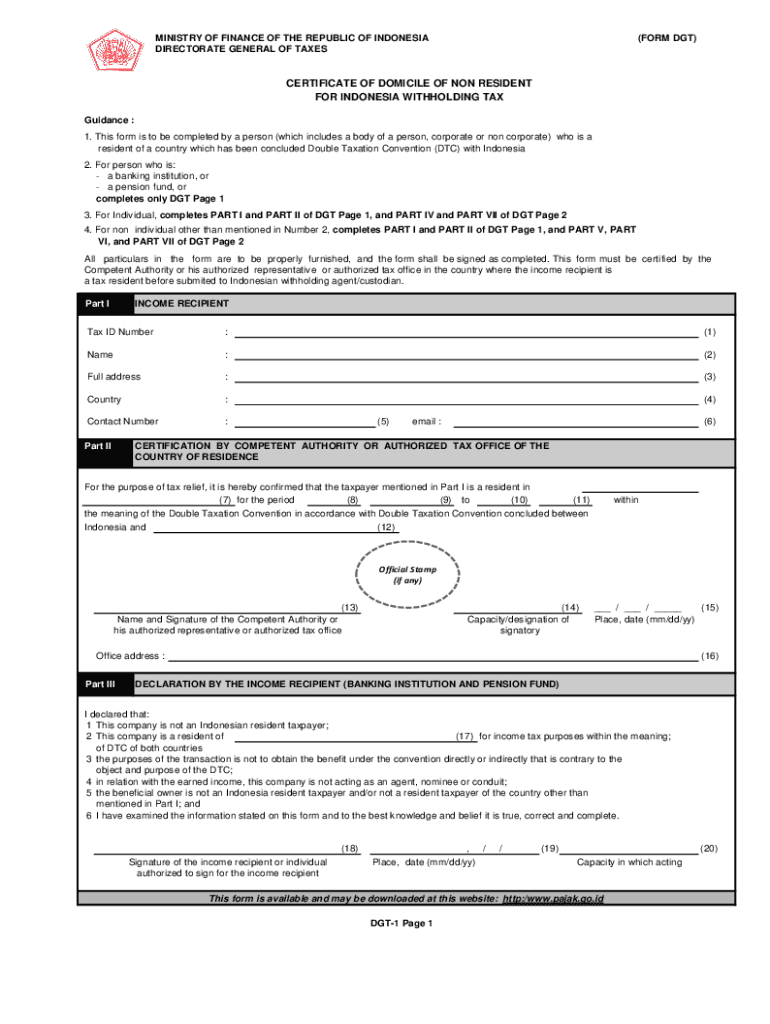
The Certificate of Domicile of Non Resident for Indonesia Tax is a formal document issued to non-resident individuals or entities who seek to benefit from withholding tax relief under the Double Taxation Convention (DTC) with Indonesia. This certificate confirms the domicile status of the taxpayer and is essential for ensuring that income sourced from Indonesia is taxed appropriately according to the tax treaty between Indonesia and the taxpayer's country of residence. By obtaining this certificate, non-residents can avoid being taxed twice on the same income.
How to Obtain the Certificate of Domicile
To obtain the Certificate of Domicile for non-residents, applicants must follow a specific process with several key steps:
-
Identify the Competent Authority: The certificate must be certified by the competent authority in the applicant's country of residence. This authority is typically the national tax agency or an equivalent governmental body responsible for international taxation matters.
-
Complete the Application Form: Fill out the application form with accurate details. This includes personal information for individuals or, if applicable, entity details for businesses.
-
Provide Necessary Documentation: Submit supporting documents such as a tax residency certificate from the home country, proof of income derived from Indonesia, and any other required certifications.
-
Submit the Application: Depending on the specific requirements and procedures of the competent authority, applications can be submitted online, via mail, or in person.
The approval time can vary depending on the specific processes of both the Indonesian tax office and the applicant's local authority.
Steps to Complete the Certificate of Domicile
Completing the Certificate of Domicile involves detailed steps to ensure accuracy and compliance:
-
Gather Required Information: Collect all necessary information, including taxpayer identification numbers, the nature of income received from Indonesia, and the type of relief being claimed under the DTC.
-
Fill in Personal or Entity Details: Enter the full legal name, address, and tax identification details on the form. Specify whether the applicant is an individual or an entity.
-
Income Declaration: Specify the type of income subject to tax in Indonesia, such as royalties, dividends, or other taxable income streams.
-
Get Certification from Competent Authority: Submit the completed form to the tax authority in the applicant’s country of residence for official certification.
-
Provide Additional Signatures: Ensure all required parties sign the document, including any representatives or agents if applicable.
Key Elements of the Certificate of Domicile
The Certificate of Domicile includes several key elements that are crucial for its validity:
- Applicant Information: Clear identification details including name, address, and tax identification number.
- Income Source: Detailed breakdown of income sources, specifying the type and origin of the income received from Indonesia.
- Competent Authority Certification: Official endorsement from the authority designated in the taxpayer’s home country, signifying the applicant’s domicile status.
- Declaration Section: A declaration signed by the income recipient affirming the correctness and completeness of the information provided.
Legal Use of the Certificate of Domicile
Using the Certificate of Domicile correctly ensures compliance with international tax laws under the DTC:
- Tax Relief Eligibility: It serves as proof to Indonesian tax authorities that the taxpayer is eligible for tax relief benefits in accordance with the treaty.
- Avoidance of Double Taxation: Facilitates the process of avoiding double taxation on income earned in Indonesia by non-residents.
- Reducing Withholding Tax Rates: Allows for reduced withholding tax rates on specific income types, such as dividends and interest, when conditions are met.
Who Typically Uses the Certificate of Domicile?
The Certificate of Domicile is commonly used by:
- Multinational Corporations: Business entities with cross-border transactions involving Indonesian income streams.
- Foreign Investors: Individuals or corporations investing in Indonesian assets or securities.
- International Freelancers: Non-resident individuals providing services to Indonesian clients.

Form Submission Methods
Applicants can generally submit the Certificate of Domicile through various methods:
- Online Platforms: Many jurisdictions offer electronic submission options through designated governmental web portals.
- Mail Services: Physical forms can be mailed to the appropriate authority if online submission is not available or preferred.
- In-Person Submission: Some authorities allow or require in-person submission at designated offices.
Important Terms Related to the Certificate of Domicile
Understanding key terms related to the Certificate of Domicile is vital:
- Double Taxation Convention (DTC): A treaty designed to prevent income from being taxed twice in two different jurisdictions.
- Withholding Tax: A tax retained at source on income paid to a non-resident.
- Competent Authority: The official government agency that certifies the residency status for tax purposes.
By focusing on these topics, individuals and businesses can effectively navigate the process of obtaining and utilizing the Certificate of Domicile to optimize their tax position under international tax agreements.




