




01. Edit your form online
Type text, add images, blackout confidential details, add comments, highlights and more.

Type text, add images, blackout confidential details, add comments, highlights and more.

Draw your signature, type it, upload its image, or use your mobile device as a signature pad.

Send it via email, link, or fax. You can also download it, export it or print it out.
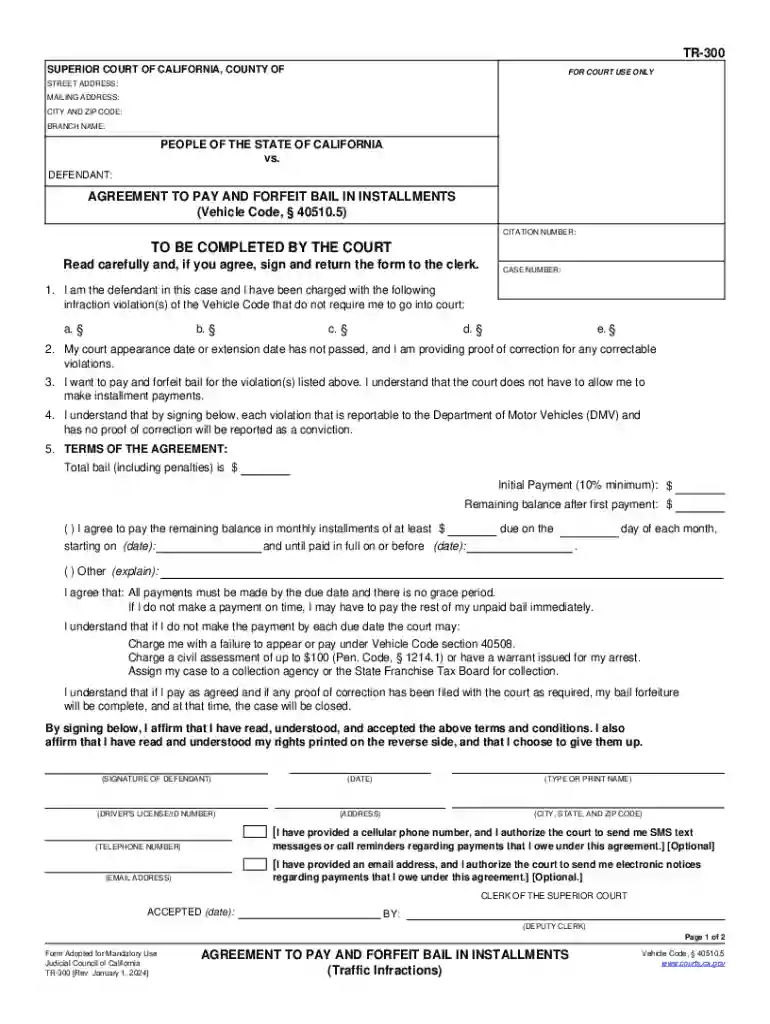
The TR-300 Agreement to Pay and Forfeit Bail in Installments is a California-specific legal document used by defendants who wish to arrange payment of bail through installments instead of a lump sum. This option applies to traffic infractions, as specified under California Vehicle Code § 40510.5. By choosing this agreement, defendants acknowledge their infraction and agree to forfeit their bail, thus waiving certain rights to contest the charge further in court.
Initial Payment and Installments: The agreement outlines the structure for the initial payment followed by subsequent installments. Defendants need to understand the payment schedule and ensure they can meet each deadline to avoid additional penalties.
Waiver of Rights: By signing the TR-300, defendants waive their rights to a trial and any other court proceedings related to the infraction. It is a binding agreement acknowledging the infraction and committing to the payment terms.
Consequences of Non-Payment: Missing a payment can lead to additional charges, the full amount becoming immediately due, or even an arrest warrant. The agreement specifies these consequences to ensure defendants are fully aware before signing.
Modification Provisions: The document allows for potential modifications to the payment plan if the defendant's financial circumstances change. This provides flexibility for those facing unexpected financial difficulties.
Review the Infraction Details: Ensure you understand the nature of the infraction and that you adhere to California's Vehicle Code § 40510.5.
Provide Personal Information: Accurately fill out your name, address, and contact information on the form. Incomplete or incorrect entries can delay processing.
Acknowledge Payment Obligations: Clearly comprehend and accept the payment terms, including amounts, scheduling, and methods of payment.
Affix Signature: Sign the document as evidence of your agreement. Ensure all details are true to the best of your knowledge.
Submit the Form: File the completed TR-300 with the appropriate court. The submission guidelines specify whether it should be done in person, by mail, or electronically.
The TR-300 serves a legal function by offering defendants an alternative to lump-sum bail payments. Legally binding, the form obligates defendants to the conditions outlined, including forfeiture of trial rights. It is specific to traffic infractions within California, ensuring compliance with local legal frameworks.
This form is primarily used by individuals in California who have committed a traffic infraction and prefer not to, or cannot, pay the bail amount all at once. It benefits those facing minor violations who want to manage their financial obligations more effectively.


A driver receives a ticket for not stopping completely at a stop sign. Unable to pay the bail fully, the driver opts to complete a TR-300, agreeing on a feasible payment plan that fits their monthly budget, allowing them to avoid immediate financial strain.
Regular commuters facing minor speeding fines frequently use the agreement to maintain financial liquidity while managing their obligations over a longer period.
These examples illustrate the practical application of the agreement, demonstrating its utility for everyday individuals managing routine traffic violations.
The TR-300 can be obtained through the court handling your traffic infraction case. Depending on the location, it might be available online through the court's website or physically at the court’s clerk office. Defendants are encouraged to verify the specific process with their assigned court.
Understanding these terms is crucial for properly navigating the agreement and ensuring compliance with the terms set forth by the court.
Since the TR-300 is applicable only in California, it aligns strictly with the state's Vehicle Code § 40510.5, and it is not transferable or applicable to infractions outside this jurisdiction. Defendants in other states need to reference their local regulations and equivalents of this form.
We've got more versions of the TR-300 AGREEMENT TO PAY AND FORFEIT BAIL IN INSTALLMENTS form. Select the right TR-300 AGREEMENT TO PAY AND FORFEIT BAIL IN INSTALLMENTS version from the list and start editing it straight away!
At DocHub, your data security is our priority. We follow HIPAA, SOC2, GDPR, and other standards, so you can work on your documents with confidence.
Jan 1, 2024 ( ) I agree to pay the remaining balance in monthly installments of at least $ due on the day of each month, starting on (date): and until paidRead more
by TJ MONESTIER Cited by 3 In Part III, I analyze clauses that require a buyer to forfeit his deposit in contracts to purchase real estate as a form of liquidated damages.


