




01. Edit your 2023 schedule 1 pdf online
Type text, add images, blackout confidential details, add comments, highlights and more.

Type text, add images, blackout confidential details, add comments, highlights and more.

Draw your signature, type it, upload its image, or use your mobile device as a signature pad.

Send 2023 schedule 1 via email, link, or fax. You can also download it, export it or print it out.
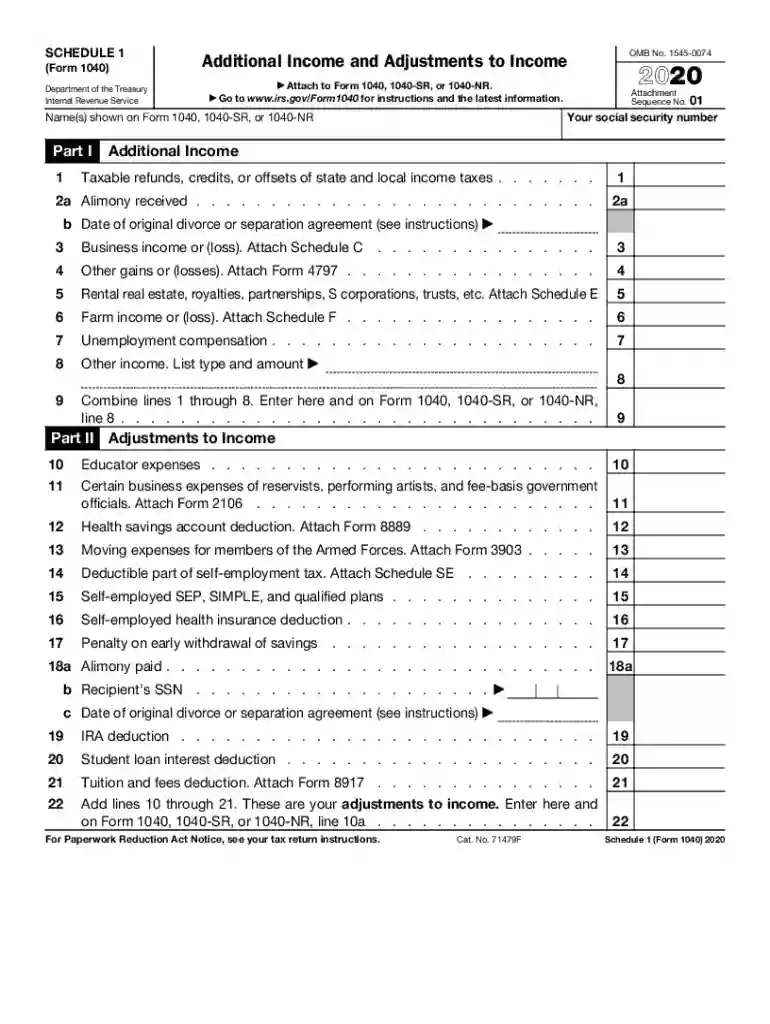
Schedule 1 (Form 1040) is an essential document used by individual taxpayers in the United States to report additional income and adjustments. This form includes sections for various income types such as taxable refunds, alimony, business income, and unemployment compensation. It also allows users to report adjustments to income, including educator expenses, health savings account deductions, and student loan interest deductions. Taxpayers attach Schedule 1 to their main tax return forms (1040, 1040-SR, or 1040-NR).
To properly utilize Schedule 1, taxpayers must identify all sources of income and any adjustments allowed. The form is divided into sections, each catering to specific types of income and adjustments. Properly categorizations of income and deductions ensure compliance and accuracy in tax reporting. Note that failing to report relevant income or deductions could result in penalties or audits by the IRS.
Schedule 1 can be accessed and downloaded directly from the IRS website. It is commonly included in tax preparation software packages like TurboTax and QuickBooks, facilitating easy integration with other tax forms. For those filing paper returns, printed versions of Schedule 1 can be requested from the IRS by mail.
Schedule 1 consists of two parts:
Schedule 1 must be submitted along with Form 1040 by the IRS's annual tax deadline, typically April 15. This deadline can be extended if a taxpayer files for an extension. It's crucial to adhere to these timelines to avoid late filing penalties and interest on unpaid taxes.
Adhering to IRS guidelines when completing Schedule 1 is paramount. These guidelines ensure that all reported information is accurate and reflect the taxpayer's financial situation. Key considerations include ensuring all reported income aligns with the taxpayer's supporting documents and any deductions are substantiated with appropriate documentation.
Schedule 1 is required for individuals with income sources or deductions that are not covered on Form 1040 alone. This can include self-employed individuals, business owners, educators with unreimbursed expenses, and individuals receiving alimony. The form provides a way to report these additional incomes or adjustments effectively.
Failure to accurately complete Schedule 1 or omitting it when required accompanies significant penalties. The IRS can impose fines, initiate audits, and charge interest on unpaid taxes. Understanding the necessity of filing Schedule 1 when applicable helps prevent such penalties.
Supporting documents are crucial when filling out Schedule 1. Taxpayers must have access to financial records such as W-2 and 1099 forms, receipts for deductible expenses, and proof of adjustments like alimony payments or student loan interest. Accurate records guarantee the legitimacy of the information reported on the form, ensuring compliance.
We've got more versions of the 2023 schedule 1 pdf form. Select the right 2023 schedule 1 pdf version from the list and start editing it straight away!
At DocHub, your data security is our priority. We follow HIPAA, SOC2, GDPR, and other standards, so you can work on your documents with confidence.



Jul 25, 2025 For 2025, enter the amount reported to you on Form(s) 1099-K that was included in error or for personal items sold at a loss .Read more
There are established five schedules of controlled substances, to be known as schedules I, II, III, IV, and V. Such schedules shall initially consist of theRead more
Schedule 1 Game is an immersive strategy game that challenges players to build and manage their criminal empire. Manufacture products, expand your territory,Read more


