




Here's how it works
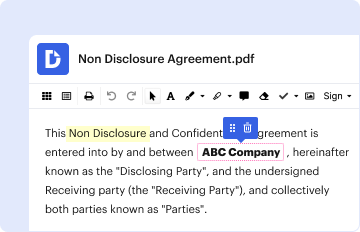
01. Edit your form online
Type text, add images, blackout confidential details, add comments, highlights and more.

02. Sign it in a few clicks
Draw your signature, type it, upload its image, or use your mobile device as a signature pad.

03. Share your form with others
Send it via email, link, or fax. You can also download it, export it or print it out.
How to use or fill out SC1041 2013 form with our platform

- Click ‘Get Form’ to open the SC1041 2013 form in the editor.
- Begin by entering the name of the estate or trust at the top of the form, followed by the fiduciary's name and title.
- Fill in the address of the fiduciary, including city, state, ZIP code, and county.
- Indicate whether an extension is requested and answer all relevant questions regarding distributions and federal changes.
- Proceed to Part I where you will calculate South Carolina fiduciary adjustments. Enter federal taxable income from Form 1041 on line 1.
- Complete lines for federal fiduciary exemption, modifications, and net taxable income as instructed.
- In Part II, allocate adjustments among beneficiaries based on their shares of federal distributable net income.
- For nonresident estates or trusts, complete Part III to compute taxable income from South Carolina sources.
- Finally, review all entries for accuracy before saving or printing your completed form for submission.
Start using our platform today to easily fill out your SC1041 form online for free!
Fill out sc1041 2013 form online
It's free
It's free
See more sc1041 2013 form versions
We've got more versions of the sc1041 2013 form form. Select the right sc1041 2013 form version from the list and start editing it straight away!
| Versions | Form popularity | Fillable & printable |
|---|---|---|
| 2025 | 4.4 Satisfied (36 Votes) | |
| 2024 | 4.4 Satisfied (46 Votes) | |
| 2023 | 4.3 Satisfied (43 Votes) | |
| 2022 | 4.8 Satisfied (50 Votes) | |
| 2021 | 4.8 Satisfied (104 Votes) | |
| 2020 | 4.4 Satisfied (52 Votes) | |
| 2019 | 4 Satisfied (46 Votes) | |
| 2018 | 4.4 Satisfied (199 Votes) | |
| 2017 | 4.4 Satisfied (51 Votes) | |
| 2016 | 4.3 Satisfied (362 Votes) | |
| 2015 | 4 Satisfied (51 Votes) | |
| 2014 | 4.3 Satisfied (54 Votes) | |
| 2013 | 4.1 Satisfied (31 Votes) | |
| 2006 | 4.1 Satisfied (62 Votes) | |
| 2003 | 4.2 Satisfied (31 Votes) |
Got questions?
We have answers to the most popular questions from our customers. If you can't find an answer to your question, please contact us.
Contact us
Where do I mail my SC1041ES?
Attach payment to the SC1041ES and mail to SCDOR, Estimated Tax, PO Box 125, Columbia, SC 29214-0038. The SC1041ES is available at dor.sc.gov/forms.
What is the IRS Rule 1041?
26 U.S. Code 1041 - Transfers of property between spouses or incident to divorce. a former spouse, but only if the transfer is incident to the divorce. the basis of the transferee in the property shall be the adjusted basis of the transferor. is related to the cessation of the marriage.
Who needs to file a 1041?
If the estate generates more than $600 in annual gross income, you are required to file Form 1041, U.S. Income Tax Return for Estates and Trusts. An estate may also need to pay quarterly estimated taxes. See Form 1041 instructions for information on when to file quarterly estimated taxes.
Does form 1041 have to be filed every year?
If youre wondering when to file 1041 Forms, you should file it each year the estate is open. As long as the estate exists, a Form 1041 should be filed. The due date for filing a 1041 falls on tax day.
Who is required to file a form 1041?
More In File If the estate generates more than $600 in annual gross income, you are required to file Form 1041, U.S. Income Tax Return for Estates and Trusts. An estate may also need to pay quarterly estimated taxes. See Form 1041 instructions for information on when to file quarterly estimated taxes.
Security and compliance
At DocHub, your data security is our priority. We follow HIPAA, SOC2, GDPR, and other standards, so you can work on your documents with confidence.
Learn more


People also ask
Does everyone need to file an estate tax return?
An estate tax return (Form 706) must be filed if the gross estate of the decedent (who is a U.S. citizen or resident), increased by the decedents adjusted taxable gifts and specific gift tax exemption, is valued at more than the filing threshold for the year of the decedents death, as shown in the table below.
What is the form for a trust return?
Use Schedule D (Form 1041) to report gains and losses from the sale or exchange of capital assets by an estate or trust.
Do I need to file a 1041 for a revocable trust?
When one spouse dies, however, things change. At that point, the portion of that spouses assets in a revocable living trust become irrevocable. The trust must file a Form 1041 for that year, reporting and paying taxes on the income from the deceased spouses portion of the assets.