
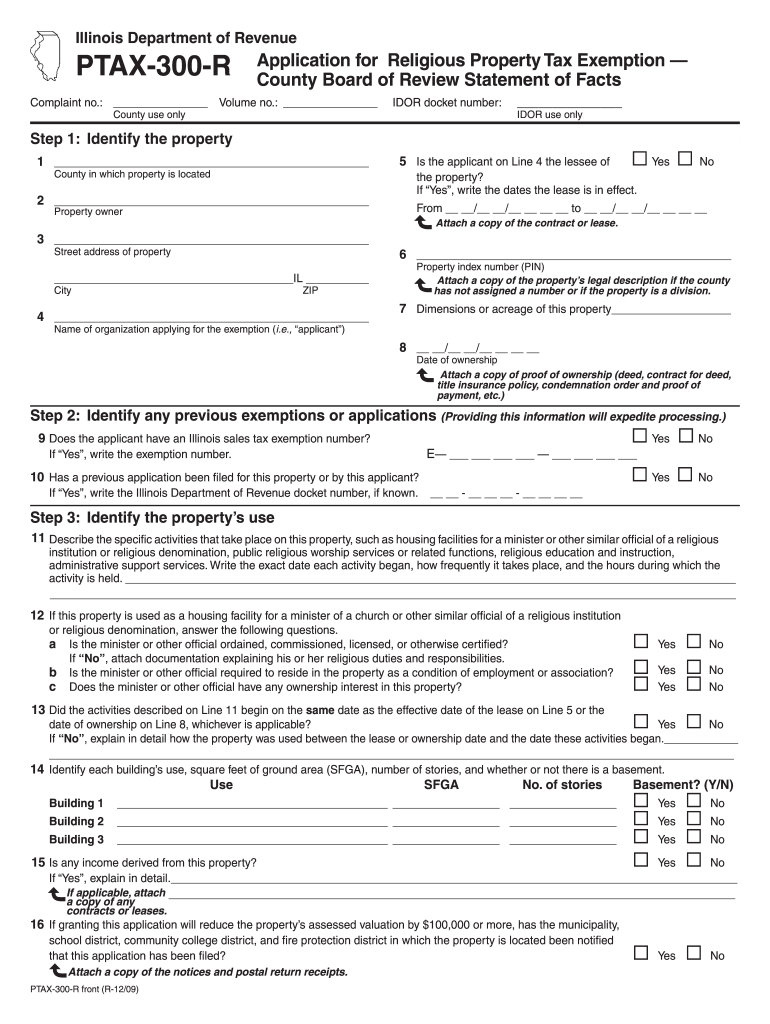



Ptax 300 r 2009 form-2025

Get Form
ptax 300 r 2009 form Preview on Page 1

Here's how it works

01. Edit your form online
Type text, add images, blackout confidential details, add comments, highlights and more.

02. Sign it in a few clicks
Draw your signature, type it, upload its image, or use your mobile device as a signature pad.

03. Share your form with others
Send it via email, link, or fax. You can also download it, export it or print it out.

How to use or fill out ptax 300 r 2009 form with our platform

Form edit decoration
9.5
Ease of Setup
DocHub User Ratings on G2
9.0
Ease of Use
DocHub User Ratings on G2
  1. Click ‘Get Form’ to open the PTAX-300-R in the editor.
  2. Begin by identifying the property. Fill in the county, property owner, street address, and organization name applying for the exemption.
  3. Indicate if the applicant is a lessee and provide lease dates if applicable. Enter the property index number and dimensions or acreage.
  4. Describe any previous exemptions or applications by checking 'Yes' or 'No' and providing relevant numbers.
  5. Detail the property's use by describing activities that take place, including start dates and frequency.
  6. Attach required documentation such as proof of ownership, pictures of the property, and notarized affidavits.
  7. Identify a contact person for this application with their details for follow-up communication.
  8. Finally, ensure you sign the application to verify all information is accurate before submitting it through our platform.

Start filling out your PTAX-300-R form online for free today!

See more ptax 300 r 2009 form versions

We've got more versions of the ptax 300 r 2009 form form. Select the right ptax 300 r 2009 form version from the list and start editing it straight away!
Versions Form popularity Fillable & printable
2017 4.8 Satisfied (102 Votes)
2009 4.4 Satisfied (509 Votes)
2003 4.4 Satisfied (263 Votes)
be ready to get more

Complete this form in 5 minutes or less

Get form

Got questions?

We have answers to the most popular questions from our customers. If you can't find an answer to your question, please contact us.
Contact us
Most senior homeowners are eligible for this exemption if they are 65 years of age or older (born in 1959 or prior) and own and occupy their property as their principal place of residence. Once this exemption is applied, the Assessors Office automatically renews it for you each year.
This annual exemption is available for residential property that is occupied by its owner or owners as his or their principal dwelling place, or that is a leasehold interest on which a single family residence is situated, which is occupied as a residence by a person who has an ownership interest therein, legal or
The Homeowner Exemption reduces the Equalized Assessed Value (EAV) of a property by $10,000. EAV is the partial value of a property used to calculate tax bills. It is important to note that the exemption amount is not the dollar amount by which a tax bill is lowered.
All property used exclusively for religious purposes, or used exclusively for school and religious purposes, or for orphanages and not leased or otherwise use with a view to a profit, is exempt, including all such property owned by churches or religious institutions or denominations and use in conjunction therewith as
The Illinois homestead exemption allows homeowners to exempt up to $15,000 of equity ($30,000 for married couples) from collection attempts from creditors, potentially preventing the seizure, foreclosure, and sale of their home.
be ready to get more

Complete this form in 5 minutes or less

Get form

People also ask

You may be eligible if: You are disabled or became disabled during the 2023 tax year. Either own or have a legal or equitable interest in the property on January 1, 2023. You are liable for the payment of the property taxes on the property. You occupied the property as the principal residence as of January 1, 2023.
County offices and the Illinois Department of Revenue use this form to collect sales data and to determine if a sale can be used in assessment ratio studies. This information is used to compute equalization factors.

Related links

