




Here's how it works

01. Edit your colorado lease agreement online
Type text, add images, blackout confidential details, add comments, highlights and more.

02. Sign it in a few clicks
Draw your signature, type it, upload its image, or use your mobile device as a signature pad.

03. Share your form with others
Send colorado residential lease agreement via email, link, or fax. You can also download it, export it or print it out.
How to use or fill out Colorado Residential Lease Agreement with our platform

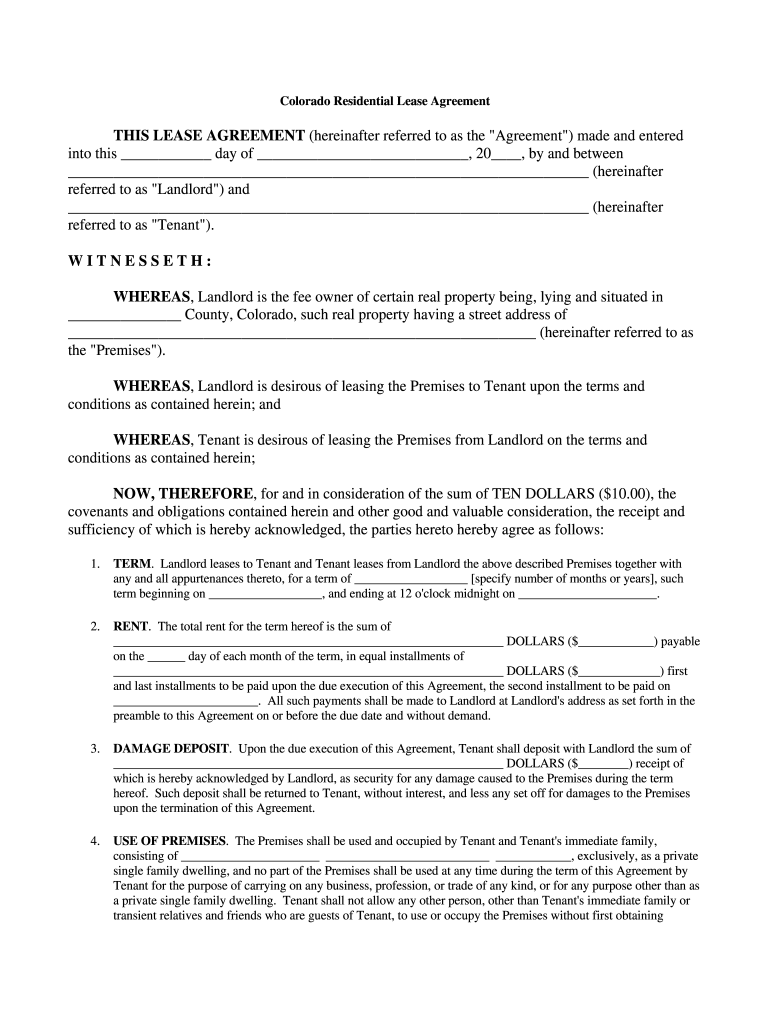
- Click ‘Get Form’ to open the Colorado Residential Lease Agreement in the editor.
- Begin by filling in the date and names of both the Landlord and Tenant at the top of the form. Ensure accuracy as this information is crucial for legal purposes.
- Specify the term of the lease in months or years, along with the start and end dates. This section outlines how long the Tenant will occupy the Premises.
- Enter the total rent amount and payment schedule. Clearly indicate when payments are due each month to avoid any confusion.
- Complete the Damage Deposit section by specifying the amount to be held as security for potential damages during tenancy.
- Fill out details regarding permitted use of the Premises, ensuring compliance with local laws and regulations.
- Review all sections carefully, including maintenance responsibilities and rules regarding alterations, before finalizing your agreement.
Start using our platform today to easily complete your Colorado Residential Lease Agreement online for free!
Fill out colorado residential lease agreement online
It's free
It's free
Got questions?
We have answers to the most popular questions from our customers. If you can't find an answer to your question, please contact us.
Contact us
Does Colorado have a standard lease agreement?
A Colorado standard residential lease agreement is a contract between a landlord and tenant that defines the terms and conditions of renting residential real estate. The parties are typically bound to the agreement for a period of one year and have the option to negotiate an extension or renewal at the lease term.Oct 2, 2025
What not to say to a landlord?
When talking to a landlord, avoid complaining about past landlords, discussing illegal activities or lease violations (like running a business or having unapproved pets), showing instability (job, finances), or making unreasonable requests, as these raise red flags; instead, focus on being a responsible tenant who respects the property and lease terms. Things to Avoid Saying or Doing Complaining about previous landlords or situations: Dont badmouth past landlords, neighbors, or mention evictions; it makes you seem difficult. Discussing illegal activities: Dont ask about eviction timelines, running a business from the unit, or engaging in illegal activities. Hiding pets or guests: Dont lie about pets or having unapproved roommates. Showing financial or job instability: Avoid talking about unstable employment or payment issues. Making unreasonable requests: Dont ask for major renovations (like painting everything black) or suggest youll be noisy. Being overly demanding: Dont ask endless questions or try to change the lease terms immediately. Lying: Dont lie about rent payments, property damage, or anything else, as it erodes trust. What to Say Instead (When Applicable) Be honest about your situation: If youre a good tenant, highlight your reliability and respect for rules. Ask responsible questions: Inquire about maintenance, contact methods, or security, but dont suggest youll be a problem. Show youre a good fit: Emphasize your stability and responsible habits to build trust. AI can make mistakes, so double-check responses5 Things You Should Never Say When Renting an ApartmentNov 20, 2023Realtor.comWhat should you not tell your landlord when renting an apartment or house?Jul 26, 2022 Reason for Leaving: Avoid providing reasons for leaving a previous residence that might concern a new landlord, such aQuora
Can I make my own lease agreement?
Yes, you can write your own lease agreement, but its risky because it must comply with specific state and local laws and include critical clauses, so using reliable templates or getting a lawyer to review it is highly recommended to ensure its legally binding and protects you from future disputes. While you can find simple templates online, comprehensive, legally sound agreements often require professional input to cover all essential terms like rent, deposits, maintenance, utilities, and state-specific landlord-tenant rules. Key considerations for writing your own lease: State Local Laws: Laws vary DocHubly by location; your lease must adhere to these. Essential Clauses: Include party details, property description, lease term (start/end dates), rent amount, due dates, late fees, security deposit terms, utility responsibilities, maintenance rules, and rules for guests/pets/smoking. Legal Protection: A well-written lease protects both landlord and tenant from misunderstandings, unlike verbal agreements. Recommended approach: Use a Template: Start with a reputable online template (like those from LawDepot or TurboTenant) to get the structure right. Customize Carefully: Fill in all details accurately, paying close attention to state-specific requirements. Get Legal Review: Have a real estate lawyer review your draft to identify missing clauses or potential liabilities, which is a cost-effective way to ensure enforceability. AI can make mistakes, so double-check responsesFree Lease Agreement Template | Residential Rental Forms - LawDepotAug 18, 2025 Can I write my own lease agreement? Yes, you can write your own Residential Lease Agreement no need for a lawyer. HoLawDepotHow to Write a Lease Agreement: 5 Easy Steps to FollowCan I Write My Own Lease Agreement? It is possible to draft your own lease agreement, but you are leaving yourself open to issues.ContractsCounsel
What is the new rental law in Colorado?
Colorados recent landlord-tenant laws (mostly effective 2024-2026) DocHubly strengthen tenant protections, requiring just cause for lease non-renewals, mandating landlords respond to habitability issues within 24 hours (for urgent matters), capping pet deposits/rent, and enforcing clear, upfront disclosure of all mandatory housing costs (eliminating hidden fees). Other key changes include enhanced security deposit rules, protections for subsidized tenants, and new enforcement powers for the Attorney General. Key Changes for Landlords Tenants Lease Non-Renewals Evictions For Cause Evictions: Landlords need a valid reason (e.g., non-payment, lease violation) to evict or not renew a lease, a major shift from previous rules. Notice Requirements: Expanded timelines for non-renewal notices, with specific notice periods for different tenancy lengths. Warranty of Habitability (Repairs) Urgent Issues: Landlords must address life/health/safety issues within 24 hours of notice. Non-Urgent Issues: 72-hour response window, with repairs due in 14 days. Relocation: If temporary relocation is needed for repairs, landlords must provide comparable, accessible housing or pay for hotels/meals after 48 hours. Pricing Fees (Effective Jan 1, 2026) Total Price Disclosure (HB 1090): Landlords must advertise the total rent, including all mandatory fees (parking, amenities), as one single, prominent number. Junk Fee Ban: Landlords cant charge for things they cant reasonably avoid; separate optional fees must reflect actual costs. Security Deposits Deposit Cap: Limited to one months rent (effective Jan 1, 2026). Installment Payments: Tenants can pay deposits in installments over six months. Wear Tear: Deposits cant be withheld for normal wear and tear. Move-Out Inspections: Tenants can request to be present for move-out inspections. Other Important Laws Radon Disclosure: Landlords must disclose radon presence and test results. Subsidized Tenants: Protections for tenants using housing subsidies. Enforcement: The Colorado Attorney General can now prosecute landlord-tenant law violations. These changes DocHubly alter landlord obligations and tenant rights in Colorado, focusing on transparency and habitability. AI can make mistakes, so double-check responsesDocHub Changes to Landlord-Tenant Law in 2024In 2024, the Colorado legislature passed and Governor Polis signed into law eight bills that DocHubly impact the residential Colorado Lawyer2024 Legislative Updates: New Landlord-Tenant Laws in Colorado - Otten Johnson Robinson Neff + Ragonetti PCNov 25, 2024Otten Johnson Robinson Neff + Ragonetti
Does a lease agreement need to be DocHubd in Colorado?
Does Lease need to be DocHubd in CO? No, Colorado Rental Contracts do not need to be DocHubd. As long as they are signed by both parties they are considered fully executed and legally binding.
Security and compliance
At DocHub, your data security is our priority. We follow HIPAA, SOC2, GDPR, and other standards, so you can work on your documents with confidence.
Learn more


Related forms
Project LINK Training Program Application - Moffitt Cancer ...
The document is an application form for the Post-Doctoral Training in Behavioral Oncology at H. Lee Moffitt Cancer Cente ...
Nj childcare staff records checklist
The document is a confidential staff record checklist for group child care centers in Wisconsin, outlining required trai ...
Florida 504ha
The document is an application form (DR-504HA) for ad valorem tax exemption for nonprofit homes for the aged in Florida. ...
Florida services tax return form
The document is the Florida Communications Services Tax Return (Form DR-700016), which outlines the requirements for reg ...
St1 tax form
The document is the Illinois Department of Revenue's ST-1-X form, which is used for filing an amended Sales and Use Tax ...

Fr 399
The document outlines the requirements and procedures for businesses in the District of Columbia to self-certify as Qual ...
MEMBER AUTHORIZATION This form is to be filled out by a member ...
The document is a Member Authorization form that allows members to authorize the release of their protected health infor ...

Vaccination consent form
The document is a COVID-19 Vaccination Consent Form for 2020-2021, which includes sections for personal information, scr ...
People also ask
What are the new tenant laws in Colorado 2026?
The new law expands the definition of normal wear and tear, making it illegal for a landlord to charge a tenant for expected wear and tear resulting from the propertys everyday use. This would include carpet buckling, wall scuffs, or general deterioration. This does not apply to irreparable damage.
What makes a lease legally binding in Colorado?
A lease is a legally binding contract, which means that it can be enforced by the courts. A lease is the best evidence of the specific rights and responsibilities of both the landlord and the tenant. The lease tells both parties what they can count on receiving and what they are expected to do.