




01. Edit your form online
Type text, add images, blackout confidential details, add comments, highlights and more.

Type text, add images, blackout confidential details, add comments, highlights and more.

Draw your signature, type it, upload its image, or use your mobile device as a signature pad.

Send it via email, link, or fax. You can also download it, export it or print it out.
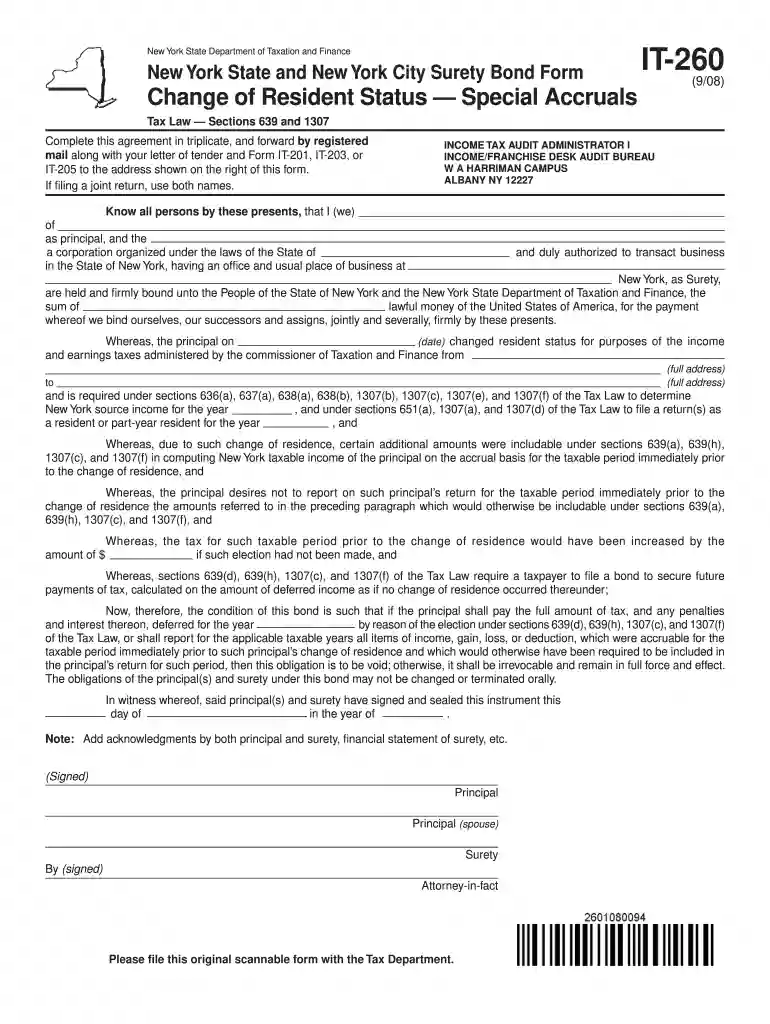
Form IT-260-I is a critical document used by taxpayers who have changed their resident status in New York State for income tax purposes. This form, also known as the Surety Bond Form, outlines the responsibilities of both the principal and the surety to ensure payment of taxes, penalties, and interest related to deferred income due to the residency change.
Form IT-260-I can be accessed and obtained through various channels. Whether you prefer digital convenience or traditional methods, these options ensure that you can acquire the necessary document with ease.
Completing Form IT-260-I correctly is essential. Follow these steps to ensure accurate and complete submission.
This form is primarily utilized by individuals and entities undergoing a residency change within New York State. Understanding the typical users can help identify if this form applies to your situation.


The Form IT-260-I serves a crucial legal function in the context of New York State taxation. It mandates the obligations linked to deferred income relevant to residency transitions.
To navigate Form IT-260-I effectively, familiarize yourself with key terminology used throughout the documentation process.
Filing Form IT-260-I promptly is crucial to avoid penalties. It is important to comply with specific dates set by New York State.
Failing to comply with Form IT-260-I regulations can result in significant penalties. Understanding these potential consequences is vital.
The decision between utilizing a digital versus paper version of Form IT-260-I can affect workflow efficiency. Understanding these differences can guide your choice.
Each state may have unique rules concerning forms like IT-260-I. For New York State residents, specific guidelines emphasize compliance with local taxation laws.
Taxpayers often use software to manage tax documents. Knowing which software supports Form IT-260-I is beneficial.
By thoroughly covering each aspect of Form IT-260-I, from definition and obtaining methods to compliance and software use, this structured content ensures comprehensive understanding and proper utilization of the document for tax purposes in New York State.
We've got more versions of the Form IT-260-I - Tax ny - New York State form. Select the right Form IT-260-I - Tax ny - New York State version from the list and start editing it straight away!
At DocHub, your data security is our priority. We follow HIPAA, SOC2, GDPR, and other standards, so you can work on your documents with confidence.
by T Henry-Reid 2022 Cited by 2 12 With regard to taxation, the United States is exceptional yet again: it is the only nation aside from Eritrea that imposes its income tax on.Read more
Form IT‐260, New York State and New York City Surety Bond Form Change of Resident Status Special Accruals, must be properly executed in triplicate


