




01. Edit your 1098 2008 online
Type text, add images, blackout confidential details, add comments, highlights and more.

Type text, add images, blackout confidential details, add comments, highlights and more.

Draw your signature, type it, upload its image, or use your mobile device as a signature pad.

Send 1098 mortgage via email, link, or fax. You can also download it, export it or print it out.
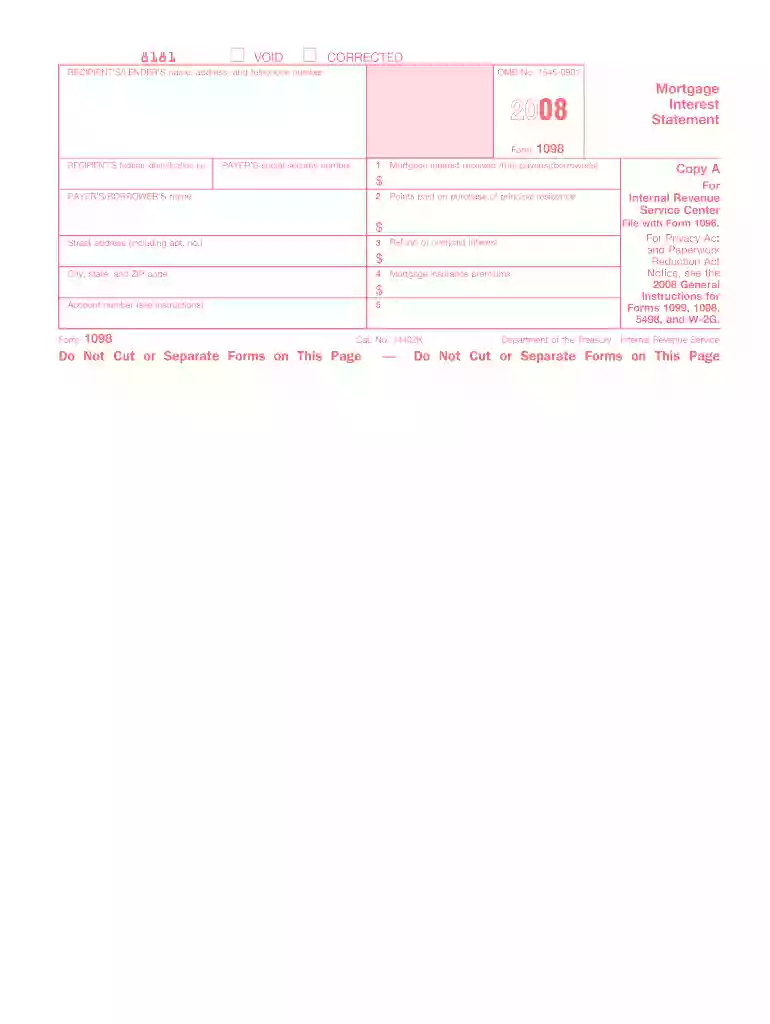
The 2008 Form 1098, titled the "Mortgage Interest Statement," is a crucial document used in the United States tax system. Lenders utilize this form to report the amount of mortgage interest received from borrowers over the tax year. This form serves as an essential record for both lenders and borrowers, detailing mortgage interest, points paid during the purchase of a primary residence, any refunds of overpaid interest, and mortgage insurance premiums. These details are necessary for tax purposes, primarily to assist borrowers in claiming deductions on their federal tax returns.
The form plays a vital role in tax preparation for both lenders and borrowers. For borrowers, the information contained within the form is used to determine the amount of mortgage interest they can deduct on their tax return. Deductibility is based on the interest and points reported, potentially providing significant tax savings. Borrowers should include the amounts reported on Form 1098 when completing their Schedule A for their individual income tax return, especially when itemizing deductions. Lenders must ensure accuracy in the details reported to avoid discrepancies that might trigger audits or questions from the IRS.
Typically, lenders are responsible for issuing Form 1098 to borrowers by the end of January following the tax year in question. Borrowers do not generally need to request the form, as lenders must automatically provide it. However, if you haven’t received your Form 1098, contact your mortgage lender to request it. In some cases, lenders might offer digital copies through their online accounts systems, allowing easier access and retrieval without waiting for mail delivery.
Completing this form accurately is primarily the responsibility of the lender. The form comprises several sections requiring detailed information. Here is an outline of the essential steps for completing the form:
This form is predominantly used by taxpayers who have paid interest on a mortgage for their primary home. The primary users include homeowners who have opted to itemize their deductions on their tax return, allowing them to claim any relevant interest paid as a deduction, reducing their taxable income. For lenders and mortgage holders, this form is a required report to the IRS, ensuring that the tax implications of interest payments are accounted for.


Understanding the key components of the form is crucial for both lenders and borrowers:
Legally, this form facilitates transparency and accuracy in tax reporting for mortgage payments. Both borrowers and lenders must ensure that the figures reported on this form align with the actual transactions made during the tax year. The integrity of this data is critical for compliance with IRS requirements, serving as a documentation basis for potential audits and reviews by tax authorities. The ESIGN Act governs the electronic submission and signature processes to maintain legality in digital document handling.
The Internal Revenue Service (IRS) provides specific instructions regarding the Form 1098, emphasizing the importance of correct filing and reporting. Lenders are required to submit a copy of all issued Form 1098 to the IRS, ensuring consistency and accuracy between the taxpayer's claim and what's reported. IRS guidelines also determine how deductions from this form influence a taxpayer's final owed amount. It’s critical for taxpayers to keep detailed records that match the reported mortgage interest and any other related financial activity to ensure accuracy and compliance.
The filing deadlines for the Form 1098 are stringent, primarily focusing on accuracy for the tax year. Issuers need to deliver the form to borrowers by January 31 of the following year to ensure borrowers have sufficient time to prepare their tax returns. Additionally, lenders must file the form with the IRS by the final day of February if filing by mail or by March 31 if filing electronically. These deadlines are designed to maintain a smooth tax reporting process and to minimize the potential for errors or delays.
We've got more versions of the 1098 2008 form. Select the right 1098 2008 version from the list and start editing it straight away!
| Versions | Form popularity | Fillable & printable |
|---|---|---|
| 2022 | 4.9 Satisfied (20 Votes) | |
| 2021 | 4.8 Satisfied (113 Votes) | |
| 2020 | 4.2 Satisfied (69 Votes) | |
| 2019 | 4.4 Satisfied (328 Votes) | |
| 2018 | 4.4 Satisfied (296 Votes) | |
| 2017 | 4.3 Satisfied (331 Votes) | |
| 2016 | 4.4 Satisfied (460 Votes) | |
| 2015 | 4.2 Satisfied (66 Votes) | |
| 2014 | 4 Satisfied (40 Votes) | |
| 2013 | 4 Satisfied (45 Votes) | |
| 2012 | 4.3 Satisfied (65 Votes) | |
| 2011 | 4 Satisfied (33 Votes) | |
| 2010 | 4.1 Satisfied (61 Votes) | |
| 2008 | 4 Satisfied (53 Votes) |
At DocHub, your data security is our priority. We follow HIPAA, SOC2, GDPR, and other standards, so you can work on your documents with confidence.
Feb 14, 2020 Lien: any mortgage, pledge, hypothecation, assignment interest, a statement substantially in the form of Exhibit K-1,. K-2Read more
General and specific form instructions are provided as separate products. The products you should use to complete Form 1098 are the 2008 General Instructions.Read more
Form 1098. Use Form 1098, Mortgage from an at-risk activity carried on as a collecting its income exceeded that. Interest Statement, to report the receipt.Read more


