




01. Edit your physical form for school online
Type text, add images, blackout confidential details, add comments, highlights and more.

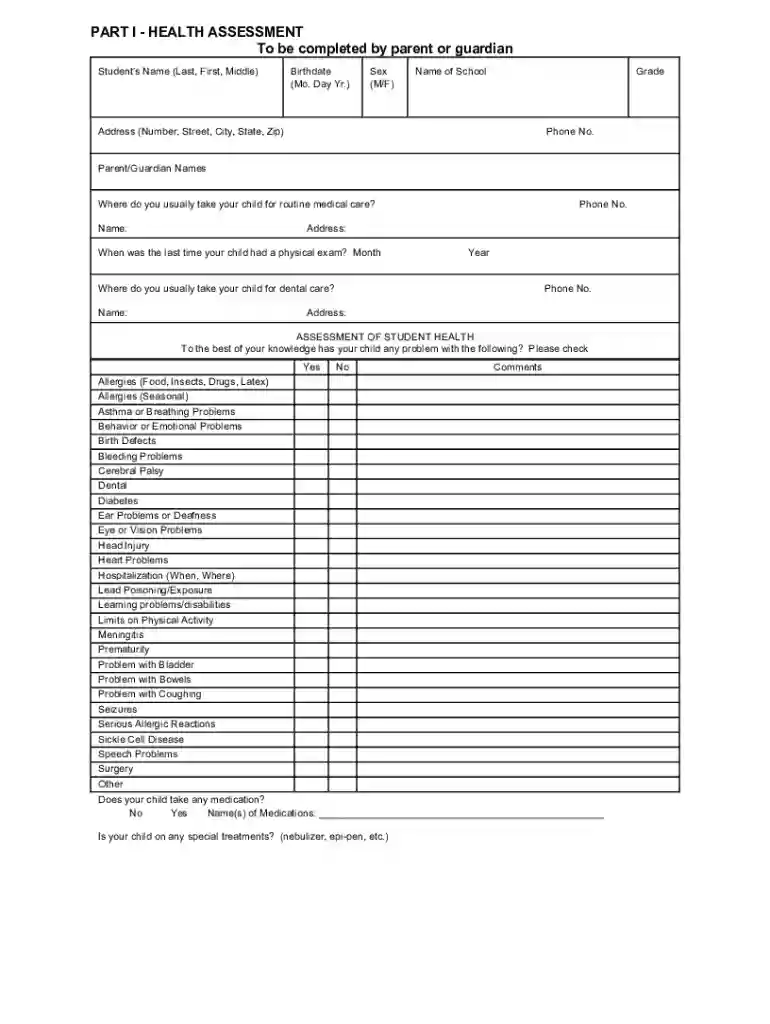
Type text, add images, blackout confidential details, add comments, highlights and more.

Draw your signature, type it, upload its image, or use your mobile device as a signature pad.

Send school physical form via email, link, or fax. You can also download it, export it or print it out.
Physical forms for school are essential documents required by various educational institutions for student enrollment and participation in activities. These forms typically ensure that students comply with health requirements, such as physical examinations and immunizations. In the United States, different states have specific variations and regulations governing these requirements.
Physical forms serve multiple purposes within the school system. They are used to:
Verify Health Status: Schools utilize these forms to ensure students are physically fit to participate in athletics and other school activities. The information is often critical for identifying health issues that could impact a student’s participation.
Document Immunization Records: Many states require proof of immunization against communicable diseases. The physical form helps maintain accurate health records for each student, adhering to state health regulations.
Facilitate Participation in Sports: Physical forms are a prerequisite for students wishing to engage in sports. Many schools accept specific versions, like the sports physical form, to document a student athlete's health status.
While each state may have its own unique requirements, there are widely accepted forms and stipulations. For example:
Maryland Physical Form: This form typically requires submission of a health assessment, performed by a licensed healthcare provider. It includes information on immunizations, physical examination results, and may require a blood test for at-risk students.
Oklahoma School Physical Form: Similar to Maryland, this form includes specific health questions that must be answered by a physician. The completed form must be submitted to the school before the start of the school year.
Generic School Physical Form: Many institutions offer a generic printable physical form that can be easily accessed and filled out by parents and healthcare providers.
A standard physical form often includes several key components:
Student Information: Basic details such as name, date of birth, and grade level.
Health History: A section for parents to provide information on any existing medical conditions, allergies, or previous injuries.
Physical Examination Results: Documentation from the healthcare provider detailing the findings from the physical exam, including height, weight, and any notable health issues.
Immunization Records: A list of required vaccinations and their dates, usually signed by the healthcare provider.
Signature Section: A place for the parent or guardian to sign, acknowledging the validity of the information provided.
Physical forms are utilized in various scenarios, including:
Enrollment in Public Schools: Parents must present a completed physical form during the enrollment process to ensure compliance with state health laws.
Participation in Extracurricular Activities: Students wishing to join sports teams or other physical activities are often required to submit a validated school physical form.
Transportation for School Events: For out-of-town field trips or sporting events, schools may request updated physical forms to mitigate health risks during travel.
Schools must adhere to both state and federal regulations regarding student health documentation. This often includes:
Health Privacy Laws: Schools are subject to the Family Educational Rights and Privacy Act (FERPA), which protects the privacy of student health information.
State-Specific Regulations: Each state has differing requirements for the content and submission of physical forms. Compliance with these regulations is essential for both students and educational institutions.
Penalties for Non-Compliance: Failing to submit the required health documentation may result in students being barred from participation in specific activities or even from attending classes.
Printable Alternatives: Many schools provide downloadable, printable versions of their physical forms on their websites, making it easier for parents to obtain and complete them.
State-Specific Guidelines: Each state’s department of health typically offers resources outlining specific requirements, forms, and best practices for schools and students regarding physical exams.
Online Submission Options: Some educational institutions are moving towards digital formats, allowing parents to submit completed physical forms electronically to improve efficiency and compliance tracking.
Understanding the various aspects of physical forms is essential for parents and students navigating the school system. Each form serves a vital role in ensuring that students are healthy and ready to learn, while also maintaining compliance with state regulations.
We've got more versions of the physical form for school form. Select the right physical form for school version from the list and start editing it straight away!
| Versions | Form popularity | Fillable & printable |
|---|---|---|
| 2004 | 4.9 Satisfied (36 Votes) |
At DocHub, your data security is our priority. We follow HIPAA, SOC2, GDPR, and other standards, so you can work on your documents with confidence.
Pages 1-3 MUST be submitted to the school to be eligible for VHSL sports. This form expires 14 months from the date of the practitioners signature on page 3.Read more
1003.455, Physical education, Each school district shall adopt a written physical education (PE) policy and provide 150 minutes of PE each week for grades K-5.Read more


