




01. Edit your form online
Type text, add images, blackout confidential details, add comments, highlights and more.

Type text, add images, blackout confidential details, add comments, highlights and more.

Draw your signature, type it, upload its image, or use your mobile device as a signature pad.

Send it via email, link, or fax. You can also download it, export it or print it out.
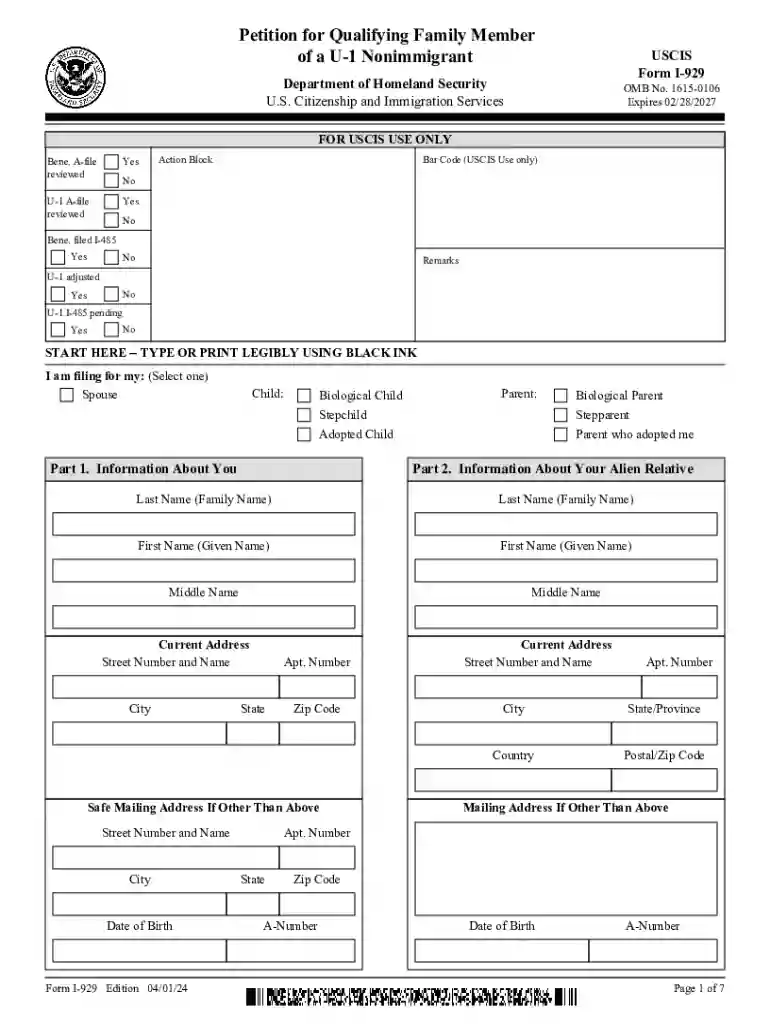
The Form I-929, Petition for Qualifying Family Member of a U-1 Nonimmigrant, is a document used to facilitate the immigration process for eligible family members of individuals who have received U-1 nonimmigrant status. This form enables U-1 visa holders, who are recognized as victims of criminal activities and have been helpful in law enforcement investigations, to petition for certain family members to join them in the United States. The petition primarily involves collecting detailed information about the petitioner and their eligible relative to assess qualifications.
Gather Required Information: Begin by collecting all necessary personal details regarding the petitioner and the family member, including names, addresses, and relationship to the U-1 visa holder.
Complete Petitioner Information: Fill in the sections detailing the U-1 visa holder’s biographical information, including current status and evidence of cooperation with law enforcement agencies.
Detail the Family Member's Information: Provide comprehensive details about the relative, such as their previous immigrations status, current location, and familial connections.
Complete Supporting Documentation: Attach all relevant documents, such as proof of the U-1 status, criminal history records (if applicable), and other requested evidence that supports the petition.
Review and Sign: Ensure accuracy by reviewing the completed form. Both the U-1 visa holder and the family member, where required, should sign the document before submission.
U-1 Visa Status: The primary criterion is that the petitioner must currently hold U-1 nonimmigrant status in the U.S.
Qualifying Family Member: Typically includes spouses, children, and sometimes, parent or unmarried siblings of certain ages, particularly if the U-1 holder was under 21 years at the time of application.
Evidence of Family Relationship: Documentation proving the familial relationship, like marriage certificates or birth certificates, is required to establish eligibility.


Proof of U-1 Status: This could be the approval notice or documentation of the petitioner’s current status.
Relationship Documentation: Legal papers proving family ties, such as marriage or birth certificates.
Identity Documents: Passports or national identification cards of both the petitioner and family member.
Criminal Records (if applicable): Any legal documents, if either party has had encounters with law enforcement, that might affect the petition.
Form I-929 serves as a legal mechanism to protect family unity for U-1 visa holders by allowing eligible relatives to immigrate legally. It becomes critical when the family member's presence in the U.S. is deemed beneficial for the U-1 status holder's role in aiding law enforcement or if humanitarian conditions apply, thus playing a pivotal role in immigration policy related to victims of crime.
U-1 Visa Holders: Primarily used by individuals holding a U-1 visa, recognized as victims of certain crimes such as domestic violence or human trafficking, who have cooperated with law enforcement and wish to petition for family members.
Legal Representatives: Immigration attorneys and accredited representatives commonly assist U-1 visa holders in completing and submitting the form correctly to avoid errors that could delay processing.
Mail Submission: Traditional practice involves sending the completed application through mail to specified USCIS addresses as per their latest instructions.
Electronic Filing: While not explicitly mandated for Form I-929, applicants often explore online resources and tools for supporting documents, given the increasing shift towards electronic processes in legal forms.
Derivative Family Members: The term refers to family members eligible for benefits based on the principal U-1 visa holder's status.
Principal and Qualifying Family Member: The 'Principal' is the U-1 visa holder, while 'Qualifying Family Members' are those eligible to be petitioned for through the Form I-929.
Processing Time: Processing times can vary significantly depending on USCIS workloads, but maintaining all documentation ready and following the required guidelines can help expedite the process.
Notification: Applicants are typically informed through mail once forms are received and processed. Keeping track of application status through USCIS’s tools may provide timelines and updates.
Consider a U-1 visa holder who escaped domestic violence and alerted legal authorities. Through the cooperation, they secured U-1 status and now file Form I-929 to bring their child, currently living abroad, to the U.S., showcasing the form's intended use to unite affected families and continue assistance to legal processes.
No Fixed Deadline: The form does not have a specific filing deadline, but timely submission after acquiring U-1 status is recommended to avoid delays.
USCIS Notifications: Tracking dates for biometrics appointments or additional evidence requests ensures adherence to timelines and smoother application progression.
This comprehensive view of the Form I-929 process offers clarity for potential applicants and representatives, emphasizing the importance of precision, proper documentation, and timely submission in aiding eligible family members through challenging circumstances.
We've got more versions of the Form I-929, Petition for Qualifying FamilyMember of a U-1 Nonimmigrant form. Select the right Form I-929, Petition for Qualifying FamilyMember of a U-1 Nonimmigrant version from the list and start editing it straight away!
At DocHub, your data security is our priority. We follow HIPAA, SOC2, GDPR, and other standards, so you can work on your documents with confidence.
Denial of the U-1 principal applicants application will result in the automatic denial of a qualifying family members Form I-929. There shall be no appeal ofRead more
Jun 1, 2026 Use this form to request immigration benefits on behalf of a family member who never held U nonimmigrant status.Read more


