



01. Edit your mmse pdf online
Type text, add images, blackout confidential details, add comments, highlights and more.

Type text, add images, blackout confidential details, add comments, highlights and more.
Draw your signature, type it, upload its image, or use your mobile device as a signature pad.

Send mmse test via email, link, or fax. You can also download it, export it or print it out.
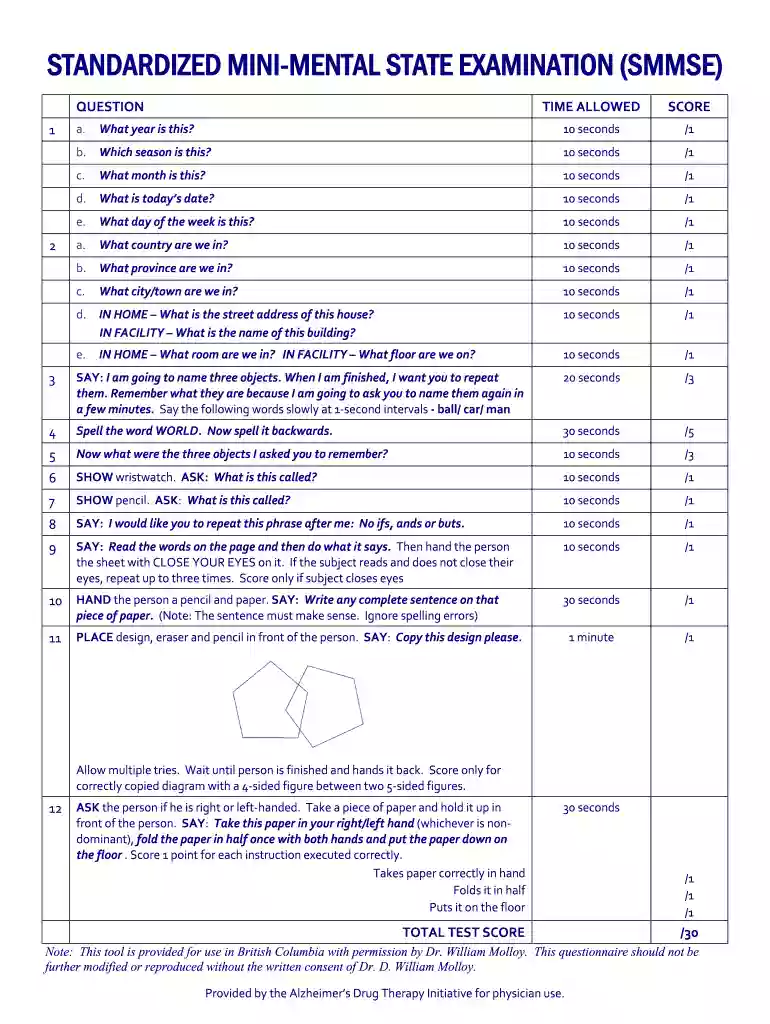
The Standardized Mini-Mental State Examination (SMMSE) is a widely recognized cognitive assessment tool designed to evaluate an individual's mental status. The exam consists of a structured series of questions that assess various cognitive functions, including memory, attention, language, and visuospatial abilities. The primary objective of the SMMSE is to detect cognitive impairment and provide a measure of a person's overall cognitive function, aiding healthcare professionals in diagnosing conditions like dementia or other cognitive disorders.
Understanding the SMMSE can facilitate early detection and intervention for cognitive decline, ultimately enhancing patient care.
Administering the SMMSE requires careful adherence to standardized procedures to ensure accurate results. It is important for healthcare professionals to follow these steps consistently.
By ensuring a calm and structured administration, the evaluator can collect meaningful data that reflects the individual's cognitive state.
The scoring of the SMMSE is based on the accuracy of the participant's responses to the questions posed in the examination. Each section of the test is allocated a specific number of points, with the total score reflecting the overall cognitive function.
The total score can inform whether the individual falls within the normal range or shows signs of cognitive impairment. It is beneficial for clinicians to interpret these scores in the context of a patient’s age, education level, and clinical condition.
Interpreting the results of the SMMSE involves understanding the significance of different score ranges, which can indicate varying degrees of cognitive impairment.
It’s important to consider these scores in conjunction with other assessments and clinical observations. Additionally, the context of the score—including changes over time—is vital for developing treatment plans or interventions.
The SMMSE serves as a crucial tool in the routine assessment of cognitive function, particularly for older adults or those presenting with concerning symptoms. Healthcare providers can use the SMMSE as part of a comprehensive neuropsychological evaluation.
Clinicians can utilize this tool to improve patient care by identifying cognitive concerns early on, facilitating timely intervention and support.
While the SMMSE is a widely adopted assessment tool, several variations exist, depending on the specific requirements of clinical settings or patient populations.
Healthcare professionals may choose different tools based on the characteristics and needs of their patients, ensuring the most accurate representation of cognitive health.
With DocHub, you can rapidly approve your mini mental status examination pdf or any other document on iOS, even without installing extra programs. You can access your DocHub account from any web-connected browser and complete and sign your form in any way you like with just a couple of clicks.
If you use Chrome, there are two straightforward ways to edit your mmse test pdf online. First, visit the DocHub site, add your document, and edit it using our toolbar. You can also set up our Chrome extension and edit any document by dragging and dropping it in your web browser tab.
At DocHub, your data security is our priority. We follow HIPAA, SOC2, GDPR, and other standards, so you can work on your documents with confidence.
Cost of the Test: $155 for users manual, 25 standard blue forms, 25 standard red forms, 10 brief version blue forms, 10 brief version red forms and pocketRead more
In this section, clinicians collect detailed information about previous mental problems, treatment techniques, medication history, and substantial medical
by DW Molloy 1997 Cited by 707 The Mini-Mental State Examination (MMSE) is a widely used screening test for cognitive impairment in older adults. Because the guidelines for itsRead more


