




01. Edit your extrajudicial heirs settlement online
Type text, add images, blackout confidential details, add comments, highlights and more.

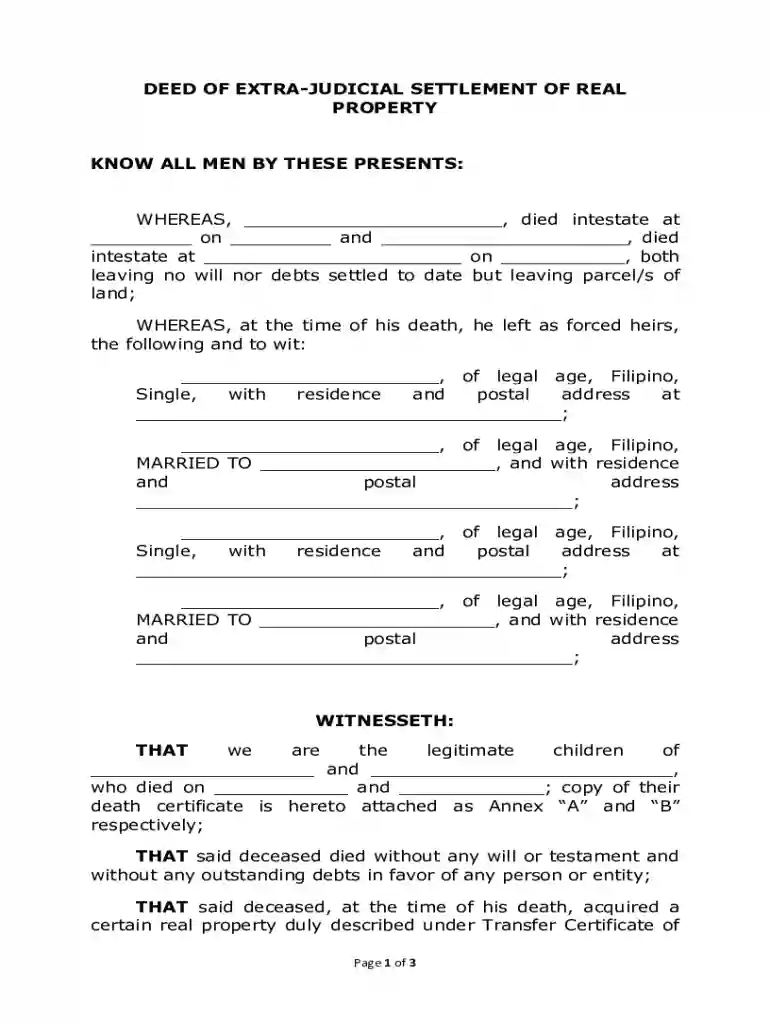
Type text, add images, blackout confidential details, add comments, highlights and more.

Draw your signature, type it, upload its image, or use your mobile device as a signature pad.

Send estate extrajudicial via email, link, or fax. You can also download it, export it or print it out.
The Extra Judicial Settlement of Estate With Deed of Absolute is a legal document used primarily in the United States to facilitate the distribution of an estate among heirs without going through probate. This form is especially relevant for heirs who wish to settle estate matters amicably and efficiently when no will is available, or when all parties agree on the division of assets. By utilizing this process, heirs can avoid the sometimes lengthy and costly probate process while ensuring that the decedent's assets are properly allocated.
Here are key components typically included in this document:
Through this process, a legally binding agreement is established among the heirs, providing clarity and oversight regarding the ownership of the estate's assets.
The Extra Judicial Settlement includes several critical elements that must be accurately represented for legal enforceability. Properly addressing these components ensures that all parties involved understand their rights and responsibilities regarding the estate.
By ensuring all these elements are attentively addressed, the settlement serves as a robust legal foundation for the estate division.
Completing an Extra Judicial Settlement involves a series of steps that must be followed sequentially to ensure legal compliance and mutual agreement among heirs.
Gather Required Information:
Draft the Document:
Review the Draft:
Sign the Document:
File the Document (if necessary):
By adhering to these steps, heirs can efficiently navigate the settlement process while maintaining compliance with applicable laws.
Understanding how the Extra Judicial Settlement of Estate With Deed of Absolute can be applied in various scenarios helps clarify its practical utility. Here are common examples:
Scenario 1: Assets Without a Will: In a case where a decedent passes away without a will, the heirs may utilize an Extra Judicial Settlement to agree on how to divide the real property, such as a family home, ensuring all parties are satisfied with their respective shares.
Scenario 2: Accord Among Heirs: If all heirs agree on the distribution of the deceased's assets, they can formalize this agreement through the Extra Judicial Settlement, which provides legal protection against future disputes.
Scenario 3: Tax Implications: Heirs may choose this route to manage tax liabilities effectively, especially when certain properties may have tax implications upon transfer. By clarifying ownership through a legally binding document, heirs can also prepare for potential tax obligations accordingly.
Through these examples, the framework of the Extra Judicial Settlement becomes clear, illustrating its function in various estate scenarios.
Familiarity with specific terms related to the Extra Judicial Settlement of Estate With Deed of Absolute is beneficial for all parties involved in the estate settlement process. Understanding these terms aids in navigating legal discussions and paperwork effectively.
By understanding these terms, heirs can engage more meaningfully in discussions regarding estate matters.
The legal enforceability of the Extra Judicial Settlement is crucial for ensuring that the distribution of the estate is respected by all parties. It operates within the legal framework established for intestate succession in each state, which varies across the United States.
Understanding these legal foundations ensures that the document serves its intended purpose without future challenges.
We've got more versions of the extrajudicial heirs settlement form. Select the right extrajudicial heirs settlement version from the list and start editing it straight away!
Sure, and it’s really easy! DocHub is an online PDF editor with advanced document processing functions that allow you quickly modify your documents, complete blank fields and insert new ones for other people to fill out, and create eSignatures in several ways. Upload your extra judicial settlement sample, provide information as requested, and decide how you want to eSign your document - by typing your name, drawing your signature, uploading its image, or utilizing a QR code.
If you edit your extrajudicial settlement with deed of absolute sale philippines sample with DocHub, you only need a steady web connection and virtually any web browser installed on your device. No need to install any third-party applications or research tutorials. Simply open a tab with DocHub, drag and drop your file, and edit it immediately.
At DocHub, your data security is our priority. We follow HIPAA, SOC2, GDPR, and other standards, so you can work on your documents with confidence.
A deed of trust or mortgage executed by the life tenant shall not be construed to be an absolute disposition of the estate, unless such estate is sold under theRead more
by DF Cavers 1934 Cited by 68 The unpleasantness of the litiga- tion itself works for extra-judicial procedure. Some courts have hesitated to countenance such settlements,8 but recognition


