




01. Edit your 2009 w2 form fillable online
Type text, add images, blackout confidential details, add comments, highlights and more.

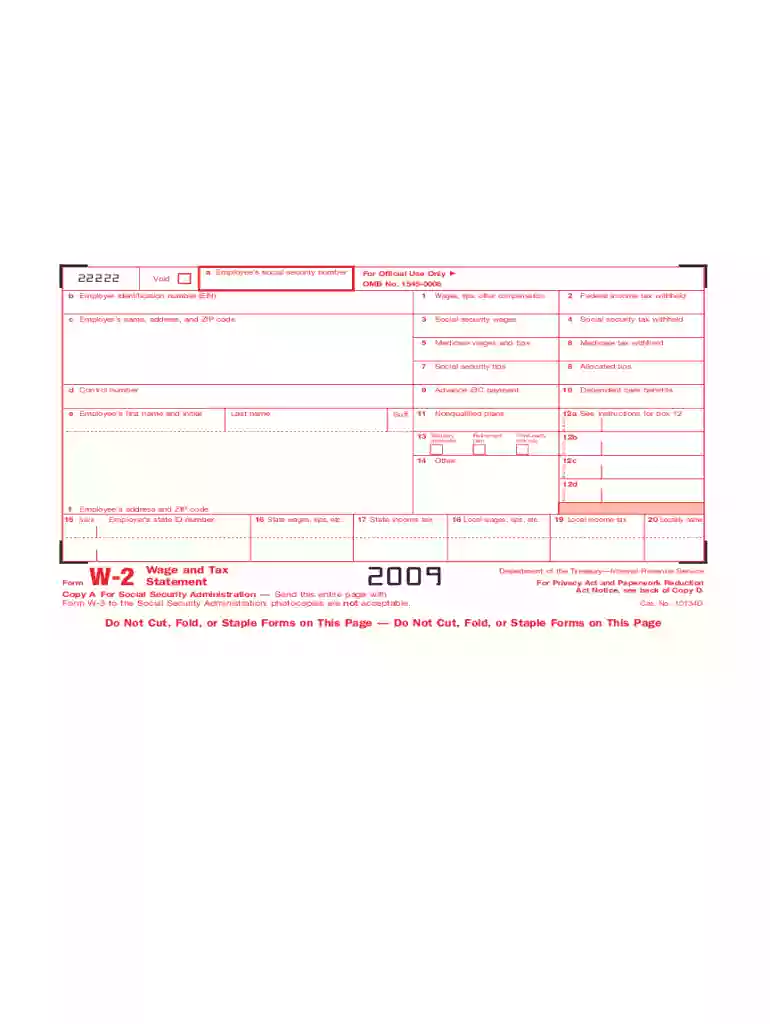
Type text, add images, blackout confidential details, add comments, highlights and more.

Draw your signature, type it, upload its image, or use your mobile device as a signature pad.

Send 2009 w2 via email, link, or fax. You can also download it, export it or print it out.
The "2009 form" refers to a standard document used for specific reporting or tax purposes. This form plays a critical role in ensuring compliance with regulatory and legal requirements set by government entities. Understanding its purpose, requirements, and implications is crucial for accurate filing and adherence to legal standards.
Using the 2009 form requires a clear understanding of its fields and the information to be provided. The form typically includes sections that capture personal, financial, or business-related information. Users must carefully fill in all required fields, ensuring that each entry is accurate to prevent errors that could result in penalties. It is advisable to review the form guidelines to correctly interpret each section.
You can obtain the 2009 form from several sources, including online platforms or direct requests from relevant agencies. One common approach is to download the form from official websites of issuing bodies. Alternatively, you can request a physical copy via mail or pick it up at designated offices. It's important to ensure you have the latest version of the form for accurate completion.
Read Instructions: Begin by thoroughly reading the instructions accompanying the form. Understanding the requirements and terminology will guide accurate completion.
Gather Required Information: Before filling out the form, collect all necessary documents and information. This preparation avoids interruptions and ensures accuracy.
Accurate Entry: Fill in the form carefully, double-checking each entry for accuracy. Pay attention to mandatory fields to avoid incomplete submissions.
Review and Correct: After completing the form, review it for any missing or incorrect information. Rectify errors before signing or submitting the form.
Submit: Follow the prescribed method of submission, whether by mail, online, or in person, ensuring compliance with deadlines.
The 2009 form is used by various individuals and entities, such as businesses, tax filers, or other specific groups that the form pertains to. This form serves to report financial data or other relevant information that impacts legal standing or compliance with regulatory obligations. Identifying the typical users helps tailor its completion to specific needs and circumstances.


Critical sections of the 2009 form often include:
Complying with filing deadlines is crucial to avoid penalties. The 2009 form must be filed by a specific date, typically dictated by regulatory bodies. Familiarize yourself with these deadlines to ensure timely submission. Missing these dates can lead to financial penalties or other repercussions.
Failing to comply with the form's requirements can lead to various penalties. These may include fines, interest on unpaid amounts, or legal action. It's crucial to meet all deadlines, provide accurate information, and adhere to submission guidelines to avoid these consequences.
The 2009 form may be available in both digital and paper formats. Understanding the pros and cons of each format is essential. Digital versions offer convenience, speed, and error-checking functionalities. Conversely, paper versions might be preferred for those who require a traditional approach due to lack of internet access or personal preference. Each version must align with the submission requirements specified by the issuing entity.
We've got more versions of the 2009 w2 form fillable form. Select the right 2009 w2 form fillable version from the list and start editing it straight away!
| Versions | Form popularity | Fillable & printable |
|---|---|---|
| 2024 | 4.7 Satisfied (35 Votes) | |
| 2023 | 4.4 Satisfied (26 Votes) | |
| 2022 | 4.7 Satisfied (59 Votes) | |
| 2021 | 4.8 Satisfied (120 Votes) | |
| 2020 | 4.4 Satisfied (218 Votes) | |
| 2019 | 4.4 Satisfied (910 Votes) | |
| 2018 | 4.4 Satisfied (233 Votes) | |
| 2017 | 4.2 Satisfied (267 Votes) | |
| 2016 | 4.4 Satisfied (882 Votes) | |
| 2015 | 4.3 Satisfied (259 Votes) | |
| 2014 | 4.2 Satisfied (43 Votes) | |
| 2013 | 3.9 Satisfied (53 Votes) | |
| 2013 | 4 Satisfied (60 Votes) | |
| 2012 | 4 Satisfied (53 Votes) | |
| 2011 | 4.2 Satisfied (74 Votes) |
At DocHub, your data security is our priority. We follow HIPAA, SOC2, GDPR, and other standards, so you can work on your documents with confidence.







Section 1 is the biographical section. It is here that you will write in your name, address, date of birth, etc. This is to be filled out and signed by theRead more
Appendix C discusses the specific coding for distracted driving data from the National. Motor Vehicle Crash Causation Survey (NMVCCS). Presentation of Data.Read more
8a Taxable interest. Attach Schedule B if required. 8a b Tax-exempt interest. Do not include on line 8a. 8b. 9a Ordinary dividends.Read more


