




Here's how it works

01. Edit your form online
Type text, add images, blackout confidential details, add comments, highlights and more.

02. Sign it in a few clicks
Draw your signature, type it, upload its image, or use your mobile device as a signature pad.

03. Share your form with others
Send it via email, link, or fax. You can also download it, export it or print it out.
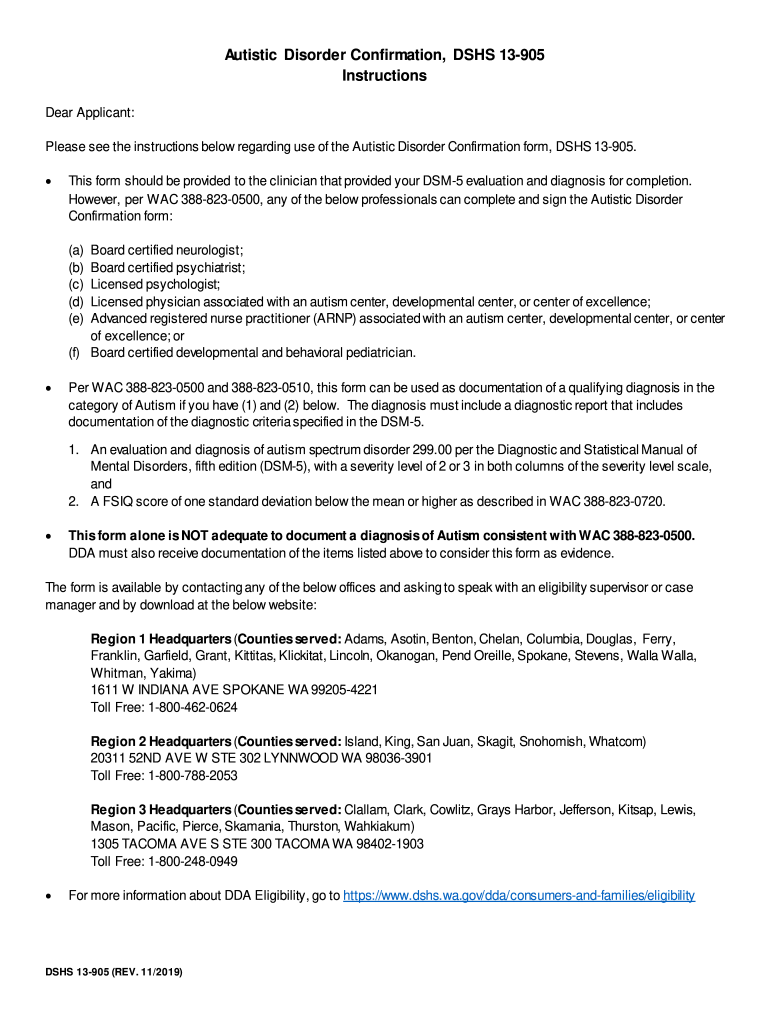
How to use or fill out Diagnostic Criteria Autism Spectrum Disorder (ASD)

- Click ‘Get Form’ to open it in the editor.
- Begin by entering the applicant's name and date of birth in the designated fields. Ensure accuracy as this information is crucial for identification.
- In the clinician section, input the name of the qualified professional completing the form, along with the date of their report. This must be a certified individual as specified in the instructions.
- Provide detailed examples of qualitative impairments in social interactions, communication, and restricted behaviors as required by DSM-IV-TR criteria. Use clear and specific language to describe these examples.
- Document any delays or abnormal functioning evident prior to age three in the specified areas. This information is essential for eligibility determination.
- Finally, ensure that the clinician signs and dates the document before submission. You can easily add a signature using our platform’s signing feature.
Start filling out your Diagnostic Criteria Autism Spectrum Disorder (ASD) form today for free on our platform!
Fill out Diagnostic CriteriaAutism Spectrum Disorder (ASD online
It's free
It's free
See more Diagnostic CriteriaAutism Spectrum Disorder (ASD versions
We've got more versions of the Diagnostic CriteriaAutism Spectrum Disorder (ASD form. Select the right Diagnostic CriteriaAutism Spectrum Disorder (ASD version from the list and start editing it straight away!
Got questions?
We have answers to the most popular questions from our customers. If you can't find an answer to your question, please contact us.
Contact us
How does autism affect your life?
Autistic people may: find it hard to communicate and interact with other people. find it hard to understand how other people think or feel. find things like bright lights or loud noises overwhelming, stressful or uncomfortable.
What is the gold standard for diagnosing ASD?
The different types of autism include autism spectrum disorder (ASD), autistic disorder (classic autism), Aspergers syndrome, pervasive developmental disorder not otherwise specified (PDD-NOS), childhood disintegrative disorder (CDD), and Rett syndrome.
What are the 12 signs of autism?
Signs and characteristics little or no babbling. little or no eye contact. showing more interest in objects than people. appearing not to hear when spoken to directly. playing with toys in an unusual or limited manner. repetitive movements with their fingers, hands, arms or head.
What are 5 signs and symptoms of autism spectrum disorder?
Autism spectrum disorder (ASD) is a developmental disability caused by differences in the brain. People with ASD often have problems with social communication and interaction, and restricted or repetitive behaviors or interests. People with ASD may also have different ways of learning, moving, or paying attention.
How to treat autism in toddlers?
Depending on your childs needs, speech therapy to make communication skills better, occupational therapy to teach activities of daily living, and physical therapy to make movement and balance better may help. A psychologist can recommend ways to manage problem behavior. Medicines.
Security and compliance
At DocHub, your data security is our priority. We follow HIPAA, SOC2, GDPR, and other standards, so you can work on your documents with confidence.
Learn more


People also ask
What is the biggest symptom of autism?
Main signs of autism finding it hard to understand what others are thinking or feeling. getting very anxious about social situations. finding it hard to make friends or preferring to be on your own.
What are the 7 types of autism?
Common signs of autism in adults include: finding it hard to understand what others are thinking or feeling. getting very anxious about social situations. finding it hard to make friends or preferring to be on your own. seeming blunt, rude or not interested in others without meaning to. finding it hard to say how you feel.