




01. Edit your statutory declaration form png online
Type text, add images, blackout confidential details, add comments, highlights and more.

Type text, add images, blackout confidential details, add comments, highlights and more.

Draw your signature, type it, upload its image, or use your mobile device as a signature pad.

Send statutory declaration form via email, link, or fax. You can also download it, export it or print it out.
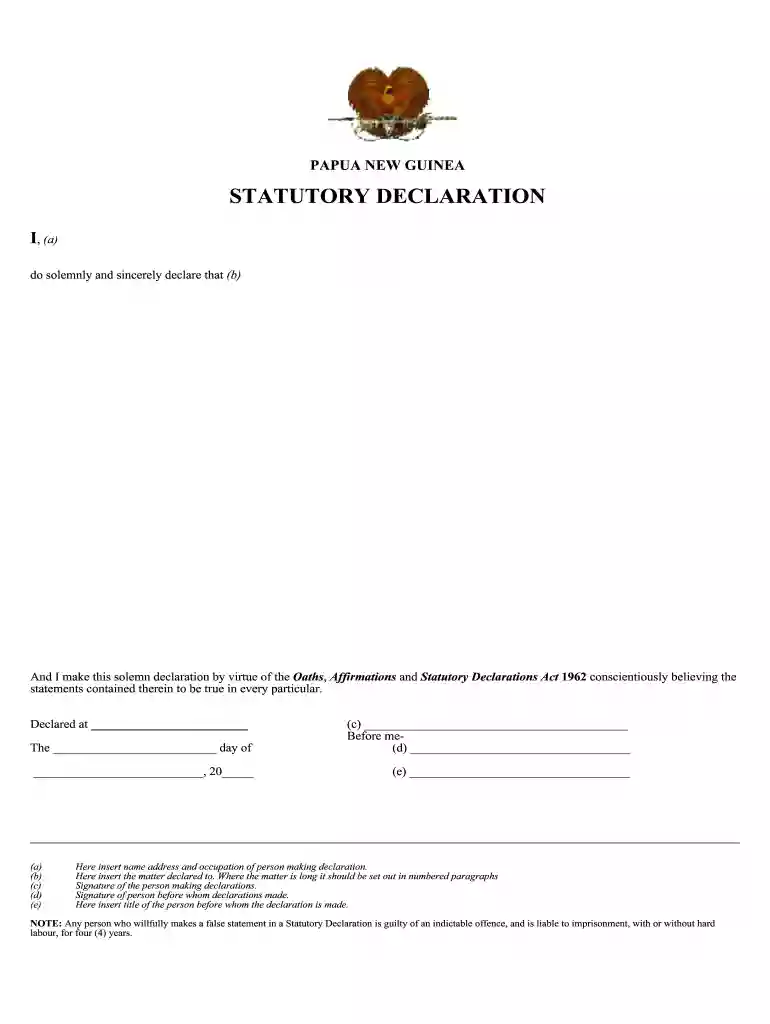
The png statutory declaration form is a legal document widely used in Papua New Guinea. It allows an individual to make a solemn declaration regarding specific statements, which they affirm to be true. This is done under the Oaths, Affirmations, and Statutory Declarations Act 1962. The document typically requires personal details, the matters being declared, and signatures from both the declarant and a witness. Importantly, individuals need to be aware that providing false information on a statutory declaration is a serious offense, which can lead to penalties, including imprisonment.
A statutory declaration is often utilized in various legal matters, such as confirming a fact when formal evidence may not be available. It serves as a substitute for written evidence in several instances, effectively providing a declaration that can carry weight in legal and administrative contexts. The png statutory declaration form must be completed accurately to ensure its validity, safeguarding both the declarant's and the witness's responsibilities under the law.
Obtaining the png statutory declaration form is a straightforward process. Here are several avenues through which individuals can acquire this document:
Government Websites: Official government portals often provide downloadable versions of the png statutory declaration form, ensuring that users have access to the most recent and legally compliant version.
Legal Offices: Many legal firms and notaries public maintain physical copies of the form. Visiting a local legal office can offer immediate access to the necessary documentation.
Community Halls or Local Departments: In various regions, community centers or local government departments may distribute forms as part of their services, especially in areas where statutory declarations are frequently required.
Online Downloads: The form is also available in downloadable formats, such as PDF and Word. Websites catering to legal documents may offer templates that can be filled out electronically or printed for manual completion.
Completing the png statutory declaration form involves several key steps to ensure it is filled out correctly and meets legal standards:
Obtain the Latest Version: Download or collect the most current form, either as a PDF or Word document, to ensure compliance with legal requirements.
Fill in Personal Details: Enter accurate personal details, including full name, address, and any other required identifying information. This information allows legal bodies to identify the declarant.
State the Declaration: Clearly outline the matter being declared, ensuring that it is described in detail. This includes all pertinent details that validate the assertion being made.
Sign and Date: The declarant needs to sign and date the form. This act signifies that the information provided is true and accurate to the best of their knowledge.
Witnessing: A witness must also sign the form. This witness should ideally be an authorized individual under the statutes of Papua New Guinea, such as a lawyer or a notary public, who can affirm the authenticity of the signatures.
Review and File: Once completed, review the form thoroughly to ensure there are no errors or omissions. It may then be required to be filed with relevant authorities, depending on the specific use case of the declaration.
The png statutory declaration form holds significant legal value in various contexts within Papua New Guinea. It is commonly used in circumstances such as:
Affidavits and Legal Proceedings: The form can serve as an affidavit in court cases, helping individuals establish facts in legal proceedings without needing further evidence.
Business Transactions: It is often required in business dealings to confirm certain facts, such as the legitimacy of a business or to declare ownership of assets.
Government Applications: Various government-related processes, including applications for permits or licenses, may necessitate the submission of a statutory declaration to verify information.
Property Transactions: When dealing with properties, the declaration often affirms the identity of the parties involved and outlines the legitimacy of the transaction.
Recognizing the legal implications associated with the form is critical. Each declaration must be truthful and accurate, as legal repercussions can follow if the statements are proven false.
The png statutory declaration form is utilized by a diverse range of individuals and entities, including:
Individuals: Everyday citizens frequently use the form for personal matters, such as confirming identity or asserting information in legal matters, particularly when evidence may be lacking.
Business Owners: Entrepreneurs and business owners use the form to verify information about their business, especially when applying for financing, permits, or licenses.
Legal Practitioners: Lawyers and notaries utilize the form as part of their service offerings, often guiding clients through its creation and ensuring it meets all legal requirements.
Government Agencies: Certain government departments require statutory declarations from citizens when making claims, applying for benefits, or engaging in official matters that require proof of truthfulness.
Understanding the various users of the form helps in recognizing its relevance across personal, business, and regulatory domains.


Having familiarity with the key terms associated with the png statutory declaration form assists in better understanding its context and implications. Some important terms include:
Declarant: The person making the declaration, affirming the truth of the statements provided in the form.
Witness: An individual who affirms the declaration by signing the document. This person should be an authorized representative capable of serving in this capacity.
Oaths, Affirmations, and Statutory Declarations Act 1962: The legal framework under which statutory declarations are governed in Papua New Guinea, outlining the legal obligations and processes involved.
Legal Consequences: The potential penalties faced by individuals providing false information through a statutory declaration, which can include legal action or criminal charges.
Affirmation: A non-religious equivalent to an oath, allowing individuals to affirm statements without swearing, ideal for those who may not adhere to religious practices.
An understanding of these terms provides clarity on the form's legal context and enhances compliance with its requirements.
According to eSignature laws, documents signed digitally have the same validity as those approved with pen and paper. You can electronically sign almost any business and personal documentation. Four types of paperwork still require wet signatures only - wills and testamentary trusts, court orders and other court papers, state statutes governing divorce, adoption, or other family law, and notice of cancellation of utility services. If you adhere to the guidelines and utilize a safe and compliant software solution, like DocHub, you can eSign your png statutory declaration form without printing it.
When you edit your state declaration form png with DocHub, you merely require a steady internet connection and virtually any browser installed on your device. No need to install any third-party software or study tutorials. Simply open a tab with DocHub, drag and drop your file, and edit it immediately.
At DocHub, your data security is our priority. We follow HIPAA, SOC2, GDPR, and other standards, so you can work on your documents with confidence.


All deed polls (enrolled or unenrolled), change of name deeds and statutory declarations must be accompanied by one piece of valid photo identity evidence whichRead more
DECLARATION OF LOYALTY. Where a law requires a Declaration of Loyalty to be made, it shall be made in the following form:. IRead more
The legal system of the Kingdom of Pontunia is a statutory civil law system. The main source of law is primary legislation, which takes the form of theRead more


