LOCAL BANKRUPTCY RULES - District of Maryland 2026

Get Form
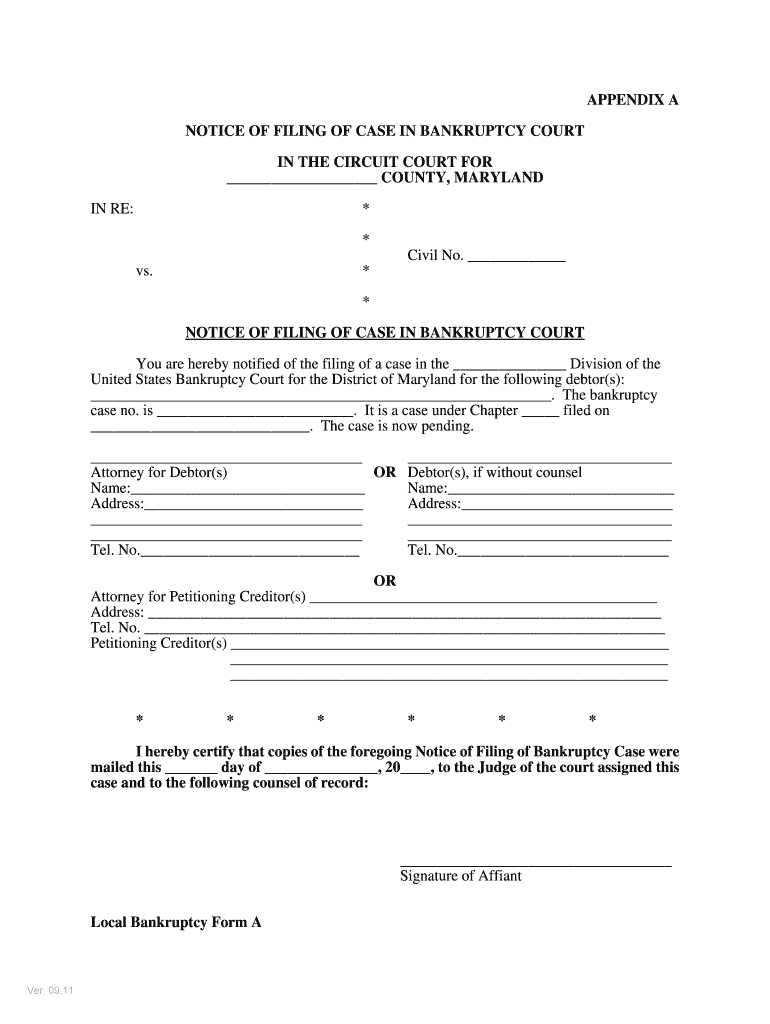
LOCAL BANKRUPTCY RULES - District of Maryland Preview on Page 1

Here's how it works

01. Edit your form online
Type text, add images, blackout confidential details, add comments, highlights and more.
02. Sign it in a few clicks
Draw your signature, type it, upload its image, or use your mobile device as a signature pad.
03. Share your form with others
Send it via email, link, or fax. You can also download it, export it or print it out.

How to use or fill out LOCAL BANKRUPTCY RULES - District of Maryland with our platform

Form edit decoration
9.5
Ease of Setup
DocHub User Ratings on G2
9.0
Ease of Use
DocHub User Ratings on G2
  1. Click ‘Get Form’ to open the LOCAL BANKRUPTCY RULES - District of Maryland in the editor.
  2. Begin by filling in the 'IN RE' section with the names of the debtor(s) involved in the case. Ensure accuracy as this information is crucial for identification.
  3. Next, enter the Civil No. and Bankruptcy Case No. in their respective fields. This helps track your case within the court system.
  4. Indicate the Chapter under which the bankruptcy is filed by selecting from the dropdown menu provided.
  5. Complete the attorney's details if applicable, including name, address, and telephone number. If there is no attorney, fill in the debtor(s) information instead.
  6. For petitioning creditors, provide their name, address, and contact number in the designated fields.
  7. Finally, certify that copies of this notice were mailed by entering today's date and signing as required at the bottom of the form.

Start using our platform today to streamline your document editing and ensure a smooth filing process!

be ready to get more

Complete this form in 5 minutes or less

Get form

Got questions?

We have answers to the most popular questions from our customers. If you can't find an answer to your question, please contact us.
Contact us
The new value exception to the Chapter 11 absolute priority rule allows a debtors owner to retain an interest in a business or property under certain circumstances, even if all senior claimants are not paid in full.
Rule 9013-5 SCHEDULING HEARINGS (a) Parties are directed to ascertain, and shall comply with, procedures stated on the Courts website for the scheduling practices of each Judge. (b) The moving party shall serve all parties in interest with the motion, proposed order, and notice of hearing.
Rule 9013-5 SCHEDULING HEARINGS For fee applications in Chapter 7 and 13 cases, use Local Bankruptcy Form 8 (Summary Cover Sheet and Notice of Hearing on Professional Fees in Chapters 7, 12 and 13). For fee applications in Chapter 11 and 15 cases, use Local Bankruptcy Form 9 (Summary Cover Sheet).
A motion for a new trial or to alter or amend a judgment must be filed within 14 days after the judgment is entered.
P. 26 requires that discovery be relevant to any partys claim or defense; proportional to what is at issue in a case; and not excessively burdensome or expensive as compared to the likely benefit of obtaining the discovery being sought.

Security and compliance

At DocHub, your data security is our priority. We follow HIPAA, SOC2, GDPR, and other standards, so you can work on your documents with confidence.

Learn more
ccpa2
pci-dss
gdpr-compliance
hipaa
soc-compliance
be ready to get more

Complete this form in 5 minutes or less

Get form

People also ask

Pursuant to Local Rule 701.1, members of the bar agree to accept pro bono appointments by the Court to represent indigent parties in civil cases in this District unless the acceptance of such appointments is inconsistent with an attorneys professional employment obligations.
Local Bankruptcy Rule 5005-2(d) requires that a copy of every document filed must be served on the judge who presides over the bankruptcy case or adversary proceeding. 1.2 Assembling a Judges Copy. A judges copy must comply with ALL of the following: (a) One Copy.
The 3-Year Rule: Waiting Period for Tax Return Due Dates This rule means that the tax debt must be tied to a return that was due three years before the date you file for Chapter 7 bankruptcy. If an extension was filed for that tax return, then the 3-year clock starts from the extended due date.

Related links