Housing Tax Credit Basics - FAQs 2026

Get Form
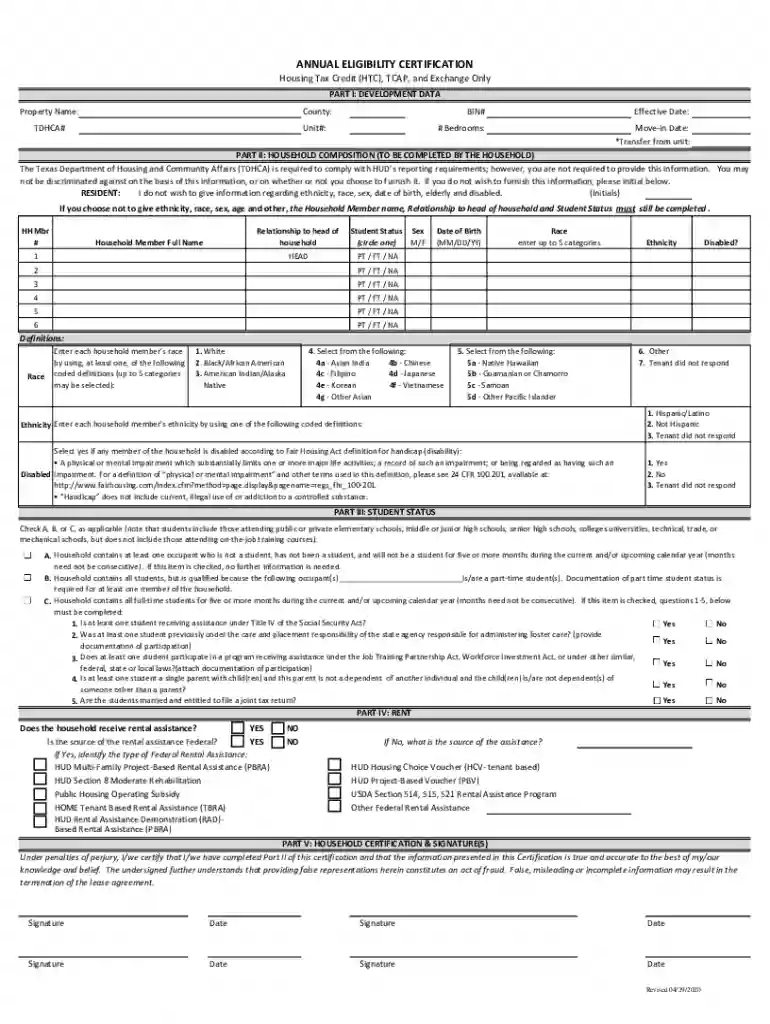
annual eligibility certification form Preview on Page 1

Here's how it works

01. Edit your annual eligibility certification form online
Type text, add images, blackout confidential details, add comments, highlights and more.

02. Sign it in a few clicks
Draw your signature, type it, upload its image, or use your mobile device as a signature pad.

03. Share your form with others
Send annual eligibility certification via email, link, or fax. You can also download it, export it or print it out.

How to use or fill out Housing Tax Credit Basics - FAQs with our platform

Form edit decoration
9.5
Ease of Setup
DocHub User Ratings on G2
9.0
Ease of Use
DocHub User Ratings on G2
  1. Click ‘Get Form’ to open it in the editor.
  2. Begin with Part I: Development Data. Fill in the Property Name, County, BIN#, Effective Date, TDHCA#, Unit#, Number of Bedrooms, and Move-in Date. Ensure all fields are accurately completed for proper documentation.
  3. Proceed to Part II: Household Composition. Here, you will provide details about each household member. Complete the required fields including Household Member Full Name, Relationship to Head of Household, Student Status, Sex, Date of Birth, Race, Ethnicity, and whether they are Disabled.
  4. In Part III: Student Status, check the appropriate box (A, B, or C) based on your household's situation regarding student status. If applicable, provide additional information as required.
  5. Move to Part IV: Rent. Indicate if your household receives rental assistance and specify the source if applicable.
  6. Finally, complete Part V: Household Certification & Signatures by signing and dating where indicated to certify that all information is true and accurate.

Start using our platform today for free to streamline your document editing and form completion!

See more Housing Tax Credit Basics - FAQs versions

We've got more versions of the Housing Tax Credit Basics - FAQs form. Select the right Housing Tax Credit Basics - FAQs version from the list and start editing it straight away!
Versions Form popularity Fillable & printable
2020 4.9 Satisfied (51 Votes)
2012 3.9 Satisfied (29 Votes)
be ready to get more

Complete this form in 5 minutes or less

Get form

Got questions?

We have answers to the most popular questions from our customers. If you can't find an answer to your question, please contact us.
Contact us
Eligible basis is a component of the qualified basis of an LIHC project. It is generally equal to the adjusted basis of the building, excluding land but including amenities and common areas. Existing Building. An existing building is a building that has been previously placed in service.
A tax credit directly reduces your tax bill dollar-for-dollar, as opposed to deductions, which lower your taxable income. Providing a substantial financial benefit is an effective incentive for certain investments or actions, such as renewable energy.
The Structure of LIHTC Investments LIHTC operates by providing tax credits to developers, who then sell these credits to investors to raise equity for their projects.
Financial Benefits For investors, purchasing LIHTC offers a direct reduction in federal tax liability and can be a stable, long-term investment. This symbiotic relationship between developers and investors facilitates the creation of affordable housing, benefiting both parties and the broader community.
Who Invests in LIHTCs? There are two main types of LIHTC investors currently in the market. Financial Institutions: LIHTC investing compliments the familiarity banks have with real estate underwriting and can also help meet their goals under the Community Reinvestment Act (CRA).

Security and compliance

At DocHub, your data security is our priority. We follow HIPAA, SOC2, GDPR, and other standards, so you can work on your documents with confidence.

Learn more
ccpa2
pci-dss
gdpr-compliance
hipaa
soc-compliance

People also ask

Affordable housing developers monetize these tax credits by selling them to investors or tax credit syndicators who aggregate tax credits from different projects into a single fund and solicit investments from other private investors.
The Low-Income Housing Tax Credit provides a tax incentive to construct or rehabilitate affordable rental housing for low-income households. The Low-Income Housing Tax Credit (LIHTC) subsidizes the acquisition, construction, and rehabilitation of affordable rental housing for low- and moderate-income tenants.
10-Year Rule: The building is eligible for acquisition credit so long as the existing building was not placed-in-service during the 10-year period preceding the acquisition.

Related links