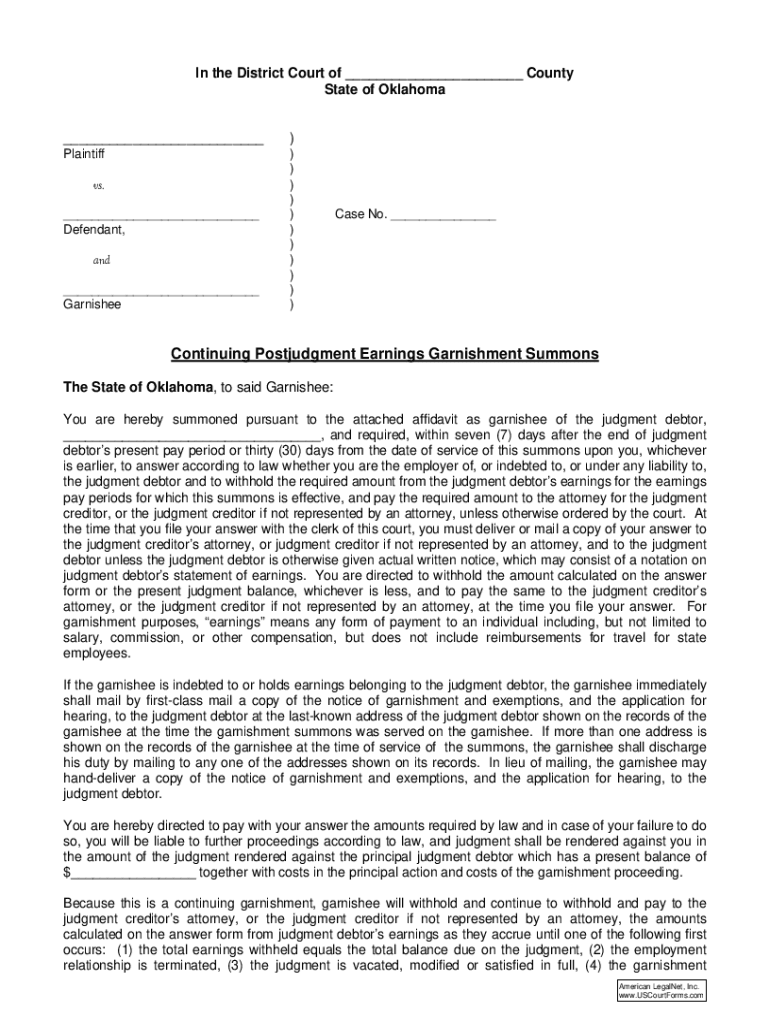
Continuing Postjudgment Earnings Garnishment Summons 2026

Get Form
Continuing Postjudgment Earnings Garnishment Summons Preview on Page 1

Here's how it works

01. Edit your form online
Type text, add images, blackout confidential details, add comments, highlights and more.
02. Sign it in a few clicks
Draw your signature, type it, upload its image, or use your mobile device as a signature pad.
03. Share your form with others
Send it via email, link, or fax. You can also download it, export it or print it out.

How to use or fill out Continuing Postjudgment Earnings Garnishment Summons with our platform

Form edit decoration
9.5
Ease of Setup
DocHub User Ratings on G2
9.0
Ease of Use
DocHub User Ratings on G2
  1. Click ‘Get Form’ to open the Continuing Postjudgment Earnings Garnishment Summons in the editor.
  2. Begin by filling in the court name and county at the top of the form. This identifies where the summons is being issued.
  3. Next, enter the names of the plaintiff and defendant in their respective fields. Ensure accuracy as this information is crucial for legal proceedings.
  4. In the case number section, input the assigned case number to link this summons with its corresponding legal case.
  5. Complete the garnishee section by providing details about the employer or entity that will be withholding earnings from the judgment debtor.
  6. Fill out any amounts due and ensure you understand your obligations regarding withholding and payment as outlined in the document.
  7. Finally, review all entries for accuracy before saving or printing your completed form for submission.

Start using our platform today to streamline your document editing and ensure a hassle-free experience!

be ready to get more

Complete this form in 5 minutes or less

Get form

Got questions?

We have answers to the most popular questions from our customers. If you can't find an answer to your question, please contact us.
Contact us
The consequences for ignoring a garnishment can be extreme. In the majority of states, an offending garnishee (i.e., an employer) is liable for up to the full amount of the debtors (whether this person turns out to be an employee or not) outstanding debt.
A creditor starts the garnishment of your bank account by serving the bank with a Garnishment Summons. The bank will then freeze a sufficient amount of money in your account to pay the debt to the creditor.
If you are served with a garnishment summons, do not ignore these documents because they do not directly involve a debt that you owe. Instead, you should immediately freeze any payments to the debtor, retain the necessary property, and provide the required written disclosure.
Dear (Creditors Name), I am writing to formally request the cessation of wage garnishment related to my account number (Your Account Number). Due to (briefly explain your situation, eg, ``a recent job loss or ``significant financial hardship), I am unable to meet my current financial obligations.
Once there is a garnishment, you cant get out of it without going back to court. The only thing that might do is reduce the pay day deduction due to financial strain. The only way to stop the garnishment altogether is to pay off the debt.

Security and compliance

At DocHub, your data security is our priority. We follow HIPAA, SOC2, GDPR, and other standards, so you can work on your documents with confidence.

Learn more
ccpa2
pci-dss
gdpr-compliance
hipaa
soc-compliance

People also ask

Payroll garnishments continuing earnings garnishments are court-ordered procedures that require an employer to withhold certain amounts from an employees paycheck and send those amounts directly to a third-person individual or entity to whom the employee owes a debt.
Federal law limits wage garnishments to 25% of your disposable income (15% for federal student loans) or the amount exceeding 30 times the federal minimum wage, whichever is less.
If your creditors agree to participate in this group payment plan, they cant garnish you as long as you make your payments. Even after a garnishment has started, you can still attempt to negotiate with the creditor, especially if your circumstances change.

Related links